




5T Series Open Hoist
Installation and User Manual
Jingxing Machinery Equipment Co., Ltd. of Cangzhou
Before starting the installation and use of this machine, please carefully read this manual and operate strictly according to the manual's instructions to ensure proper installation and use.
- Engineering equipment (such as forklifts, cranes, etc.) used in installation and transportation processes must be effective and reliable, and operated by professional certified personnel.
Employees must wear proper protective gear.
Electrical connection tests must be performed by a professional electrical engineer.
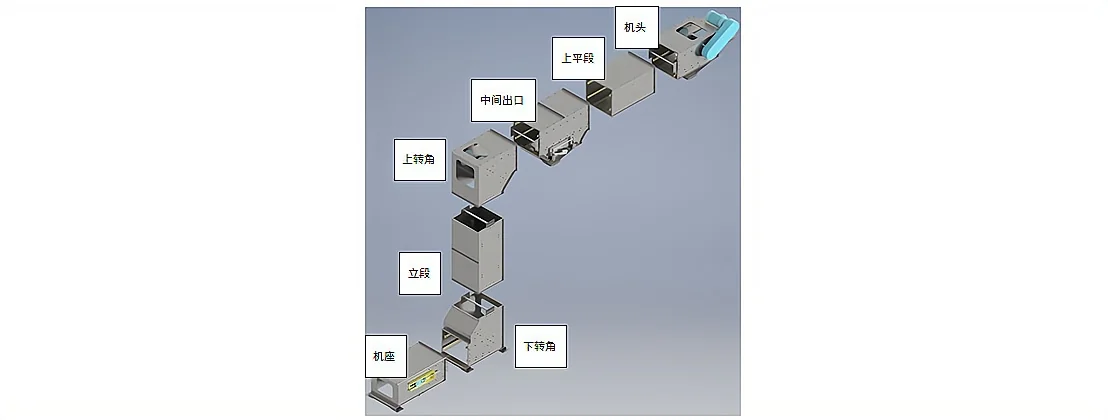
The 5T series open hoist consists of the base, lower flat section, lower corner, vertical section, upper corner, upper flat section, middle outlet, and head. Both the upper and lower flat sections and the vertical section can be customized to meet specific lengths. They can also be designed in Z, C, or T shapes as needed, allowing for multiple entry feeding and discharge points. The structure is simple, the operation is stable, and the layout is flexible.
Installation and Commissioning
Ensure the installation location is flat and sturdy before installing the device.
First, securely place the base, lower horizontal section, and lower turn angle, level them, connect them, open the cover, and connect the middle support. After installation, ensure that the chain guides between different components are smooth with no gaps or protrusions.
3. Next, install the uprights, each with an intermediate support. When installing the bolts, the small end plate on one side must be opened. All connecting bolts must be fitted with anti-backout washers and tightened securely.
After the uprights are installed according to specifications, install fixed brackets approximately every 1.2 meters and securely connect them to the platform or wall. Once the uprights are installed, they must remain upright.
5. Install the corner, upper horizontal section, middle outlet, and machine head. Pay attention to the installation direction when installing the middle outlet. After installation, ensure that the chain guides of different components transition smoothly without gaps or protrusions. A bracket support is required approximately every 2 meters.
6. Install the chain links first, ensuring that the number of links is a multiple of 6. When connecting the chain, all joints must be aligned in the same direction (the spring clip on the same side). When installing the chain, first adjust the chain tensioner of the base to the shorter position, align the spring clips of the chain joints on both sides for easy future maintenance and repair. After installation, tension the chain.
7. Perform electrical installation as required. Since the machine is equipped with a ratchet to prevent reverse rotation in the event of an unexpected shutdown due to material gravity, it is necessary to test the direction of rotation after powering on the electrical system to ensure the motor operates correctly.
8. Test the motor, inspect for any abnormalities in the chains, chain guides, and torque limiters. Once everything is normal, shut down the motor to proceed to the next step.
9. Install a scoop, then restart the motor and check for any impacts or interference. Inspect the scoop's operation at the discharge outlet, mid-point outlet, upper and lower angles, and base for any anomalies. Once everything is normal, shut down the machine to proceed to the next step.
10. Install a bucket every six chains, then attach 5-10 consecutive buckets, and restart the motor to inspect the bucket operation. Check for any collisions or interference, and verify that the buckets are running normally at the discharge outlet, middle outlet, upper and lower angles, and base. Once everything is in order, shut down the machine to proceed to the next step.
All rakes installed; after completion, start the motor, run the machine empty, check for any abnormalities. The machine should run empty for no less than 24 hours before being officially put into operation.
After the formal material-based operation, adjust the torque limiter to ensure the torque settings meet normal working requirements.

Adjustment Method: First, remove the three tightening bolts, then turn the adjustment nut. Clockwise rotation increases torque, while counterclockwise rotation decreases torque. Adjust by turning the nut 120 degrees each time. After adjustment, re-install the tightening bolts. (The bolts have a fixed position. If the bolts are not aligned when the appropriate torque is achieved, ensure all three bolts are tightened to the same appropriate degree, without over-tightening.) When the lifting machine malfunctions, it will automatically shut down. In this case, identify the fault, resolve it, and then press the "Reset" button on the control box. After resetting, restart the lifting machine.
Operations and Maintenance
1. When the equipment is starting up normally, all buckets should be kept empty of material. Start feeding after 5 seconds. If there is material in the buckets upon startup, empty the material first before feeding.
When shutting down equipment normally, feed should be stopped first, then wait for all buckets to be emptied before shutting down.
3. In the event of equipment malfunction, the machine should be shut down first for troubleshooting. Do not force the machine to start until the issue is resolved. If manual reverse rotation of the machine is needed during troubleshooting, you may first disengage the anti-reversal device, and then manually turn the machine.

To release the reverse stopper, remove the four bolts shown in the diagram and take out the restricting component. Note: Do NOT release the reverse stopper if there is still material in the machine bucket!!!
4. After the equipment is officially put into operation for two shifts, inspect and adjust the tension of the regulating chain. Subsequently, check it twice during each processing season.
Each machine base and head features two sets of mounted bearings, which are lubricated with oil after the end of each processing season.
6.应及时更换磨损或损坏的铲斗。
