


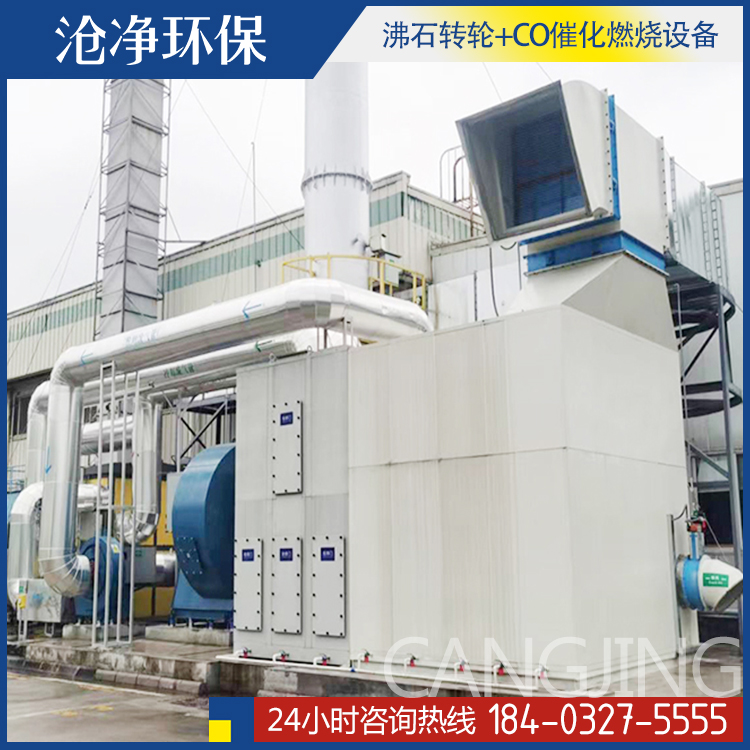


Zeolite Molecular Sieve Adsorption Concentration Wheel Overview
High-volume, low-concentration organic waste gas combustion or recovery requires very large-scale equipment and incurs substantial operating costs. To address this issue, using zeolite molecular sieve adsorption concentration units can concentrate low-volume, high-concentration organic waste gas into high-volume, low-concentration gas, thereby reducing equipment investment and operating costs, achieving an economically efficient organic waste gas treatment.
1) Purification Principle:
Zeolite Wheel Organic Waste Gas Purification Technology is a technique that utilizes zeolite molecular sieve adsorbents to adsorb and purify VOCs from emitted waste gases. Zeolite molecular sieves are crystalline silicate-aluminates, widely used in waste gas treatment due to their regular crystal structure, uniform pore distribution, and adjustable surface properties.

Hydrophobic zeolite adsorbent exhibits strong hydrophobic/lipophilic properties, uniform pore size, a large specific surface area (500~1000 m2/g), and high adsorption capacity. It can be used to adsorb and remove many organic molecules from waste gases, making it a new type of environmental protection material.
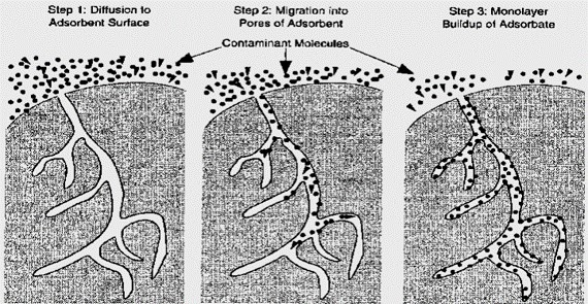
Figure: Schematic illustration of沸石分子筛对多VOCs吸附过程
Step 1: VOCs in the exhaust gas are transferred to the surface of the zeolite molecular sieve by gas flow.
Step 2: Under the van der Waals forces of the zeolite molecular sieve, VOCs molecules diffuse into the internal pores of the zeolite molecular sieve. During this process, the VOCs in the organic waste gas are adsorbed in the micro-pores of the zeolite molecular sieve, achieving the requirements for adsorption purification.
Step 3: Once all the micropores of the zeolite molecular sieve are filled with VOCs, the sieve reaches adsorption saturation and must be desorbed and regenerated to restore its adsorption capacity.
2) Zeolite Molecular Sieve Working Principle:
The Zeolite Molecular Sieve Adsorption and Concentration System utilizes a continuous吸附-脱附浓缩-冷却 process to concentrate VOCs waste gases. The basic principle is as follows:
Zeolite molecular sieve wheel is divided into three functional zones: adsorption, desorption, and cooling areas, each separated by heat and solvent-resistant sealing materials. The zeolite molecular sieve wheel operates continuously within each functional zone.
After passing through a preliminary filter, the exhaust gas is directed to the adsorption zone of the zeolite molecular sieve rotor. In the adsorption zone (area S1), VOCs in the organic exhaust gas are adsorbed and removed by the zeolite molecular sieve, and the purified organic exhaust gas is then discharged from the processing zone of the zeolite molecular sieve rotor.
VOCs adsorbed in the molecular sieve wheel are desorbed and concentrated in the desorption zone (with an area of S2) through a heat treatment with a low airflow of about 200℃. The concentration factor is generally 10 to 25 times. The concentration factor n = (S1×V1) / (S2×V2), where S1/S2 = 10:1, V1/V2 = (0.5~2.5).
The regenerated zeolite molecular sieve wheel is cooled in the cooling zone. The air that passes through the cooling zone, after being heated, is used as regeneration air, achieving energy-saving effects.

3) Characteristics of Zeolite Molecular Sieve Wheel
High Performance, High Efficiency: Utilizing hydrophobic molecular sieve with excellent adsorption properties as an adsorbent, it can fully provide sufficient performance for a wide range of VOC types and various operational conditions.
High-boiling solvent treatment: Utilizing hydrophobic zeolite molecular sieve, with its non-flammable and high-heat-resistant properties, it can be regenerated under high-temperature conditions, with regeneration temperature reaching up to 300°C. Therefore, it can also handle high-boiling VOCs that cannot be processed due to the regeneration temperature limitation when using activated carbon.
Washing and Activation: The zeolite molecular sieve wheel is a completely inorganic composite formed through sintering at high temperatures. In case of clogging in the honeycomb pathways, water washing can be performed. Additionally, the zeolite molecular sieve wheel can be activated at high temperatures through thermal treatment based on actual conditions.
Equipped with lifting lugs and support brackets for easy transportation, installation, and maintenance of the crane.
The equipment to be delivered to the site is qualified and can be modularly installed to minimize the workload for on-site installation and debugging.
