
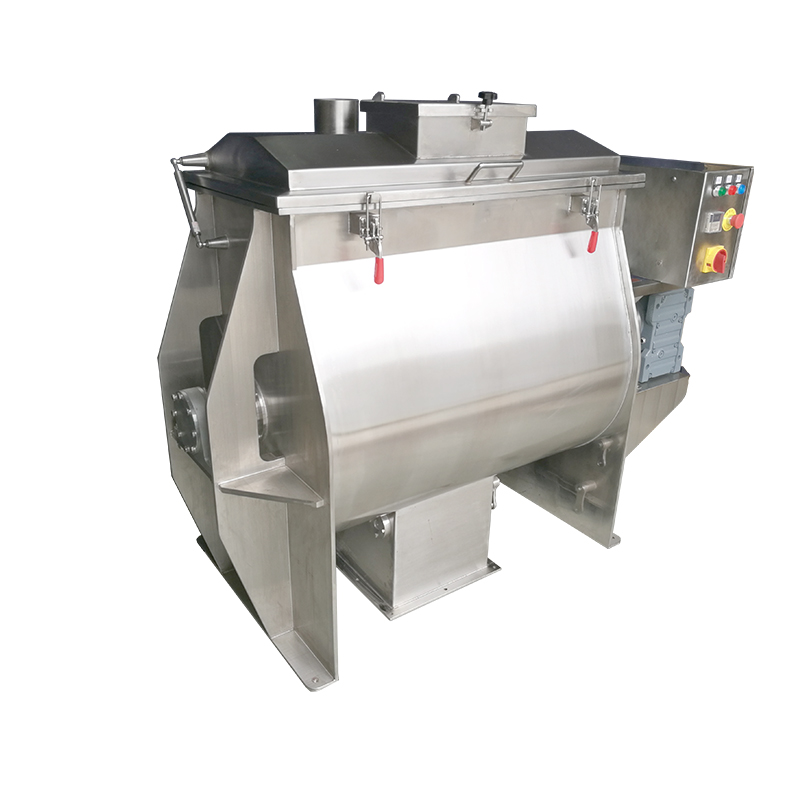
Operating Principle:
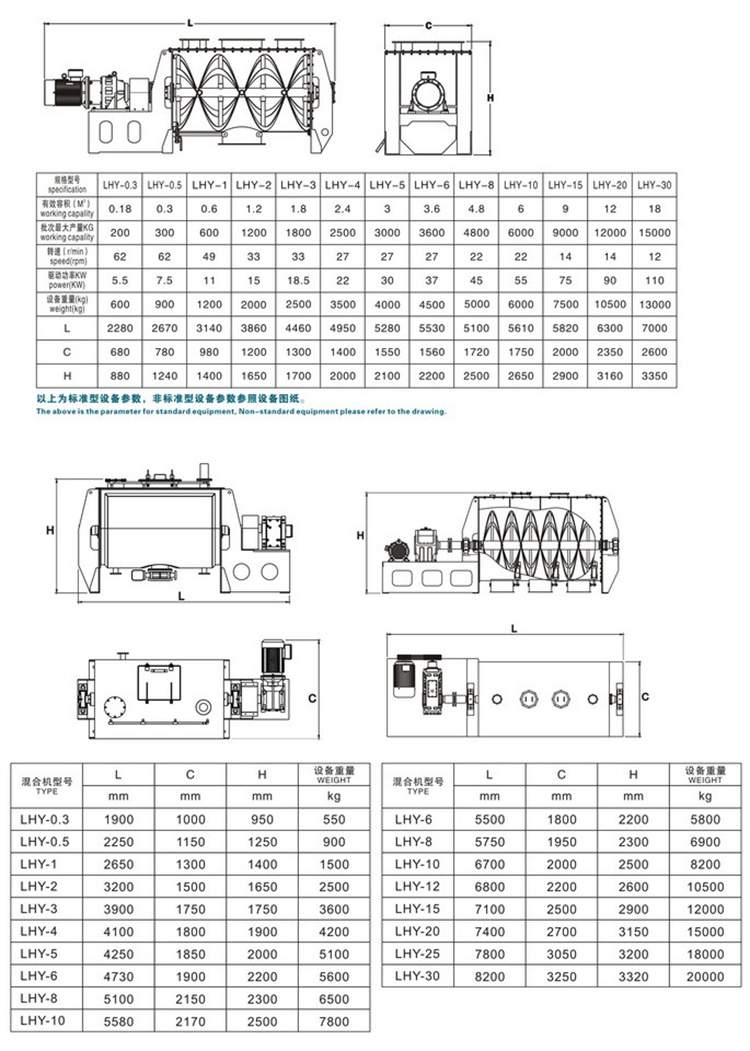
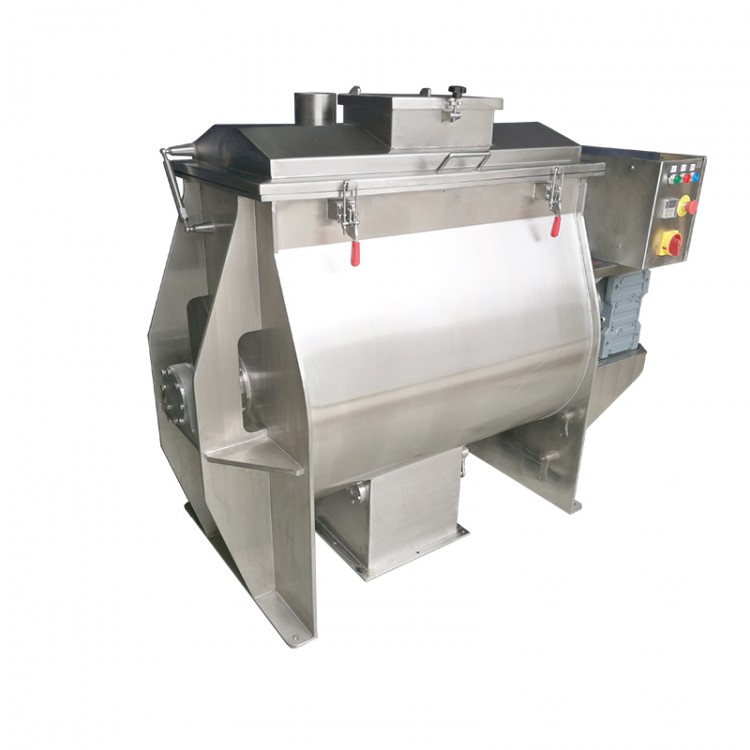
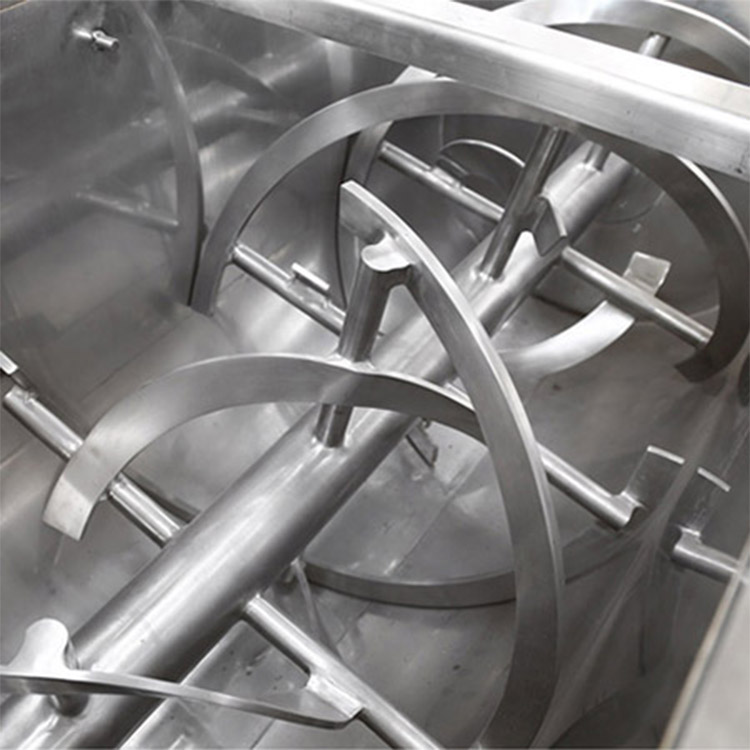
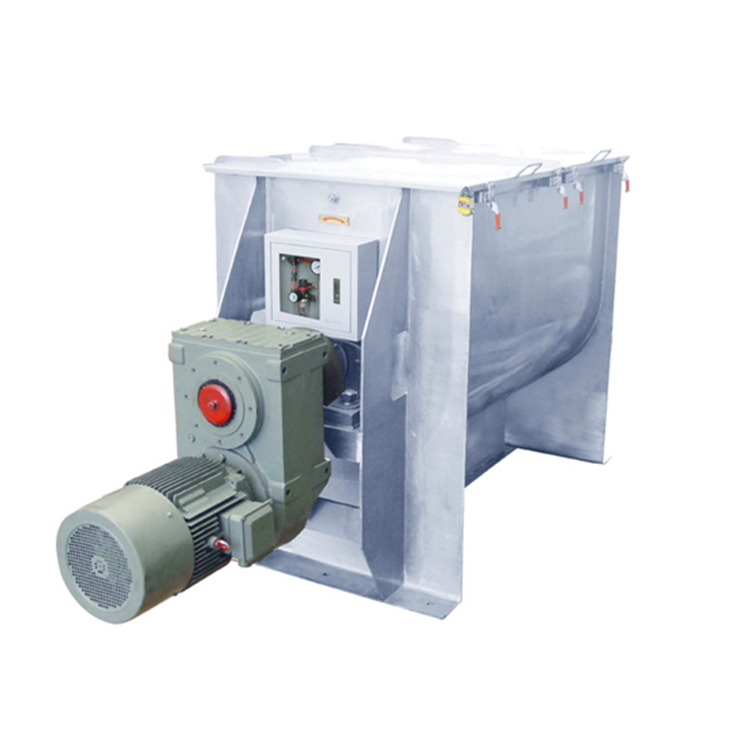
The horizontal helical ribbon blender is primarily composed of a mixing chamber, a stirrer, and a driving unit. The stirrer shaft, installed within a U-shaped tube, features double-helix blades arranged in opposite directions. The outer helical ribbon, powered by the drive, pushes the material from the ends of the U-shaped chamber towards the center due to its winding pattern and rotational direction. Conversely, the inner helical ribbon pushes the material from the center towards the ends, creating a crossflow mixing effect. The horizontal cylinder of the blender has an outlet at the center bottom, where the spiral structure of the outer helical ribbon, synchronized with the main shaft's rotation, drives the material from the inner cylinder wall towards the central outlet, ensuring that there are no dead corners in the cylinder during discharge.
Product Performance Introduction
1. Flexible material selection options
The blending machine can be customized with materials like carbon steel, manganese steel, 304 stainless steel, 316L stainless steel, 321 stainless steel, and other steel grades, and a combination of different materials is also possible. Material selection is differentiated between parts in contact with the material and those that are not. The internal surfaces of the blending machine can be treated with functional coatings or protective layers specifically for corrosion resistance, anti-adhesion, isolation, and wear resistance. Surface treatments for stainless steel include sandblasting, brushed finish, polishing, and mirror finishing, which can be applied to different parts of the equipment.
2. Reliable drive configuration
Mixers are configured with drives of varying capacities, powers, and output speeds based on material properties, start-up methods, and mixing techniques. Drive motor options include: standard motors, explosion-proof motors, variable-frequency motors, energy-saving motors, high-protection-grade motors, and motors for different voltage conditions; common reducers: R, K, F series gear reducers, cycloidal pinion reducers, general-purpose gear boxes, and planetary gear reducers; common connection methods: direct coupling, belt pulley connection, and hydraulic coupler connection.
3. Efficient mixing device
The mixer can be equipped with different agitators based on the properties of various materials; common material blending categories include: mixing different powders, batch mixing of the same material, blending powders with a small amount of liquid, mixing liquids with powders to form paste, thickening or diluting paste, mixing granular materials with powders, mixing granular materials with each other, crushing and blending lumpy materials, cooling or heating during mixing, etc. The agitators for vertical mixers can be: double helical inside and outside, paddle helical, inside and outside broken helical, and razor types, among others.
4. Outstanding material discharge equipment
Horizontal screw blade mixer features a pneumatic curved flap valve as a standard configuration. When the valve is closed, the curved flap of the valve perfectly conforms to the cylinder's arc surface, ensuring no excess mixing dead zones during the blending process, resulting in a more uniform mixture. The valve drive can be differentiated into manual, pneumatic, and electric types. For reference, other valves include spherical powder valve, drum valve, plum blossom misalignment valve, powder butterfly valve, and rotating feeding valve, etc.
5. Various opening styles
The cover of the mixer can be equipped with different types of openings to accommodate various operating conditions. Openings can be set for manholes, cleaning doors, feed ports, exhaust ports, and dust removal ports, among others. The types of openings include flanged standard openings and quick-open hinged doors. The mixer can be configured with a fully open cover for easy cleaning of the internal equipment.
6. Robust auxiliary components
The mixer can be equipped with various components for use, commonly including coiled steam jackets, honeycomb pressure-resistant jackets, circulating medium jackets, on-line sampling valves, high-speed cutters, magnetic separators, temperature detection, weighing systems, dust removal and purification, etc. The jacket of the mixer adopts different types depending on the heat source medium, allowing for both heating and cooling, with a maximum temperature of 250 degrees Celsius. When adding a small amount of liquid, a spray liquid nozzle system is required for more even dispersion and mixing with the main material. The spray liquid system consists of three basic modules: a pressure source, a storage tank, and a nozzle.
7. Tightly Sealed Dynamic shaft
Common sealing modes for mixers include: packing seal, combined gas seal, and mechanical seal; designed for shaft sealing in states such as granules, powders, micron-sized powders, liquids, and pastes.
Equipment Selection Chart
Selection Method
1. Determine the volume of materials for each batch, ranging from 0.1 to 20 cubic meters, and select the corresponding equipment size.
2. Select material for equipment manufacturing: materials are divided into parts in contact with materials and parts not in contact with materials; other equipment components maintain the original material.
Material is determined based on material properties, operating conditions, hygiene levels, etc., with common options including carbon steel and 304/316L/321 stainless steel.
After material selection, determine surface treatment requirements as per specifications.
3. Determine the driving capacity based on the material's specific gravity, fluidity, and other properties, as well as the startup standards.
(Startup Standards: Full Load Startup, No Load Startup)
4. Based on actual process conditions, add auxiliary function components such as spray, heating/cooling, etc.
5. Specify the opening requirements for the equipment design, such as the feeding opening, cleaning opening, exhaust holes, etc.
6. Select the feeding mode and driving method, which includes manual, pneumatic, and electric.