
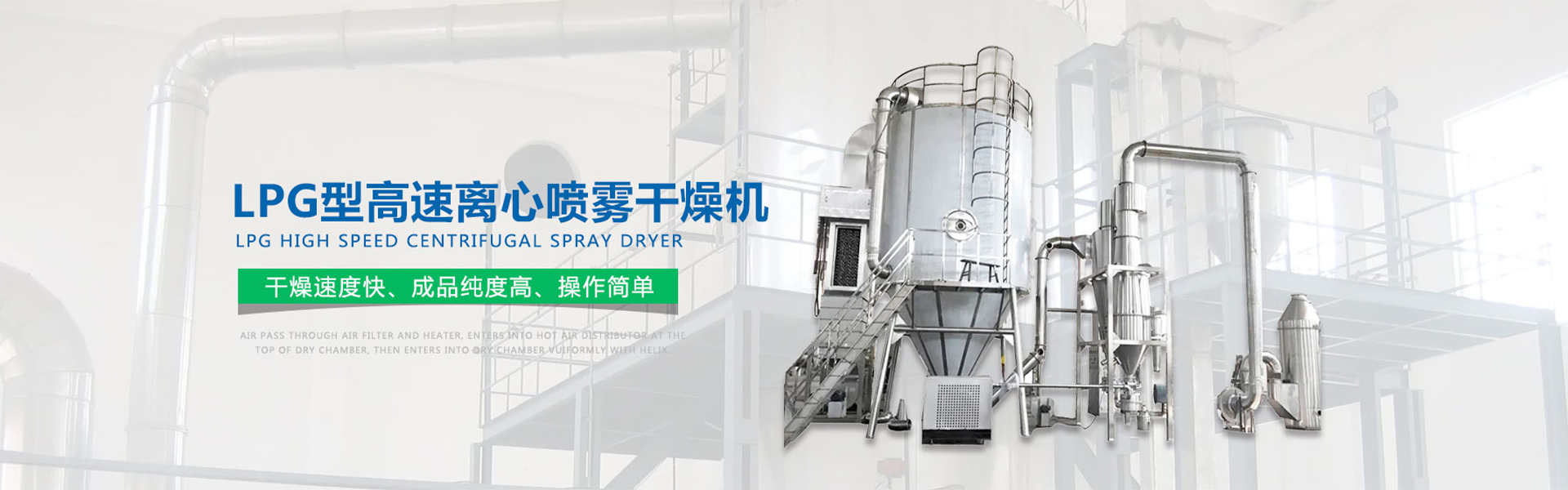

The Pressure Spray Dryer is a device that can simultaneously complete drying and granulation. The pressure, flow rate, and size of the spray holes of the material pump can be adjusted according to process requirements to produce spherical particles of the desired size and proportion. Its working process involves the material liquid being fed into the high-pressure side by a diaphragm pump, then sprayed out as mist droplets, which are then co-flowed downward with hot air. Most of the powder particles are collected through the discharge port at the bottom of the tower. The waste gas and fine powder are separated by a cyclone separator, with the waste gas exhausted by a blower and the powder collected by a powder feeding cylinder at the bottom of the separator. A secondary dust removal device can also be equipped at the blower outlet, achieving a recovery rate of over 96-98%. The tower body, pipes, and separator that come into contact with the material are all made of SUS304. There is sufficient insulation between the tower body and the outer shell, filled with ultra-fine glass wool. The tower is equipped with observation doors, viewing ports, light sources, and control instruments, which are controlled and displayed by an electrical control console. The heat source device uses steam heating or electric heaters, offering advantages such as easy operation, quick startup, compact structure, and clean, dust-free hot air. Additionally, a control and adjustment device for the electric heater is installed in the electrical control cabinet, allowing for infinite adjustment of the inlet temperature. In areas with power shortages, steam heating or coal or oil-fired hot air furnaces can be used to partially or fully replace the electric heating device.
Features
The pressure spray dryer features the following characteristics:
One: With a fast drying speed, the liquid is atomized to significantly increase its surface area. In the hot air stream, 95-98% of the moisture can be evaporated instantly, and the drying process is completed in just a few seconds to several tens of seconds, making it particularly suitable for drying heat-sensitive materials.
The obtained product is spherical granules with uniform particle size, good flowability, excellent solubility, high purity, and good quality.
The product has a wide range of applications. Depending on the material's characteristics, it can be dried with hot air or granulated with cold air, demonstrating strong adaptability to various materials.
Operation is simple and stable, with convenient control and easy realization of automation.
Installation Method
According to the equipment layout diagram, first position the drying main unit, then connect the pipeline between the main unit and the heating unit. Position the heater.
According to the equipment layout diagram, hoist the cyclone separator and bag dust collector to the pre-set positions in the factory. First, connect the pipeline between the drying main unit and the cyclone separator, then connect the pipeline between the cyclone separator and the bag dust collector.
Connect the pipes between the hot air furnace, blowers, and air filters. Also, connect the pipes between the bag dust collector and induced draft fan.
Align the verticality of the drying main unit with the horizontal plane; the verticality of the top of the drying main unit should not exceed 10mm.
The dosing unit is in place and connected to the drying main unit.
During pipeline connections, asbestosis rope or a sealing strip (silicone rubber sealing pads that meet GMP requirements are required for those that do) should be inserted.
Secure all fasteners at the connection points until the fastener panel is tight and free of any looseness.
Connect electrical cabinet wiring, ensuring the cabinet is securely grounded and clearly marked (wires should be run through conduit or conduit boxes).
