




With the rapid development of urban rail transit, the demand for railway optical cables is also increasing. The GYTAH58 railway optical cable, as a flame-retardant fiber for light rail communication, boasts excellent performance and reliability, meeting the high communication requirements of modern urban rail transit. This article will discuss the cable's functions, structure, flame-retardant properties, and application scope from four aspects.
One: The Function of Optical Fiber Cable
Optical cables, as crucial communication equipment in modern rail transit, offer a variety of functions:
1. Transmission Function: The fiber optic cable can transmit large amounts of information, support high-speed communication, and achieve rapid data transfer.
2. Protection Function: The fiber optic cable protects the optical fiber from external interference and damage, ensuring the reliability of communication.
3. Remote Monitoring Function: Fiber optic cables can be used for remote monitoring of the operation status of rail transit and the operation of equipment.
4. Security Function: Fiber optic cables can be used in security monitoring systems, providing comprehensive safety management and protection.
Two: Cable Structure
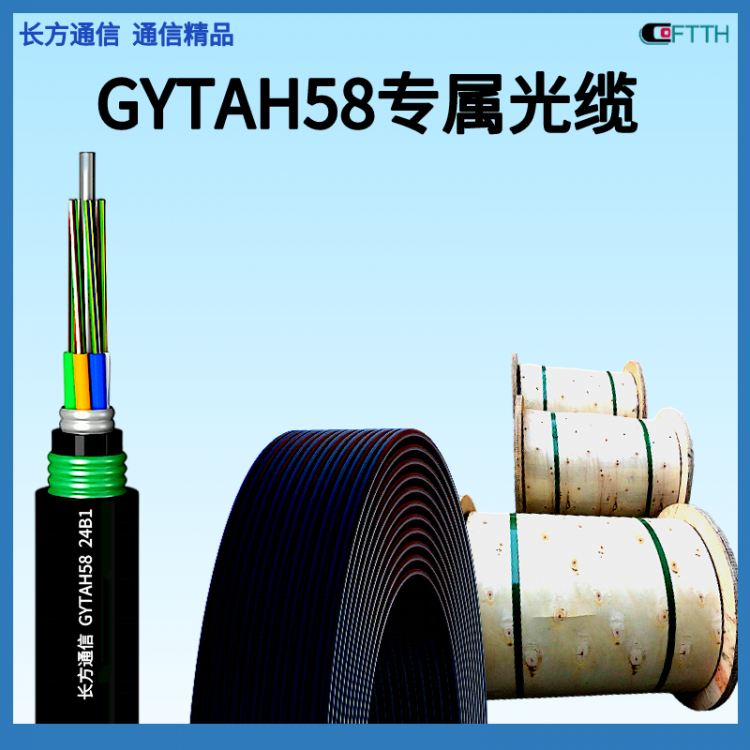
The GYTAH58 railway optical cable is composed of multiple fibers and protective layers, featuring the following structure:
1. Fiber Optics: Fiber optics are the core component of optical cables, used for transmitting light signals. The GYTAH58 railway optical cable is made with high-quality fiber optic materials, featuring low loss and high bandwidth.
2. Core: The core is the heart of the fiber optic cable, through which light signals are transmitted. The GYTAH58 railway optical cable uses multimode or single-mode fiber optics, capable of meeting different communication requirements.
3. Strength Sheath: The strength sheath is a protective component for optical fibers, featuring excellent mechanical and protective properties, capable of effectively preventing external forces from affecting the fibers.
4. Sheath: The sheath is the external protective layer of the optical cable, which can prevent damage to the cable from external physical and chemical environments.
3: Flame Retardant Performance of Fiber Optic Cables
GYTAH58 Railway Optical Cable is a flame-retardant fiber optic cable with excellent flame-retardant properties. This is mainly reflected in the following aspects:
1. Flame Retardant Materials: The flame retardant materials used in the optical cable are characterized by high-temperature resistance, low smoke, and low toxicity, effectively preventing the spread of flames in case of a fire.
2. Self-extinguishing property: Flame-retardant optical fibers possess the characteristic of self-extinguishing, meaning they can extinguish themselves after the flame is gone, reducing the loss caused by fire.
3. Environmentally Friendly: Flame-retardant materials are free of harmful substances, pollution-free, and meet environmental protection requirements.
4. Stability under Long-Term High Temperatures: Flame-retardant optical cables maintain stable performance in long-term high-temperature environments, ensuring continuous communication.
Four: Application Range of Optical Cables
GYTAH58 railway optical cables are widely used in urban rail transit systems, including subways, light rail, and tramways.
1. Communication Network: Optical cables are used to construct the communication network for rail transit systems, ensuring high-speed and stable communication.
2. Signal Transmission: Optical cables are used for signal transmission, including signal lights, infrared sensors, train positions, and other aspects.
3. Remote Monitoring: Optical cables are used for remote monitoring of rail transit operations, providing real-time monitoring data.
4. Security Monitoring: Fiber optic cables are utilized in security monitoring systems, providing comprehensive safety assurance for urban rail transit.
Summary:
GYTAH58 Rail Cable is a lightweight, flame-retardant optical fiber for rail communications, featuring multiple functions, excellent flame-retardant properties, and superior performance and reliability. It is widely used in urban rail transit systems and its introduction will provide robust communication support for the development of urban rail transit.


