
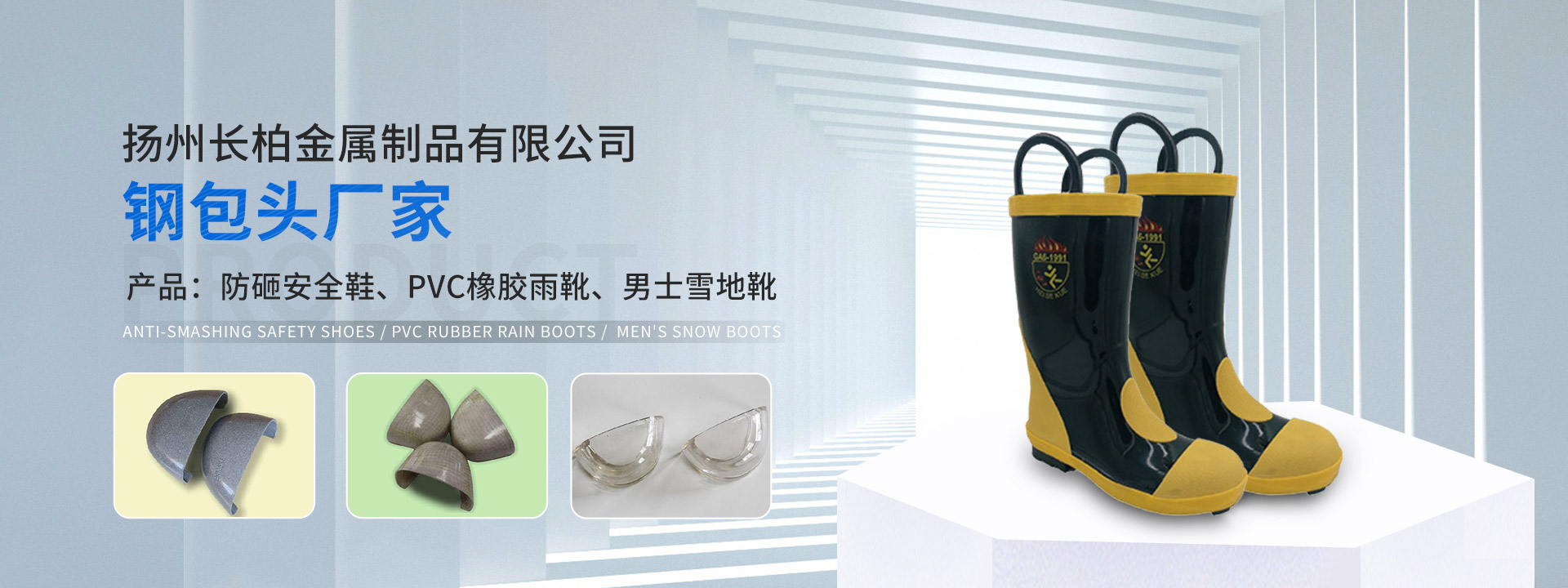

Composite headstock is completely different from steel headstock, and its advantages are very obvious. How exactly?
1. The weight of composite toe boots is higher, but with equivalent strength, the weight of the toe is about 50% of that of steel toe boots (with an average weight of about 45 grams per series). Shoes of the same size are, on average, about 5 to 15 grams lighter than those made of thermosetting composite materials.
2. Composite headliner products offer high design flexibility, with uneven thickness and the ability to shape fluid forms. Colors can be freely matched, resulting in a high-gloss finish on the finished product.
3. The material has a tightly packed molecular structure, resulting in high dimensional stability and strong impact resistance in the finished product.
4. Excellent in weather resistance, fire resistance, corrosion resistance, and alkali resistance.
5. Made from thermoplastic materials for composite toe products, this toe cap is recyclable and non-toxic, contrasting with the safety toe caps made from thermosetting materials.
6. The shoe head is made of non-metallic material, non-conductive, with excellent insulation properties, and can pass through airport security checks.
7. Steel tips may show noticeable dents after impact, while composite tips return to 85% of their original shape, demonstrating excellent resilience.
The Anti-impact Composite Toe Cap is an accessory for safety footwear. The Anti-impact Composite Toe Cap is an accessory for safety boots, designed to effectively protect the toes from external impacts or static pressure injuries. What are the safety performance standards for it?
Internal Pressure: The shoe toe is continuously cut off 25mm (3mm) from the inner toe cap, and placed on the platform of a pressure testing machine with a display error of (1%). A clay cylinder with a height of 35mm and a diameter of 22mm is placed inside the shoe toe. Then, the required force is applied at a speed of 5mm per 1 minute (2mm/min) for 1 minute, and the force is then returned to 0. Remove the compressed clay, measure the height with a caliper, and use the lower measurement without the actual value. The price must comply with the regulations.
2. Impact Test: Place a shoe with an internal cannon and a cylindrical clay object under the impactor, secure the blade, lift the sledgehammer (23 kg, 0.2 kg) to the required height, and allow it to fall freely onto the shoe head. Remove the rubber clay, measure it with a caliper, and ensure the value meets the specifications.
3. The pressure and impact resistance requirements for insole heads are the same as those for shoe head testing methods; however, the deformation intervals of the insole heads after testing must not be less than 22 millimeters.
4. Corrosion requirements for the inner insole of the composite insole: Corrosion of the inner insole using sweating and moisture can affect the quality of the shoe, therefore, the inner insole must be corrosion-resistant. The requirement is to use two white filter papers (100mm wide, 150mm long) to immerse one end in a 1% NaCl solution, while the other end is soaked above and below the inner insole for 48 hours.
