
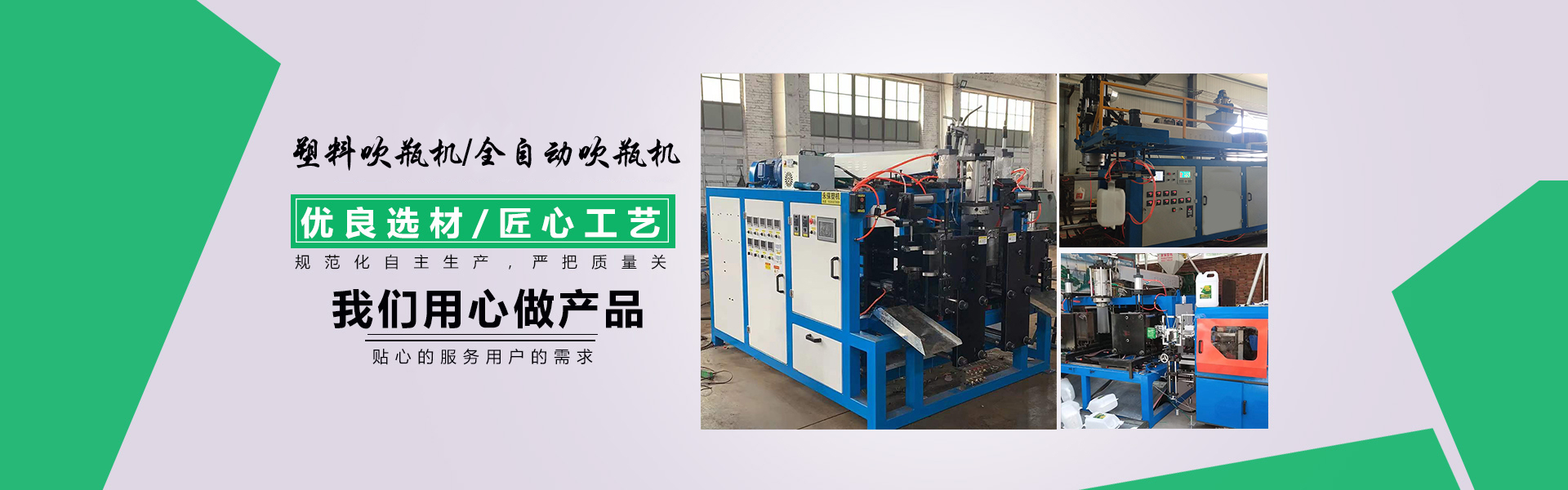

The blowing process of the fully automatic blowing machine is a bidirectional stretching process. During this process, the PET chain is elongated, oriented, and split bidirectionally, thereby enhancing the mechanical properties of the bottle wall, improving tensile, elongation, and impact strength, and ensuring excellent airtightness. Although stretching contributes to strength enhancement, it is crucial not to overstretch. The stretching-to-blowing ratio should be controlled: the radial stretch should not exceed 3.5 to 4.2, and the axial stretch should not exceed 2.8 to 3.1. The blank wall thickness should not exceed 4.5mm.
Blowing occurs between the glass transition temperature and the crystallization temperature, typically controlled between 90-120 degrees. Within this range, PET is in a high-elastic state, and after rapid blowing and cooling, it forms transparent bottles. In the one-step process, this temperature is determined by the cooling time during the injection molding process (such as with the Aoki blowing machine), thus requiring good coordination between the injection and blowing stations.
During the blow molding process, there are three steps: stretching, one-time blowing, and two-time blowing. The timing of these three steps is crucial, especially the first two, which determine the entire temperature distribution and the quality of the blow-molded bottle. Factors such as the starting point of stretching, stretching speed, pre-blow starting and stopping points, pre-blow gas pressure, and pre-blow gas flow can, if possible, control the temperature distribution of the parison and the temperature gradient between the inner and outer walls of the parison.
