


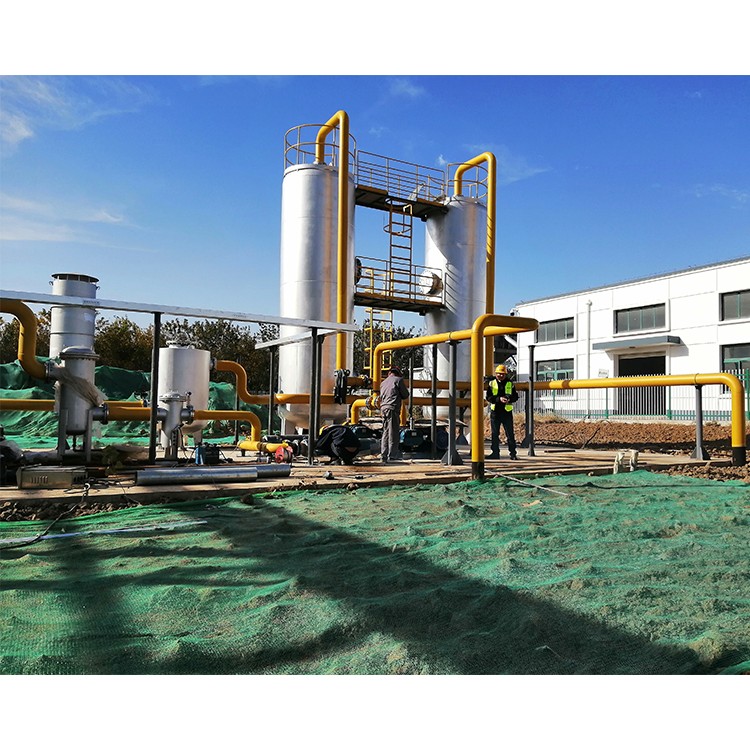


One. Process Principle of Dry Desulfurization (Desulfurization Tank)
Dry desulfurization involves filling a cylindrical desulfurization tower with a certain height of desulfurizing agent. Through the desulfurizing agent, H2S is removed, achieving the desulfurization process. Common desulfurizing agents include ferric oxide, which is in the form of cylindrical granules. As it accumulates, ferric oxide absorbs H2S. When the absorption of H2S reaches a certain level, the removal rate of H2S will significantly decrease, eventually leading to failure.
Section 2: Dry Desulfurization Performance
The basic principle of dry gas desulfurization equipment (H2S) involves using O2 to oxidize H2S into sulfur or sulfur oxides, which can also be referred to as dry oxidation process. The structure of dry equipment consists of placing packing material in a container, with active carbon, iron oxide, and the like in the packing layer. Gases flow at a low velocity through the packing layer inside the container, where (H2S) is oxidized into sulfur or sulfur oxides, remaining in the packing layer. The purified gas is then discharged from the other end of the container.
Section 3: Product Construction Description
This equipment is made of stainless steel.
2. Desulfurization Filler: Iron Oxide Desulfurization Agent
Section 4: Filling Material Description
Desulfurizing agent is an efficient purification agent primarily composed of iron oxide, enhanced with other additives for processing and shaping. At room temperature, it exhibits high removal performance for sulfur compounds in gases, including mercaptans and organic sulfur, as well as a certain degree of removal for most nitrogen oxides.
Easy to use with simple equipment, user-friendly operation, high purification efficiency, low bed resistance, and strong practicality, with no secondary pollution.
V. Desulfurization and Regeneration Principle
Desulfurization:
Fe2O3·H2O + 3H2S = Fe2O3·HO + 3H2O + 15 kcal
Recycling: Fe2O3·H2O + 2O2 = Fe2O3·H2O + 3S + 145 kcal
If the ratio of O2 molecules to H2S molecules in the gas is greater than 2.5, the aforementioned desulfurization and regeneration reactions can be continuously regenerated, and the two reactions can be merged into: H2S + 2O2 = Fe2O3·H2O + H2O + S, with iron oxide acting as a catalyst in reality.
Section 6: Operation and Usage
Operation Conditions:
Air Speed: 200-400 h-1 (can be increased to 500-600 h-1 during pressurization or low H2S content)
Line Speed: 0.10—0.3 meters/second (empty tower)
Pressure: Atmospheric Pressure
Temperature: Room temperature – 130℃ (optimal between 20-80℃)
The above moisture content and pH value:
The moisture in desulfurizing agents acts as a medium, and its content should be around 10% of the desulfurizing agent's weight. During use, it is required to have a slight amount of water vapor to prevent the airflow from carrying away the moisture in the desulfurizing agent, but not to have excessive steam, as this can lead to condensation and blockage of the micropores. The desulfurization and regeneration process is most effective when the pH value is between 7.5 and 9.0.
Section 7: Maintenance of Dry Desulfurization Vessel
Regularly test the concentration of O2 at the outlet of the desulfurization tower, ensuring the oxygen content is maintained below 1%.
2. Regularly test the H2S content before and after desulfurization, as well as the post-desulfurization content. If the desulfurization efficiency falls below 90%, it indicates that the desulfurizing agent is nearly saturated with sulfur capacity and has become ineffective. Replace the desulfurizing agent, and discharge some of the ineffective agent from the bottom of the desulfurization tower, then replenish with new desulfurizing agent from the top. To ensure effective desulfurization, the filling amount of iron oxide in the desulfurization tower should maintain a ratio of reaction layer height to tower diameter greater than 3-4.
3. To prevent an excessive water content in the desulfurization tank, it is necessary to regularly drain the tank (open the bottom water drain valve). It is recommended to do so once a week.
Section 8: Reclamation Operations
If the H2S content in the gas from the desulfurization tower exceeds 1 ppm or the required standard, and the sulfur tower has not reached 30%, then the desulfurizing agent should be regeneratd.
1. Regeneration Methods: They can be categorized into continuous and intermittent regeneration. Continuous regeneration can be achieved when the molar ratio of O2/H2S in the feed gas is high, and no specific regeneration operation is required. In cases where the feed gas contains a low O2 content, and continuous regeneration is not feasible, intermittent regeneration can be conducted using the following general methods:
(1) Natural Air Regeneration
(2) Forced air regeneration
(3) Inert Gas and Air Recirculation Regeneration
2. The regeneration process primarily controls the bed temperature between 30-80°C, not exceeding 90°C. Temperature control is mainly achieved by adjusting the oxygen content in the regeneration air. Natural air regeneration is primarily suitable for situations with less quantity and sulfur absorption. Its temperature control is mainly achieved by adjusting the gas flow. In case of a sudden temperature rise, the inlet valve should be immediately closed.
3. The regeneration time depends on the amount of sulfur absorbed; more sulfur absorption leads to a longer regeneration process; less sulfur absorption results in a shorter regeneration process.
4. The regeneration times are generally 2 to 3.
5. Indication of the End of Recycling
When the bed temperature does not rise and the import content is basically approaching, it can be considered that regeneration is complete. Close the inlet valve and integrate the desulfurization tower into the system or switch to backup.
Section 9: Precautions
1. Filling: The quality of desulfurizing agent filling directly affects the effectiveness of use. Pay attention to the following points:
(1) First, lay two layers of wire mesh with openings less than 5mm on the grating plate of the desulfurization tower. Then, cover the mesh with a layer of cinder blocks, 50mm thick and Ø 20-30mm.
(2) Due to dust generation during loading and unloading, screening is required before filling.
(3) Before filling, measure and mark the height. Flatten the material to the designated height after reaching it, but do not step on the desulfurizing agent; use boards to place under the material layer. Strictly prohibit any foreign objects from being dropped into the tower during material removal and inspection.
(4) The new desulfurizing agent has a lower strength initially, which increases progressively with the increase of sulfur absorption during the desulfurization process. Therefore, it should be layered filled in the desulfurization tower, with each layer being approximately 1 to 1.5 meters in height.
