
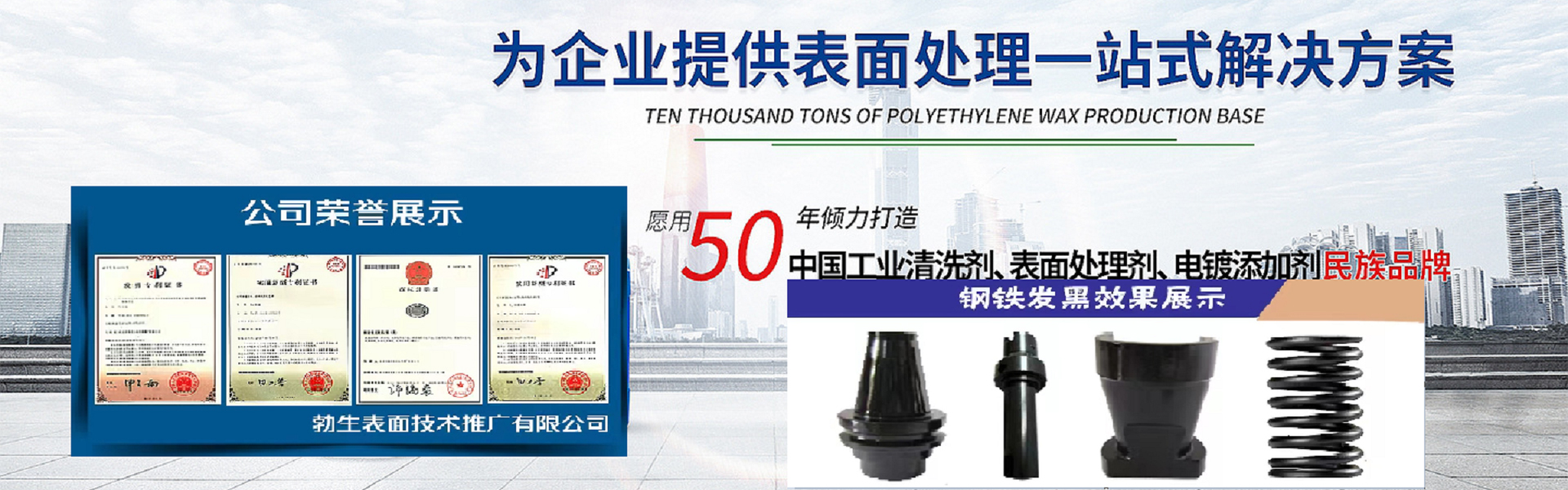


Users of the steel blackening liquid at room temperature have observed a phenomenon: precipitation and post-precipitation. Precipitation refers to the formation of sediment during the blackening process. This is due to the oxidation of the steel matrix when the workpiece is blackened, resulting in Fe...2+,Fe2+Will be further oxidized to Fe3+,Fe3+The reaction with selenite ions to produce iron.2(SeO3)3Deposits not only affect the effectiveness of use but also unnecessarily consume a large amount of active ingredients, thereby reducing efficiency.
The "post-deposit" phenomenon refers to the continued formation of sediment even after discontinuing the use of the blackening liquid. Specifically, when the blackening liquid, used for a period, is left for a day or a few days before being reused, the sediment in the solution will be significantly more than when it was stopped. Moreover, it can sometimes become so severe that it prevents the blackening process from continuing. This is what is known as the "post-deposit" phenomenon. No workpieces were processed during the period of discontinuation, yet sediment continues to form, even leading to failure. This is due to the oxidation of the steel substrate during the blackening process, resulting in Fe...2+Converted to Fe3+It wasn't instantaneous. There were still a significant amount of unoxidized Fe in the solution upon discontinuation.2+These existing Fe2+During the placement process, it will gradually oxidize into Fe.3+Continuing to generate a substantial amount of Fe.2(SeO3)3The "post-settling" phenomenon, in reality, has a more severe impact on the efficiency of black liquid usage than the earlier settling phenomenon. It significantly reduces the processing capacity of the black liquid. Overcoming the post-settling issue is essential for effectively enhancing the efficiency of the steel blackening process at room temperature. However, traditional room temperature blackening liquids all suffer from serious post-settling defects.
News Center Co., Ltd.
