

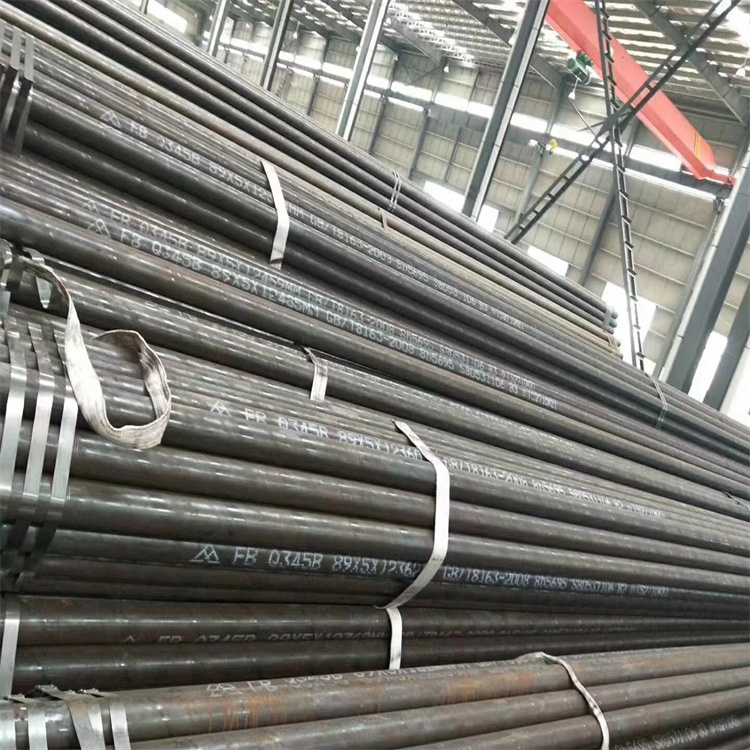


 8163 seamless steel pipes used for fluid applications have spiral, regular, or irregular grooves on their outer surface, known as scratches, which can be prevented. These pipes are a commonly used type of transmission pipeline in China, favored by many manufacturers for their affordability. During large-scale production and transportation, scratches are inevitable. The term "scratch" is not unfamiliar, but many people still have a limited understanding of the scratches on steel pipes. The defect characteristics of the scratches on 8163 seamless steel pipes for fluid applications are manifested as spiral marks or other regular or irregular grooves on the outer surface of the pipe.
Reasons for scratches on 8163 seamless steel tubes for fluid use:
1. Piercing Scratch: Due to the aging piercing machine, export guide holes are damaged or bonded with metal, the surface of the back centering roller or lift roller is not smooth, and the 8163 seamless steel tube is prone to spiral scratches on the outer surface. The piercing tip has no severe wear, with protrusions and dents, making it easy to develop spiral scratches on the inner surface. Bent pin, contact with the centering roller during piercing, causing scratches on the surface.
2. MPM Scratch: Due to severe wear on the edge of MPM roller profiles, resulting in surface scratches along the roller seam on the 8163 fluid seamless steel tubes in the form of a curved line; fine scratch marks on the outer surface of the 8163 fluid seamless steel tubes, caused by the waxing of the MPM roller and running longitudinally; and discontinuous strip-like scratches caused by the metal from the tube extractor's inlet and outlet nozzles, bending of the steel tubes after leaving the extractor, and scraping against the guard plate and dust hood.
3.8163 seamless steel tubes for fluid use may experience irregular scratches during transportation and lifting, when rubbing against objects with sharp edges.
Methods for preventing and eliminating scratches:
a. Piercing Scratches: Caused by damaged or bonded metal guide plates of the piercing machine, replace or grind the piercing guide plates and outlet nozzles; due to an uneven surface of the back-end centering roller or lifting roller, replace or grind to eliminate spiral scratches on the outer surface; if the piercing tip shows no wear but has bumps and dents, replace the tip to remove the scratches.
b. MPM Scratch: Replacing the roller can eliminate streaky, arc-shaped scratches on the surface of 8163 seamless steel tubes along the roller gap when the MPM roller edge is severely worn. When the MPM roller is coated with wax, using a polishing wheel can remove fine, longitudinal scratches on the outer surface of the tube. After passing through the uncoiler, if the 8163 fluid seamless steel tube bends and scratches the mouth guard and dust cover, adjusting or replacing the uncoiler can eliminate the streaky scratches.
c. Scratches caused by friction during transportation and lifting of seamless steel tubes for 8163 fluids, when in contact with angular machinery, can be removed by smoothing the affected areas.
Method of Treatment: Inspect and judge by visual observation and measure with gauges. Local擦伤with smooth edges are permissible if their depth does not exceed the diameter and is not negative. Sharp or severe擦伤should be removed. After removal, the diameter and wall thickness must not exceed negative deviations.
1. Seamless steel tube folding refers to the presence of folds on the outer or inner surface of seamless steel tubes, which can be straight or spiral, continuous or discontinuous. The primary cause of folding is poor tube material quality, inherent folds, or surface impurities, severe scratches, and cracks. Edges at the polishing areas, followed by stretching during the extrusion process, can also lead to folding. To prevent folding, it is essential to enhance tube material quality and pay attention to inspection and polishing.
2. Seamless steel tube cracks refer to fine cracks that appear on the inner and outer surfaces of seamless steel tubes, distributed in straight or helical lines, with a depth of 1 millimeter or more, and they can be continuous or discontinuous. The causes include: the hot-rolled billet has皮下 bubbles and inclusions, cracks or deep pockmarks are present on the steel tube before drawing, and longitudinal scratches or abrasions are formed during hot rolling or cold drawing processes. Preventing crack formation also lies in improving the quality of the billet, strengthening the inspection and dressing of the tube material. At the same time, it should be avoided for the tube to produce pockmarks, scratches, and abrasions during the cold drawing production process.
3. The characteristic of scratch defects in seamless steel tubes is longitudinal straight scratches of varying lengths on both the inner and outer surfaces of the tube, mostly in a groove-like pattern, but may also appear as raised stripes. The main causes of scratching (scarring) are: internal scratches on the tube material that were not eliminated during drawing, residual iron oxide scale mold sticking to the steel tube, insufficient or uneven mold strength and hardness, cracking and wear of the mold, poor hammer head, and sharp edges of the hammer head damaging the mold, etc. To prevent scratches and scarring, the quality of all preparation processes before drawing should be improved, and molds with high strength, hardness, and smoothness should be used.
4. Seamless Steel Pipe Dimples - This is one of the common surface defects in seamless pipes, characterized by localized indentations of varying sizes on the pipe surface, some of which are periodic and others irregular. The formation of dimples is due to the pressing of iron oxide scale or other hard contaminants into the pipe surface during the drawing or straightening process, or from the peeling off of blisters originally present on the pipe surface. Measures to prevent dimples include carefully inspecting the pipe material and removing defects such as blisters, maintaining cleanliness of the work area, tools, and lubricants, and preventing iron oxide scale and contaminants from falling onto the pipe surface.
When spiral marks appear on the outer surface of seamless steel tubes, either smooth or with sharp ridges, the straightening machine should be inspected. This could be due to the straightening rolls being out of position, incorrect angles, the tube contacting the raised shoulder on the edge of the straightening roll during straightening, wear grooves on the straightening roll, or excessive bending at both ends of the tube, which may cause dents on the outer surface of the tube.
5. The characteristic of the rough surface on seamless steel pipes is the presence of small, scattered pits on the pipe surface. The main cause of the rough surface is the formation of pinpoint corrosion during pickling, which, after annealing, results in excessively thick iron oxide scale. This scale is then pressed into the pipe surface during straightening, creating the rough texture. Additionally, if the pipes are stored in a humid environment, or even if water enters, pinpoint rust can occur. After removing the rust spots, a rough surface may form.
