
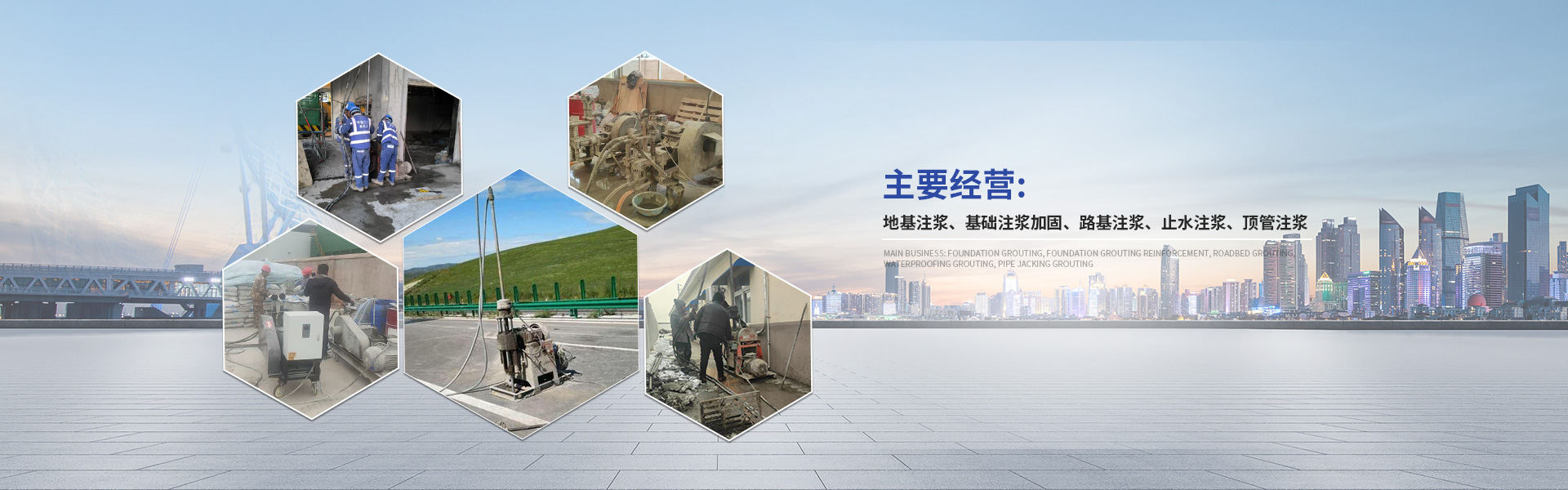
公司主营:Foundation Reinforcement, Grouting Foundation Reinforcement, Foundation Settlement Reinforcement, Roadway Settlement Reinforcement, Foundation Reinforcement, Grouting Foundation
010-68606805
企业资质
Ground Grouting Reinforcement
2025-02-26
Grouting reinforcement of foundation is a common and effective foundation treatment method. It involves injecting a solidifiable slurry into the pores, fissures, or voids of the foundation soil to improve its physical and mechanical properties, enhancing the bearing capacity of the foundation and reducing settlement and uneven settlement. Below is an in-depth introduction:
Scope of Application
Ideal for soil stabilization in sandy, silt, clay, and artificial fill foundations.
Strengthening treatments for the foundations of existing buildings, such as repairs for wall cracking and tilting caused by foundation settlement.
Also suitable for the pre-treatment of foundations for new buildings, enhancing their load-bearing capacity and stability to meet the design requirements of the structures.
Gypsum Material
Cement Grout: Made primarily from cement, mixed with water. Cement grout boasts high strength and excellent durability, making it a commonly used grouting material suitable for various soil layers.
Cement Mortar: By adding an appropriate amount of sand to cement slurry, the strength and impermeability of the slurry can be enhanced, commonly used in soil layers with coarser particles or for reinforcement projects requiring higher strength.
Chemical slurries: such as epoxy resins, polyurethane resins, etc. Chemical slurries feature good fluidity, rapid curing speed, and high bonding strength, making them suitable for dealing with small cracks and soil layers with low permeability coefficients. However, they are relatively expensive and some chemical slurries may pose certain environmental pollution.
Casting Method
Grouting Compaction: A method that involves injecting slurry into the soil foundation through drilling. Under the action of grouting pressure, the slurry compresses the surrounding soil, reducing the soil pores and increasing its density, thereby enhancing the strength and compactness of the foundation soil. Suitable for treating sandy, silt, and clayey soils with medium density and below as foundation materials.
Grouting Fracturing: When the grouting pressure exceeds the tensile strength of the soil, the slurry forms fracturing cracks in the soil. The slurry then spreads along these cracks, forming a composite structure with the soil, thereby enhancing the bearing capacity of the foundation. Commonly used for treating clayey soil foundations.
Grouting Penetration: Under lower grouting pressure, the slurry penetrates into the pores of the soil mass due to the action of pressure difference, improving the compactness and impermeability of the soil. Suitable for treating sandy soil foundations, which require larger soil pores for the slurry to penetrate smoothly.
Construction Techniques
Construction Preparation: Includes site leveling, surveying, and equipment tuning. Determine the location and spacing of grouting holes according to design requirements and make appropriate markings.
Drilling: Use a drilling machine to bore holes to the specified depth and angle according to the design requirements. Pay attention to controlling the verticality and diameter of the boreholes during the process to ensure the grouting effect.
Grouting Tube Installation: Insert the grouting tube into the drilled hole, ensuring the lower end reaches the designed depth and the upper end extends a certain height above ground for connecting the grouting equipment.
Slurry Preparation: Select appropriate grouting materials based on design requirements and geological conditions, and mix them according to the specified proportions to prepare the slurry. The prepared slurry should possess good fluidity and stability.
Grouting: In the process of grouting, the slurry is injected into the soil foundation using a grouting pump, controlling the grouting pressure, volume, and speed to ensure the slurry fills the soil pores or cracks thoroughly. During the grouting process, closely monitor changes in grouting pressure and volume, and promptly address any anomalies.
Hole Sealing: After grouting is completed, it is essential to promptly seal the grouting holes to prevent the leakage of slurry and soil collapse. Sealing can be done using cement mortar or other suitable materials.
Quality Control
We rigorously control the quality of the grouting materials to ensure they meet design requirements and relevant standards.
Regular inspections and maintenance of the grouting equipment are conducted to ensure the smooth operation of the equipment and the stability of the grouting pressure.
During the grouting process, enhance monitoring and control of grouting pressure, volume, and speed to ensure the grouting results meet design specifications.
Upon completion of construction,地基承载力 tests and grouting effectiveness evaluations should be conducted. Methods such as static load tests and standard penetration tests should be used to verify if the reinforcement of the foundation meets the design requirements.
任强 (Mr.)
010-68606805
13466562881
1728111219@qq.com
2 Group 284, Wanglou Village, Dazha Town, Daming County, Handan City, Hebei Province
b2b.china9.net © Zhongshang 114 Hebei Network Technology Co., Ltd.Address: Room 6009, Oriental New World Center, No.118 East Zhongshan Road, Qiaoxi District, Shijiazhuang City, Hebei ProvincePlatform Service Hotline: 4006299930
