
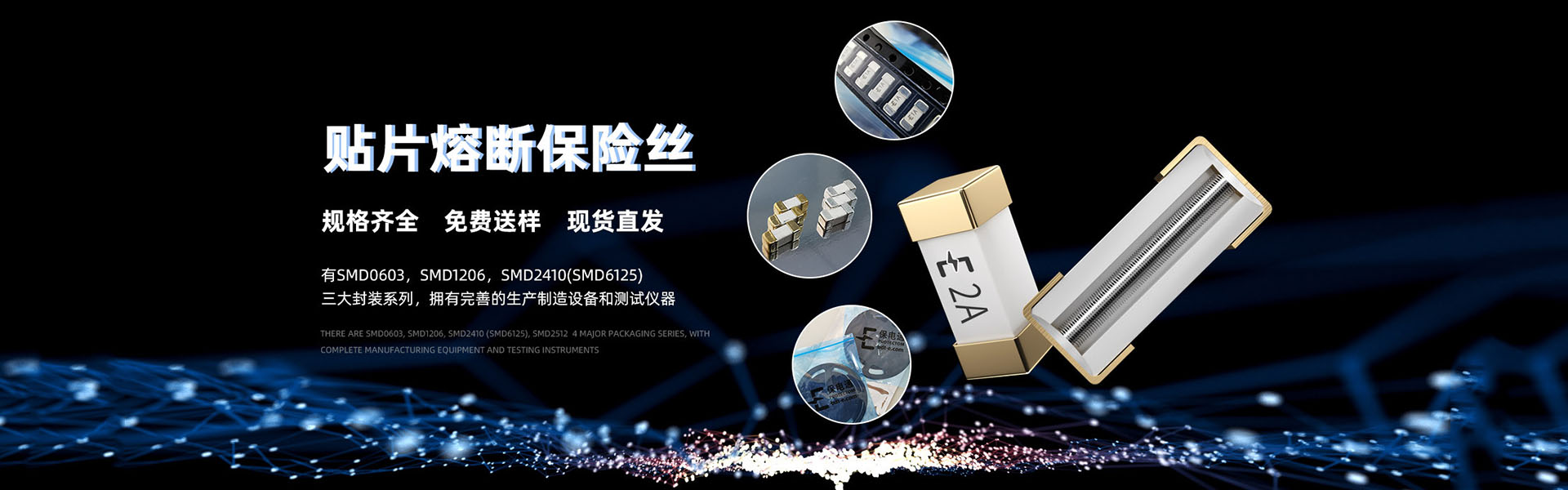

Surface mount fuses are primarily used in digital cameras, laptops, mobile phones, and other electronic products. From traditional glass tube fuses to mini fuses and surface mount fuses, due to differences in product technology, their selection focuses vary slightly.
The selection of surface mount fuses involves the following factors:
(1) Normal operating current for the circuit. The working current through the fuse should not exceed 75% of the fuse's rated current.
(2) Pulsed, surge, inrush currents, and circuit transient values. Surface mount fuses pay particular attention to this, as the smaller size brings about process-related challenges, leading to a significantly lower surge resistance in surface mount fuses compared to similarly rated glass tube fuses or those with larger sizes.
(3) The magnitude of the overload current in circuits and the short and long-term presence of overload current. Typically, a combination of oscilloscope testing and theoretical calculations is required to determine the magnitude of the overload current. The fundamental requirement for a fuse is that it should not break when it shouldn't (e.g., during surge currents), and it must break within an appropriate timeframe when it should (e.g., during overload currents that need to be interrupted).
(4) Resistance. The resistance of surface mount fuses can affect certain circuits: if a fuse with excessively high internal resistance is installed in some circuits, it will impact the system parameters of the circuit, causing it to malfunction.
(5) Environmental Temperature for Fuses. When surface mount fuses are used in portable devices, it is necessary to appropriately consider the fuse's temperature rise, which includes adjusting the fuse's rated current. The operating environmental temperature of the fuse should be within the specified operating temperature range. When the ambient temperature around the fuse exceeds 25°C, refer to the temperature derating curve for reduced usage.
(6) The external voltage applied to the fuse. Surface mount fuses are commonly used in portable devices, where circuit working voltages are typically low. As long as the rated voltage of the surface mount fuse is higher than the circuit working voltage, it can be safely selected.
(7) Product Certification. For example, products exported to North America must have UL or CSA certifications. Currently, products exported to Europe also need to comply with the EU's RoHS Directive, commonly referred to as SGS and other environmental certifications.
