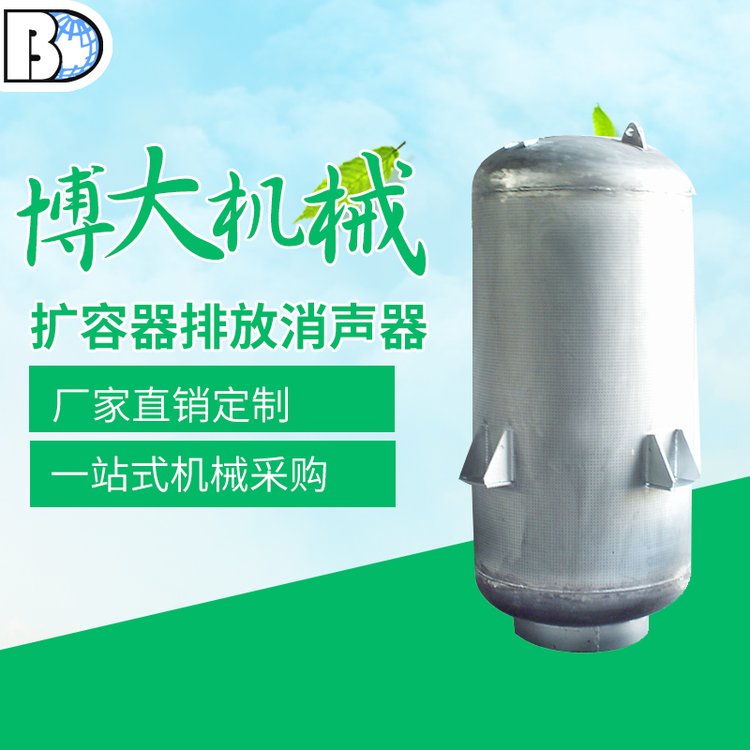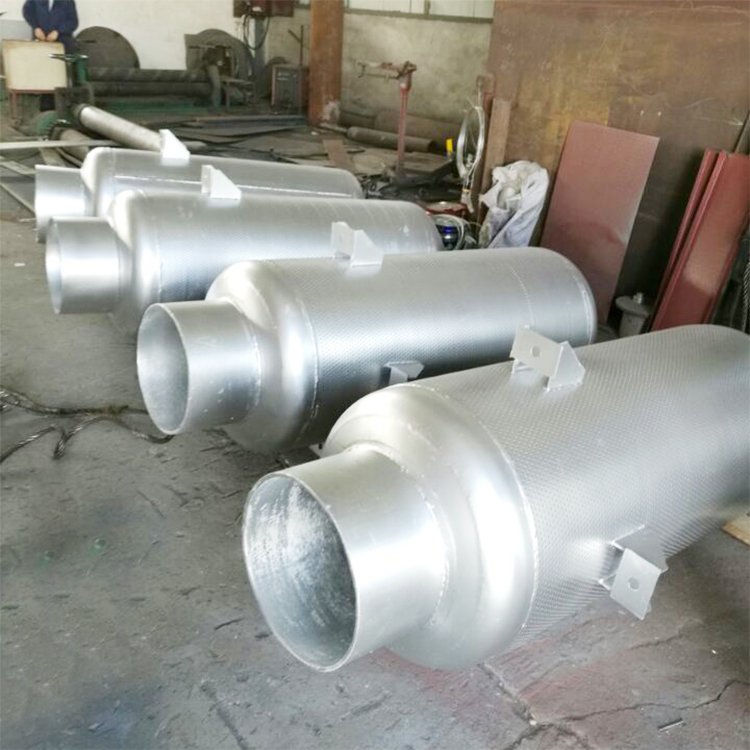





Section 1:Water-repellent expansion vessel mufflerProduct Overview:
A desuperheater exhaust silencer is a noise-reduction device installed on the air flow channel of the desuperheater exhaust in power plants or chemical factories, or within the intake and exhaust systems. The desuperheater expands and reduces the pressure of the condensate from the pressure drain line, separating steam and condensate. The steam is then introduced into a heat exchanger or deaerator to fully utilize its thermal energy, while the condensate is directed to a condensate tank for regular transfer to the feedwater system. It primarily serves to reduce pressure; if high-pressure steam is directly fed into the condenser, it can cause overpressure. This device can lower the pressure, prevent overpressure, and also includes a temperature-reducing component.
Section II: Product Structure of the Water-Repelling and Expanding Container with Noise Suppressor
Primarily, noise reduction is achieved by utilizing small-pore diffusive sound-absorbing materials. By fixing the sound-absorbing material (alumina silicate) to the inner walls of the air flow channel or arranging it in a certain pattern within the pipe, a dehumidifying and expanding silencer is formed. When sound waves enter the dehumidifying and expanding silencer, some of the sound energy is frayed in the pores of the small-pore material, converting it into heat energy and dissipating it, thereby reducing the intensity of sound waves passing through the silencer. The dehumidifying and expanding silencer is akin to a pure resistive circuit in electrical terms, with the sound-absorbing material acting as the resistor. Hence, this type of silencer is referred to as a dehumidifying and expanding silencer. The dehumidifying and expanding silencer is effective for mid-to-high-frequency noise reduction but less effective for low-frequency noise reduction.
Section 3: Application Area for Water-Repellent Expander Silencer
Suitable for safety valves of various dehydrator expansion vessels
Safety doors for pressure devices such as expansion tanks' safety valves, superheater safety valves, and reheater safety valves in power stations. The steam exhaust should not only avoid excessive noise but also allow the steam flow to be discharged smoothly without affecting the discharge, actuation, and reset of the safety valves. For this reason, the commonly used methods of multi-stage throttling and small-hole injection for noise reduction are not suitable. This restriction has always beenSafety Valve MufflerDesign difficulties, also the reason for the poor soundproofing effect of the safety door sound absorber. The new TA-type for safety valvesSafety Valve Steam SilencerUtilizes a spray impedance composite sound-damping principle, where large-pore expansion replaces smaller-diameter flow control holes, further strengthening the resistance and reactance sound-damping mechanisms structurally, achieving a higher safety coefficient in sound and noise reduction.。