




- AllProduct Category
-
Elastomeric Filler
Suspension Ball Filler
Hollow Sphere Packing
Polyurethane Foam Filler
Composite Filler
Plaited Packing
MBBR Biofill
Tilted Tube Filler
TPU Aerator Tube
170 Agitator Aerator
Vibration Aerator
Disk-Type Micro-Porous Aerator
Turbulent Aerator
Turbulent Mixing Aerator
Tube Aerator
Single-Hole Membrane Aerator
Flat Plate Aerator


详情描述
Product Description:
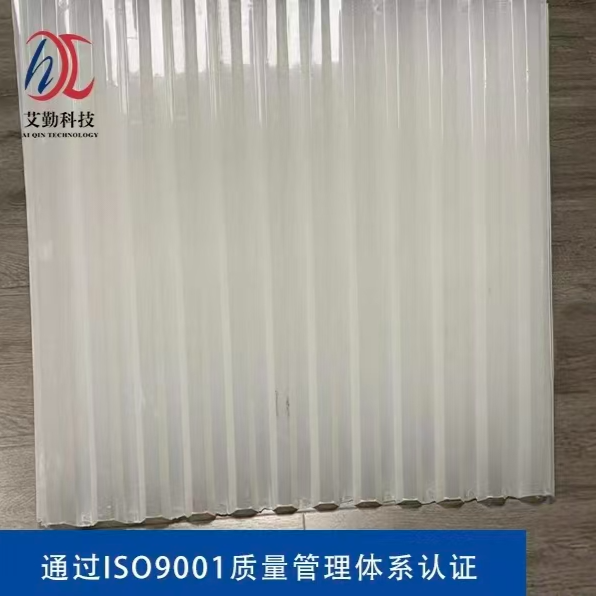
The inclined tube packing, also known as (hexagonal honeycomb inclined tube packing), is available in four materials: polypropylene, ethylene propylene copolymer, polyvinyl chloride, and glass fiber reinforced plastic. The honeycomb inclined tubes are made of modified ethylene propylene copolymer plastic, heat拉伸 into hexagonal tubes using infrared line constant temperature mechanical equipment, then high-frequency welded into a single unit, and finally installed.
Honeycomb inclined plates are primarily used for various sedimentation and sand removal purposes. They have been widely adopted in water supply and drainage projects over the past decade and have become a water treatment device. They offer advantages such as a wide application range, high treatment efficiency, and minimal land occupation. Suitable for sand removal at inlet, sedimentation of industrial and domestic water, wastewater sedimentation, oil separation, and tailings concentration, they are applicable to both new construction projects and the renovation of existing old ponds, yielding excellent benefits in all cases.
Key Features:
1. Wide wetted perimeter, small hydraulic radius.
2. Good laminar flow; particle sedimentation is not disturbed by turbulence.
3. When the honeycomb inclined tube has a length of 1 meter, the effective load is designed at 3-5 tons/square meter, with V0 controlled within the range of 2.5-3.0 mm/second, resulting in excellent effluent water quality.
4. Utilizing inclined tube sedimentation tanks, their treatment capacity is 3-5 times that of horizontal flow sedimentation tanks, and 2-3 times that of clarification ponds and pulsating clarification ponds, thereby reducing the land area required.
5. Reduced sludge volume, minimizing the workload for sludge dewatering and subsequent treatment; the sludge has good settling properties, which is beneficial for the removal of suspended solids in the later stage.


