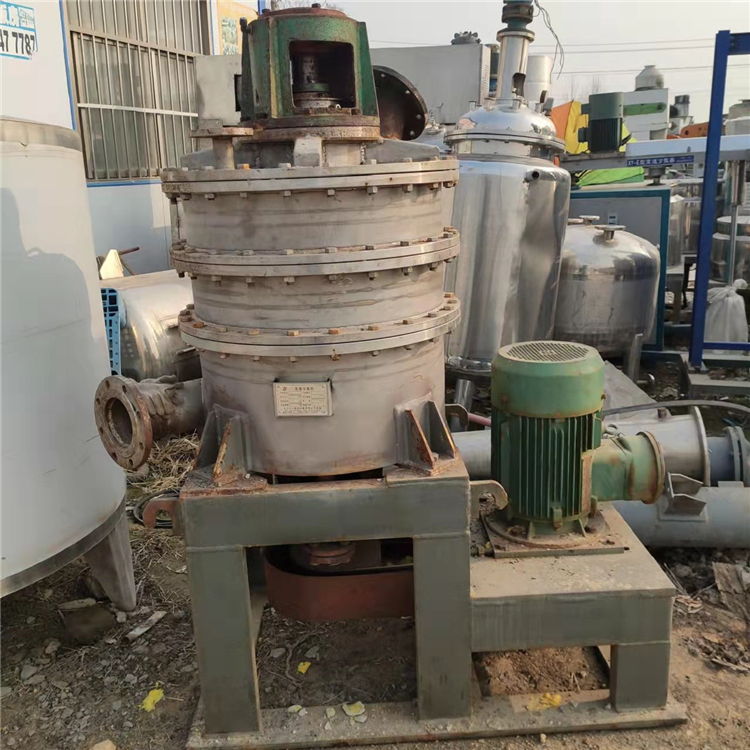


Features of the Flow-through Supergravity Bed: High mass transfer efficiency, compact equipment volume, short residence time, low liquid holding capacity, strong anti-clogging ability, easy operation and maintenance, safe and reliable. Suitable for processing valuable materials, heat-sensitive materials, high-viscosity materials, or toxic materials, and can be used in environments with limited height and size.
Separation operations of organic substances (such as distillation, stripping, or absorption, etc.) extensively employ packed towers and plate towers as tower equipment. Under the influence of gravity, the liquid phase contacts the countercurrent gas phase for mass transfer, achieving the purpose of separation and purification. In Earth's gravitational field, the liquid film in tower equipment flows slowly, resulting in a smaller gas-liquid contact surface area and relatively lower mass transfer efficiency, hence the equipment is large in volume, has low space utilization, and occupies a significant area. Supercritical gravity technology, developed in the 1980s, is a novel technique for enhancing gas-liquid mass transfer. Its working principle is to utilize the centrifugal force field generated by high-speed rotation, which is hundreds to thousands of times greater than normal gravity (referred to as supergravity field), to replace the conventional gravitational field. Under supergravity, the liquid disperses in extremely small droplets and filaments, significantly increasing the gas-liquid contact surface area. This, along with its microscopic mixing and rapid phase interface renewal, enhances the gas-liquid mass transfer process, reducing the required number of transfer units by one order of magnitude. This allows for the transformation of massive tower equipment into supercritical gravity machines less than 2 meters in height, achieving increased efficiency, reduced volume, and in some cases, a substantial decrease in energy consumption.