


Product Overview
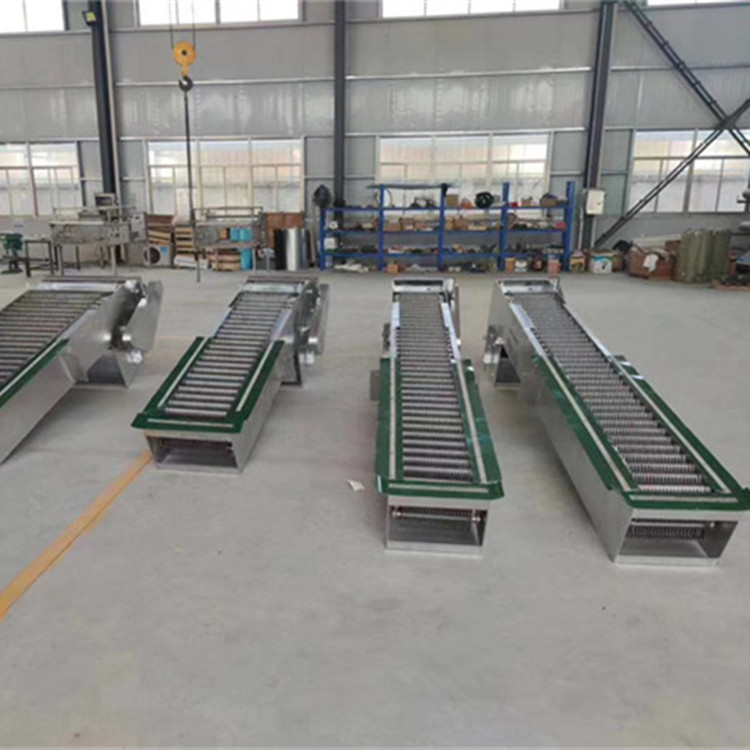
Grate cleaning machines are water treatment devices capable of continuously and automatically intercepting and removing variously shaped debris from fluids. They are widely applicable in urban sewage treatment, tap water industries, power plant intake, and can also serve as primary screening equipment in wastewater treatment processes for industries such as textiles, food processing, papermaking, and leather. They are among the currently applied solid-liquid separation equipment. The working principle of the rotary grate cleaning machine involves a set of rotating grate chains assembled with special rake teeth. Driven by a motor and reducer, the rake teeth chain rotates in the opposite direction to the water flow.
As the rake chain reaches the top of the equipment, it is guided by梅花 wheels and curved tracks, causing each rake tooth to have a relative self-cleaning movement. Most solid materials fall freely under gravity, while the remaining debris stuck on the rake teeth is cleaned off by the reverse movement of the sweeper.
Rake chain, similar to a grate, runs with the water flow direction. The gap between the teeth on the rake chain shaft can be selected according to operating conditions. After the rake separates solid suspended particles and floating matter from the fluid, the water can flow smoothly. The process can be continuous or intermittent.

Product Description
1. Before hoisting and installation, the grate cleaner should be checked to ensure that the positions and sizes of all pre-buried steel plates meet the equipment requirements.***
The side surfaces of the grid manhole should be perpendicular to the manhole plane, with the allowable deviation of perpendicularity not exceeding 20mm.
Grille wells should be parallel on both sides, with a maximum parallelism of 20mm.
The flat surfaces of the two pre-bolted steel plates with anchor feet should be level with the top platform of the grating well.
2. Since the depth of the channel was not provided during the manufacturing of this mechanism, after placing the格栅除污机 into the channel, adjusting the angle, position the bottom of the grille bracket on the base, and weld it to the frame of the grille machine. The installation angle must meet the design specifications. The installation levelness of the *** rake cleaner should be less than 1/1000mm, and then tighten the anchor bolts (if there is no pre-buried steel plate, expansion bolts can be used for fixation).
3. Release the tensioning chain wheel of the unloading area safety shield, remove the reducer end chain, power on for trial operation, check if the reducer's rotation direction matches the shoulder direction indicated on the safety shield. Reverse rotation is strictly prohibited.
4. Adjust the chain tension with the tension chain wheel and the tension bolt for the scraper chain.
5. Check if the lubricating oil of the reducer reaches the oil level line; if it's insufficient, add 46# mechanical oil to the oil level line. (Before the equipment's next operation, first add 46# engine oil to the reducer oil level line.)
(Well-lubricated upon arrival, with an annual replacement)
6. Secure the safety guard, connect the power, and run the machine unloaded. There should be no shaking, jamming, or abnormal noise. After running the unloaded test, proceed to load operation.

Structure and Working Principle
The格栅污垢清除机 is primarily composed of a drive unit, a rake mechanism, and a cleaning mechanism, assembled into a set of rotating grille chains with a special type of rake. Under the power of the motor reducer, the rake chain rotates in the opposite direction to the water flow.
As the rake chain reaches the top of the equipment, guided by the slot wheel and curved track, each set of rake teeth generates a relative self-cleaning motion. The majority of solid materials fall off due to gravity. The remaining debris stuck on the rake teeth is cleaned by the scraper's reverse movement.
Rake chain, similar to a grate, runs in the direction of water flow. The gap between the teeth on the rake chain shaft can be selected according to operating conditions. After the rake separates solid suspended particles from the fluid, water can flow smoothly through. The entire process can be continuous or intermittent.

Product Features
This equipment is highly automated, features efficient separation, low power consumption, noiseless operation, and excellent performance. It can work continuously and stably without supervision. It is equipped with overload safety protection devices, which trigger an audible and visual alarm and automatically shut down the equipment in case of a fault, preventing overloading.
The equipment can be adjusted to run at intervals as per user requirements, achieving periodic operation; it can automatically control based on the liquid level difference before and after the grate; and it also features manual control for ease of maintenance. Users can freely choose according to different working needs.
Due to the rational structural design of the equipment, it possesses a strong self-cleaning capability during operation, preventing clogging and resulting in minimal daily maintenance work.
Equipment specifications are divided into hp300-1500 models based on machine width. Machines with a width exceeding 1500mm are made into parallel machines. The gap sizes include 1mm, 3mm, 5mm, 10mm, 20mm, 30mm, 40mm, 50mm, and more, chosen based on flow rate, lifting height, total solid-liquid separation, and the shape and particle size of the separated material. Rake teeth can be made of ABS engineering plastic, nylon, or stainless steel according to customer requirements; the main frame is available in stainless steel and carbon steel with corrosion protection.
Installation and Debugging Instructions
1. Pre-installation Preparation
The grille cleaning machine should be checked for the positions and dimensions of all embedded steel plates before hoisting and installation, ensuring they ***.
A. The side surfaces of the grate well should be perpendicular to the plane of the grate well, with the allowable deviation in perpendicularity not exceeding 20mm.
B. The gratings on both sides of the manhole should be parallel, with a maximum parallelism of no more than 20mm.
C. The flat surfaces of the two pre-bolted steel plates with anchor feet should be level with the top platform of the grate well.
(2) Since the depth of the trench was not provided during the mechanism's fabrication, the grille cleaning machine is placed into the trench. After adjusting the angle, the bottom surface of the grille bracket is placed on the foundation, and the side is welded into position with the machine frame. The installation angle must meet the design requirements. The installation levelness of the rake cleaning machine should be less than 1/1000mm, and then the base bolts are tightened (if no pre-buried steel plate is available, expansion bolts can be used for fixation).
(3) Remove the safety cover from the unloading area, loosen the tensioning sprocket chain, take off the reducer end chain, power on for a test run, and check if the reducer's direction of rotation matches the shoulder direction shown on the safety cover. Reverse rotation is strictly prohibited.
(4) Adjust the chain tension with the tensioned chain wheel and the tension screw for the rake chain tension.
(5) Check if the lubricating oil of the reducer has reached the oil level line. If it's insufficient, add 46# mechanical oil to the oil level line. (Before the equipment's next operation, first add 46# engine oil to the reducer's oil level line.)
(Lubricant has been added to the unit, replaced annually)
(6) Secure the safety guard, connect the power, and operate under no-load. There should be no shaking, jamming, or abnormal noise. After the no-load test run, proceed to operate under load.
2. Common Faults and Troubleshooting Methods
(1) The motor is running normally, but the rake teeth are not functioning.
Fault Cause: Overload led to the cutoff of the overload safety pin.
Exclusion Methods:
Remove the safety shield to replace the overload safety pin.
(2) Determine the cause of equipment overload, primarily check if there is any debris jamming the rake chain.
(3) If debris is caught in the rake chain, clear the debris before starting the machine.
(4) Wear on the chain link bars of the rake chain requires replacement of the chain bars.
Replacement Steps:
(1) Secure the rake chain by inserting two iron bars.
(2) Remove the spring clip from the sprocket chain on the chain strip to be replaced using a spring clip pliers.
(3) Remove the pins from both tine chain links, replace them with new chain strip, reinsert the pins, and then install the clips in sequence.
(4) Simply install the inspection hole side panels.
3. Routine Maintenance and Care
During operation, if fibrous debris or the like gets tangled around the bars, it should be cleared promptly to prevent interference with the normal operation of the machine.
(2) During normal machine operation, calcium grease should be injected into each lubrication point using a grease gun every two months.
