


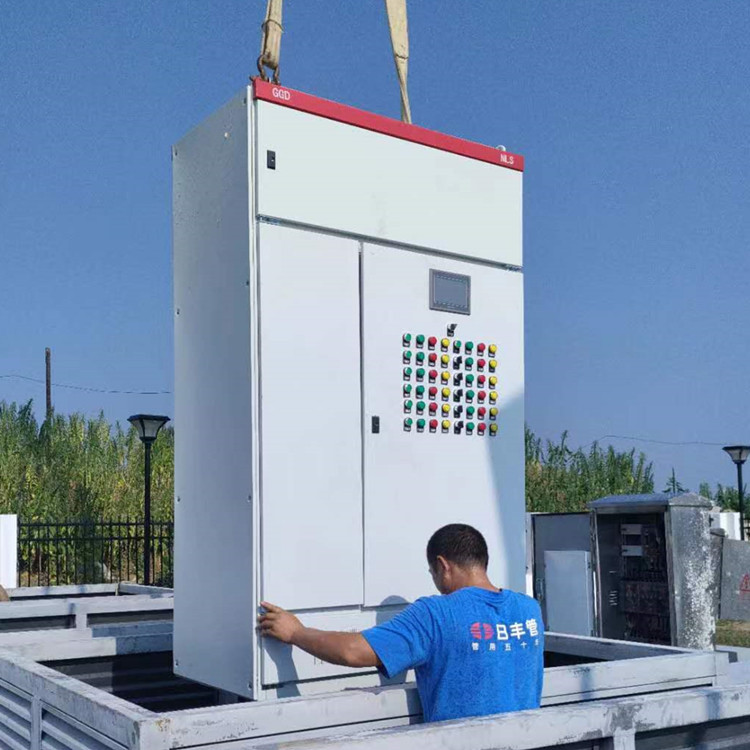


One,Product Description
Electrical control cabinets are assembled with switchgear, measuring instruments, protective devices, and auxiliary equipment according to electrical wiring requirements, either in enclosed or semi-enclosed metal cabinets or panels. Their layout should meet the requirements for the normal operation of the power system, facilitate maintenance, and not endanger the safety of personnel or surrounding equipment. This includes (distribution boards), (distribution boxes), and (electrical control cabinets), etc. During normal operation, circuits can be connected or disconnected manually or automatically. In case of faults or abnormal operation, protective devices are used to cut off the circuit or trigger an alarm. Measurement instruments can display various parameters during operation and can also adjust certain electrical parameters, providing warnings or signals for deviations from the normal operating state.

Two,Categorization of electrical control cabinets
1. Power Input Cabinet
Main power supply input line, equipped with a main circuit breaker in the main input cabinet.
2. Outgoing cabinet
Distribution system outgoing switch cabinets, equipped with lower-level electrical equipment.
3. Measurement cabinet:
A meter used to measure and record electricity supply, simply put, it's a money-collecting electricity meter. (It contains)PT, CT, and watt-hour meters.
4. Main power distribution cabinet
When the system has two power input lines and they serve as backups for each other, it is necessary to connect the main busbars of the two power sources. The switchgear that connects the two sections of the busbars is called a bus tie cabinet. Note: It is generally prohibited to close the bus tie cabinet and the two input line cabinets at the same time.
5. PT Container
Install metering devices and transformers.
6. Capacitor cabinet:
Capacitor cabinets typically connected to the main busbar of the system, used for centralized reactive power compensation, are usually installed in parallel with the incoming line cabinet (the system has...).PT cabinet, should be for high-voltage system; no PT cabinet for low-voltage system—the PT cabinet is akin to a step-down transformer, requiring only a low-voltage current transformer; however, capacitor cabinets are rarely used in high-voltage systems, as high-voltage capacitors are difficult to manufacture. It's more common to perform centralized compensation on the low-voltage side.
7. Contact Counter:
The function of the联络柜:
1. The联络柜is used for interconnecting several rows of low-voltage cabinets across multiple transformers. This means that if one transformer fails, another can be used to power the other rows of low-voltage cabinets.
2. Operationally, under normal conditions, the connections are disengaged, and the two transformers operate independently. In the event of a fault on one transformer, disconnect its main circuit switch and close the interconnection switch; its load power supply will be supported by the other transformer.
8. Ring Main Unit (Circuit Breaker Cabinet):
Ring main cabinet is a commonly used term, originally referring to load-breaking switch cabinets used for ring main supply, but now often used as a synonym for load-breaking switch cabinets, regardless of whether they are used for ring main supply.
9. Battery Cabinet
Comparable to a battery, stores power.
Battery cabinet available2 Functions:
①Serve as a backup power supply.
②As the main power source for the closing circuit, a very high current is required when the switch is closed. The rectifier circuit is unable to meet the needs of the closing coil. However, batteries possess the characteristic of allowing short-term high current discharge, which perfectly compensates for the shortcomings of the rectifier circuit, ensuring reliable operation of the closing loop.
10. Direct Current Screen (Charging Screen):
Convert AC power to DC.
Component: Charging Cabinet-Charging Module - Monitoring Module - Battery Pack
11. Variable Frequency Cabinet
Standard power cabinets or control cabinets are converted from traditional traction to variable frequency traction. In short: control cabinets that use variable frequency drives to power the traction units.
12. High-voltage switchgear
It refers to equipment used in power systems for generation, transmission, distribution, energy conversion, and consumption, which performs functions such as switching, control, or protection. High-voltage switchgear is categorized by the operating voltage level in3.6kV to 550kV electrical products, including high-voltage isolators and earthing switches, high-voltage load switches, high-voltage automatic reclosers and sectionalizers, high-voltage operating mechanisms, high-voltage explosion-proof distribution devices, and high-voltage switchgear cabinets, among other major categories.
13 Central cabinets:
Fully named Enclosed Metal-Clad Withdrawable Middle-Switching Equipment, it features a three-layer structure.
Upper Level: Busbar and Control Room
Intermediate Layer: Breaker Room
Lower Level: Cable Room
Due to the circuit breaker being located in the middle layer, it is referred to as an armored type withdrawable middle-mounted metal-enclosed switchgear, commonly known as a middle cabinet.
14. Power cabinet
A cabinet that provides power to rotating machines such as pumps and generators.

