

Summary: With the rapid development of the electric vehicle industry and the advancement of energy transformation, the construction and optimization of charging infrastructure have become a key driver for the popularization of new energy vehicles. This article first outlines the current situation and challenges of China's electric vehicle charging infrastructure, particularly the issue of uneven distribution of basic charging facilities and the intensifying contradiction between grid supply and demand. It then delves into the superiority and implementation strategies of combining orderly charging technology for charging stations with demand-side response of the distribution network. Taking the Ankeai charging station charging operation cloud platform as an example, it demonstrates the actual application in achieving orderly charging and demand-side response. Through intelligent orderly charging technology and demand-side response mechanisms, it can effectively balance grid load, improve the consumption rate of renewable energy, and at the same time, reduce the impact of electric vehicle charging on the grid. The article analyzes the potential advantages of combining both and proposes corresponding policy recommendations and technical paths, aiming to promote the orderly construction and development of charging infrastructure, ensure the convenience and efficiency of electric vehicle charging, and further promote the healthy development of the new energy vehicle industry.
Keywords: Electric Vehicles; Charging Poles; Scheduled Charging; Distribution Network; Demand-Side Response
Introduction
Electric vehicles have become a significant choice for green transportation, with their popularity on the rise. It is anticipated that by 2025, over 20 million electric vehicle charging infrastructure units will need to be constructed and developed. However, the construction and development of charging infrastructure still face numerous challenges, particularly the uneven distribution of basic charging facilities and the intensifying contradiction between electricity supply and demand in the power grid, which severely affects the convenience of electric vehicles and the user's charging experience. Therefore, researching the integration of orderly charging for charging stations with the demand-side response of the distribution network has become a vital approach to promote the orderly construction and development of charging infrastructure and to advance the popularization of new energy vehicles. This article takes Ankorui's charging station charging operation cloud platform as an example, discussing the feasibility and effectiveness of this strategy in practical application.
2. Current Status and Challenges of Electric Vehicle Charging Infrastructure
In recent years, the Chinese government has attached great importance to the construction of electric vehicle charging infrastructure, implementing a series of policy measures, including promoting intelligent and orderly charging technology and building a large number of charging stations. From January to May 2023, the national increase in charging infrastructure reached 1.147 million units, with the ratio of new public charging stations to private ones being 2.6:1, which is slower than the growth rate of existing infrastructure. As of the end of 2022, the number of public charging stations in China reached 1.797 million, up by 1.656 million from 2016, representing a growth of 1174.47%. Among them, DC charging stations and AC charging stations accounted for 42.35% and 57.65% of the total public charging stations, respectively, with 760,100 and 1,036,000 units. Additionally, it is predicted that by the end of 2023, China will add 975,000 public charging stations, bringing the total to 2.772 million. Meanwhile, the incremental increase in charging stations installed with vehicles will reach 3.4 million, raising the total to 6.812 million. However, despite the rapid growth in the number of charging stations, the issue of uneven distribution remains prominent. Particularly in remote areas or urban outskirts, the number of charging stations is severely insufficient, struggling to meet the charging needs of electric vehicles. Moreover, the impact of electric vehicle charging loads on the power grid cannot be overlooked, potentially causing fluctuations in grid load and imbalances in supply and demand. As energy transformation progresses and distributed energy develops rapidly, the operation and management of distribution networks face new challenges. It has become an urgent priority in China's power grid planning to enhance the power supply capacity of distribution networks to meet user demand, while reducing system peak-valley differences and load fluctuations, and alleviating power supply pressure.
3. Overview of有序充电Pile Technology
(1) Definition
有序充电桩 technology is a method that rationally controls and schedules the charging process of electric vehicles. It optimizes the distribution of charging loads for electric vehicles in terms of time and power, based on various factors such as the grid's operational status, user demands, and characteristics of charging facilities, to avoid the impact of a large number of electric vehicles charging simultaneously on the power grid, such as voltage fluctuations and overloads.
(II) Objective
Grid-side objective: Reduce the peak-valley difference in the distribution network, stabilize load fluctuations, enhance the reliability and quality of electricity supply in the grid, and ensure the safe and stable operation of the grid. By strategically scheduling charging times and power levels, alleviate the power supply pressure during peak hours and fully utilize the remaining capacity during off-peak periods.
User-Side Target: To meet the users' charging needs, we aim to provide economical and convenient charging services without disrupting their normal use of electric vehicles. For instance, based on the users' travel plans and battery status, we recommend suitable charging times and power levels to avoid extended waiting times for charging.
4. Analysis of the Demand-Side Response Mechanism for Power Distribution Networks
Demand-side response for the power distribution network refers to a mechanism that promotes the balance of supply and demand in the power grid by adjusting users' electricity consumption behavior. By implementing demand-side response, it can guide users to reduce electricity consumption during peak hours and increase it during off-peak hours, effectively alleviating the contradiction between supply and demand in the power grid, and improving the operation efficiency and stability of the power grid. In this context, introducing demand-side response strategies is particularly important. Demand-side response primarily motivates users to adjust their electricity consumption behavior to achieve peak shifting and valley filling, thereby enhancing the operational efficiency of the power system.
(1) Grid-side target
Peak Shaving and Valley Filling: Reducing the electricity load during peak hours of the distribution network, lowering the peak power demand of the grid, while increasing the load during off-peak hours to flatten the load curve. This helps alleviate the power supply pressure during peak hours, reduce the need for expansion of power generation and transmission equipment, and lower the construction and operation costs of the grid.
Enhancing Power Supply Reliability: By reasonably adjusting customer loads, we reduce risks of grid overload and voltage fluctuations, strengthening the distribution network's ability to handle emergencies (such as equipment failures, natural disasters, etc.), and improving power supply reliability and quality.
Enhancing Renewable Energy Consumption: As the proportion of distributed renewable energy sources (such as solar and wind) in the distribution network continues to rise, their intermittency and volatility present challenges to grid operations. Demand response mechanisms can guide users to increase electricity consumption during peak renewable energy generation periods, enhancing the utilization of renewable energy and promoting its effective consumption in the distribution network.
(II) User-Side Goals
Reduce Electricity Costs: By responding to price signals or incentives, users can adjust their electricity consumption behavior reasonably, choosing to use power during off-peak hours or receive economic compensation accordingly, thereby reducing their electricity expenses.
Enhancing Electricity Comfort and Flexibility: Under the premise of meeting basic electricity needs, users can flexibly schedule the usage of their electrical appliances based on their own circumstances and incentives, thereby increasing autonomy and comfort in electricity consumption. For instance, users can schedule non-urgent electricity tasks (such as washing clothes in a washing machine, charging electric vehicles, etc.) during off-peak hours or when receiving incentive signals.
5. The uniqueness of combining orderly charging of electric vehicle charging stations with demand-side response of the distribution network
(1) Optimizing the Utilization Efficiency of Charging Facilities
Smart charging for EV charging stations can be arranged in a way that aligns with grid load conditions and user demands, optimizing the timing and power of electric vehicle charging. When combined with demand-side response of the distribution network, the utilization efficiency of charging facilities can be further enhanced. For instance, during off-peak grid load periods, price incentives or control strategies can guide EV charging to avoid peak-hour congestion, thereby increasing the utilization rate of charging stations and reducing idle time.
(II) Alleviating the Pressure on the Distribution Network
Massive, disordered charging of electric vehicles could pose significant stress on the distribution network, leading to issues like voltage fluctuations and overloads. Combining orderly charging with demand-side response can effectively alleviate this pressure. Through demand-side response mechanisms, the distribution network can adjust the charging power of charging stations in real-time, aligning it with the grid's power supply capacity, ensuring the safe and stable operation of the distribution network.
(3) Facilitating the Green and Low-Carbon Transformation of Energy
This synergy is conducive to fully utilizing renewable energy sources. For instance, when there is a surplus of renewable energy generation, such as from photovoltaic and wind power, in the distribution network, an orderly charging strategy can guide electric vehicles to charge during peak renewable energy generation periods, increasing the consumption of renewable energy and reducing reliance on traditional fossil fuels, thereby promoting a green and low-carbon energy transformation.
Enhancing User Charging Experience
By combining有序 charging with demand-side response, we can offer users a more convenient and rapid charging service. For instance, based on users' charging needs and grid conditions, we introduce them to the optimal charging time and location, avoiding prolonged waiting times or difficulties in finding available charging stations, thereby enhancing user satisfaction.
AnkeRui Charging Station Cloud Platform Facilitates Orderly Charging Operations
6.1 Overview
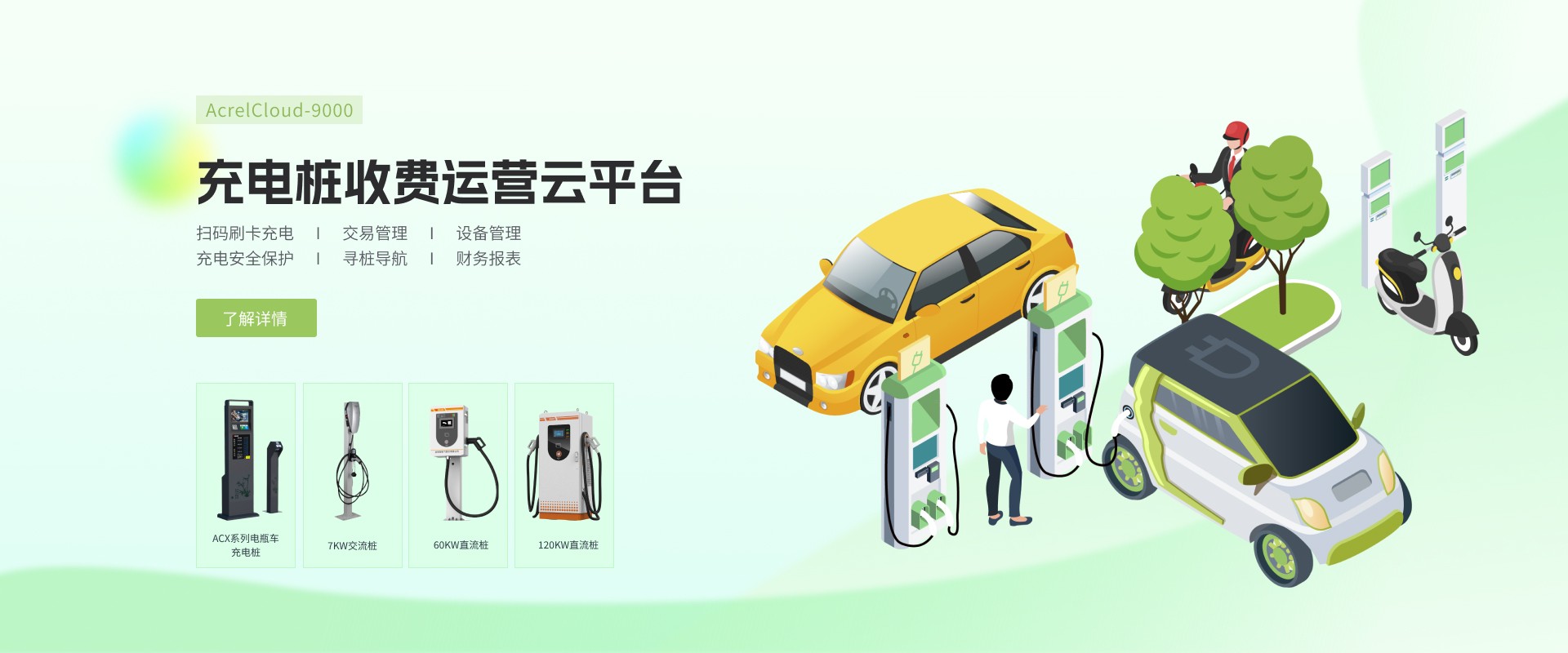
The AcrelCloud-9000 Ankorai Charging Pole Charging Operation Cloud Platform System continuously collects and monitors data from electric bicycle charging stations connected to the system using IoT technology. It provides real-time monitoring of charging桩 operation status, handles charging services, payment management, transaction settlements, resource management, power management, and detailed inquiries. Additionally, it issues early warnings for various faults such as overheating protection, leakage, input/output overvoltage, undervoltage, and insulation failure in charging machines. The charging桩 supports internet access via Ethernet, 4G, or WIFI, and users can charge via WeChat, Alipay, or UnionPay Scan-to-Pay.
6.2 Application Venue
Design of charging infrastructure for civil buildings, general industrial buildings, residential communities, industrial units, commercial complexes, schools, parks, and other similar facilities.
The system is divided into four layers:
1) The data collection layer, network transmission layer, data layer, and client layer.
2) Data Collection Layer: Utilizes the Modbus-RTU communication protocol as the standard for electric bike intelligent charging桩. The electric bike intelligent charging桩 is used to collect power parameters of the charging circuit and perform electricity metering and protection.
3) Network Transmission Layer: Upload data to the established database server via 4G network.
4) Data Layer: Consists of application servers and data servers, with application servers hosting data collection services and the WEB website, and data servers deploying real-time databases, historical databases, and basic databases.
5) For client-side access: System administrators can access the electric bike charging station billing platform via a web browser. End-users initiate charging by swiping or scanning their cards.
The community charging platform mainly covers functions such as intelligent large screens for charging facilities, real-time monitoring, transaction management, fault management, statistical analysis, and basic data management. It also provides an operation and maintenance app for maintenance staff and a charging mini-program for charging users.
6.4 AnkoRi Charging Station Cloud Platform System Function
6.4.1 Intelligent Large Screen
The intelligent large-screen display showcases the distribution of stations, providing statistics on equipment status, usage rate, charging times, charging duration, charging amount, charging capacity, and charging station faults. It also allows for viewing station information, charger list, charging records, revenue, energy consumption, and fault records for each station. It centrally manages community charging stations, monitors equipment usage rates, and allocates resources efficiently.
6.4.2 Real-time Monitoring
Real-time monitoring of the operation status of charging facilities, including the operational status of charging stations, circuit status, charging power and voltage during the charging process, as well as alarm information from charging stations.
6.4.3 Transaction Management
Platform administrators can manage the charging user accounts, performing operations such as account top-up, refunds, freezing, and cancellation. They can also view detailed daily charging transaction information for community users.
6.4.4 Fault Management
Equipment automatically reports fault information. Platform administrators can view and dispatch fault notifications through the platform. At the same time, maintenance staff can receive fault alerts via the maintenance app, and report the results after completing the maintenance work. Charging users can also report on-site issues through the charging mini-program.
6.4.5 Statistical Analysis
Through the system platform, access charging transaction statistics and energy consumption statistics from various perspectives, including charging stations, facilities, time, and methods.
6.4.6 Basic Data Management
Operators can establish and manage user accounts on the system platform, build and manage the sites and charging facilities required for their operations, maintain charging facility information, pricing strategies, discounts, and promotional activities, while also managing online card user top-ups, freezes, and unbindings.
6.4.7 Operations APP
For use by operations personnel, it allows for the management of sites and charging stations, facilitates fault closure processing, checks usage of traffic cards, and inquires about charging and recharge status. It also enables remote parameter settings and can receive fault notifications.
6.4.8 Charging Mini-App
For electric vehicle users, the app allows for viewing nearby available charging stations, and features include scanning to charge, account top-up, charging card binding, transaction inquiries, and fault complaints.
Conclusions and Outlook
The integration of orderly charging for charging stations with demand-side response of the power distribution network is a crucial approach to promote the orderly construction and development of charging infrastructure and accelerate the popularization of new energy vehicles. By implementing this strategy, we can effectively balance the grid load, increase the utilization rate of renewable energy, reduce the impact of electric vehicle charging on the grid, and guide users to adjust their electricity consumption behavior, thereby promoting a balanced power supply and demand in the grid. Ankorree's charging station charging and operation cloud platform, as an important tool for achieving this strategy, has achieved remarkable results in practical application. In the future, we should continue to strengthen policy guidance and technological research and development to promote the wider application and promotion of this strategy. At the same time, enhance the coordinated planning and construction of charging facilities and the grid, improve the intelligent management level of charging facilities, and provide a more solid support for the healthy development of the new energy vehicle industry.
Reference:
Chen Qiyuan, Zhang Qiang, Ouyuan, et al. Analysis of the Superiority of Integrating有序充电 for Charging Piles with Demand-Side Response of the Distribution Network
Li Haibin. Research on the Orderly Charging Strategy of Electric Vehicles Based on Demand Response, 2021.
Ankorree Enterprise Microgrid Design and Application Manual. 2022.05 Edition
