



Summary: Data collection, monitoring, and management are conducted for equipment such as power distribution, environmental temperature and humidity, network devices, and LPS power supplies in the machine room of the municipal meteorological center. A comprehensive information management platform based on the BS architecture is constructed on the equipment foundation, which achieves various functions including on-site data collection, fault alarms, real-time data publishing in WEB mode, and conversion of various communication protocols.
Keywords: Ethernet: GSM: LPS: B/S Architecture
0. Introduction
The comprehensive monitoring and management system for the central network room of Nantong Municipal Meteorological Bureau is in place to ensure the normal transmission of meteorological data and the stable operation of meteorological business systems.
1. Introduction to System-Related Technologies
TCP/IP network communication in Ethernet compared to RS-232 serial communication and RS-485 bus communication offers greater communication distance and stable quality. The network is designed for complex environments and features automatic error correction. The serial-to-Ethernet function can be achieved using a serial-to-Ethernet module, but this technology is not just a change in transmission medium; it involves a protocol conversion from serial to TCP/IP. Key technologies include TCP/IP operation modes, serial framing techniques, and 9-bit technology. This article delves into the detailed analysis of these serial-to-network conversion technologies.
1.1 Key Technology of Serial to Ethernet Conversion: Issues with the TP/IP Operation Mode
Serial to Ethernet conversion is not merely a transformation at the physical and data link layers. Since the serial protocol itself lacks the network and transport layers, this conversion essentially treats the serial data as application layer data of TCP/IP and transmits it using the encapsulation method of TCP/IP.
1.2 Key Technology Two: Serial Port Frame Splitting Technique
Serial data can be sent continuously, whereas Ethernet data is sent in packets. Therefore, to address the issue of data transmission matching during conversion, users can use the packet length as the basis for framing: an Ethernet packet is typically over 1500 bytes long, and can be packaged and sent when the serial-to-Ethernet converter receives 1500 bytes or less. Another method for serial framing is through packet intervals: when the converter detects a T millisecond idle time in the serial data stream, it sends the previously received serial data as an Ethernet packet.
1.3 Key Technology 3: 9-bit Technology
Ethernet data is transmitted in bytes (8 bits), but serial data may include a 9th bit, so serial data cannot be directly converted into TCP/IP application layer data transparently. The Realcom protocol packages the serial data and transmits it as a whole TCP/IP application data. This allows for the inclusion of information in the Pealcom protocol header indicating whether the 9th bit of the data packet is a 1 or a 0, thereby achieving 9-bit transmission technology.
The system utilizes two SNS-2 protocol converters (RS232 to TCP/IP), which feature simple connection and configuration methods. Simply direct the CM port to an IP address. The specific configuration steps are as follows: connect it to a PC via a serial port, then click on 'Run' in the start menu, type 'CND' and hit 'OK'. In the DS window, enter the command: 'arp s?P address><MC address>', where 'IP' is the IP address to be assigned to the protocol converter, and 'MC address' is the MC address of the protocol converter itself. After configuration, telnet to the IP address, press Enter to enter the parameter setting mode as shown in Figure 1.
Enter the corresponding number to set various parameters, such as entering 0 for server settings, where you need to set parameters like IP address, gateway address, subnet mask, etc. After entering *, press 9 to save and exit.
2. Overall System Architecture
Network Equipment Room Monitoring System Must Achieve Indoor Temperature and Humidity, Water Leakage, Smoke, Voltage, and Current MonitoringUPS monitoring is in place, with fault alerts sent via SMS, and all data is transmitted through internal network resources. The monitoring center's management platform is based on a distributed Web-Based (WB) Browser-Side (BS) architecture, allowing managers to easily access and understand the actual working conditions of the data center at any time and from anywhere, achieving integrated control and management. Data center staff can directly monitor various conditions within the facility through a web browser. The overall system structure is illustrated in Figure 2.

Figure 2: System Overall Structure Diagram
2.1 Hardware Component
The system hardware utilizes a network data collection unit, complemented by temperature and humidity transmitters, leak detection sensors, PX6 electricity meters, intelligent protocol converters, CM SMS alarm units, and data servers, among other associated equipment. The data transmission section employs RW(4*0.3) signal cables, Cat5e network cables, etc., to ensure reliable and stable data transmission. The main functions include:
(1) Data Collection Machines: The system is equipped with 3 network data collection machines, each paired with a sensor adapter. These sensor adapters supply D2V voltage to all sensors and simultaneously redirect the output signals of each sensor (including switch signals' on/off or analog signals) to interfaces that match the data collector's I/O.
(2) Temperature and Humidity Sensors: Utilizing 12 temperature and humidity sensors, 9 are employed to monitor the conditions at various locations within the server room, while the remaining 3 are dedicated to monitoring the temperature and humidity of the UPS, UPS distribution cabinet, and municipal power distribution cabinet.
(3) Water-Immersion Smoke Sensor: The water immersion adapter (including a 20-meter detection cable) is used to detect leaks in the precision air conditioning of the server room, while the smoke sensor is used to detect fires in the server room. Both sensors are powered by 12V DC, and this system selects normally open sensors with a dry contact output. The circuit is open during an alarm and shorted during an emergency.
(4) Smart Power Meter: Utilizes two PX61 units, installed internally within the data center UPS distribution panel power meter and the municipal power distribution panel power meter. It measures parameters such as three-phase voltage, current output, frequency, power factor, active power, reactive power, apparent power, and energy, and communicates with the host computer via the RS485 communication interface converted to an Ethernet port.
(5) Protocol Converter: Utilizing two SNS-2 protocol converters (RS232 to KP/IP), it is designed for protocol conversion of serial port devices compliant with the RS232 standard, such as US, precision air conditioners, and distribution cabinets. This converts 232/485 signals into TCP/IP format for transmission, enabling remote control of the devices.
(6) The CM SMS Alarm Device: It is designed to transmit UPS and precision air conditioning alarm information received by the protocol converter to designated CSM cards. With an integrated CBM module, users simply need to configure the mobile phone numbers that should receive warning SMS messages into the Ethernet, and they can then receive the warning information sent from the internal CSM card.
2.2 Network Planning
The on-site network environment is the meteorological bureau's internal network, with all system equipment connected to the central data server via Ethernet ports. The IP address planning for each hardware device is as follows:
(1) Data Server IP: 10.125.194.200
(2) Data Collection Device 1 IP: 10.125.194.201
Data Collection Machine 2 IP: 10.125.194.202
Data Collection Machine 3IP: 10.125.194.203
(5) UPS Protocol Converter IP: 10.125.194.204
(6) Precision Air Conditioning Protocol Converter IP: I10.125.194.205
(7) CSM SMS Alarm Device IP: 10.125.194.206
2.3 System Software
The central management software is designed using the standard VB software framework, utilizing the Iranevork.NET2.0 platform and L data protocol format. It receives and processes alarm information from various devices. Duty personnel manage the collected data and handle, analyze, process, and validate it through the SERMCE backend service model. This ensures timely and accurate analysis of alarm information, providing maintenance departments with daily maintenance reports, performance status statistics, and other analytical data. The software is easy to install, use, and maintain, with a stable system operation that guarantees data reliability. The structural diagram of the software is shown in Figure 3.

Figure 3: System Software Functional Block Diagram
The network equipment monitoring and management software platform operates on Windows XP/2003 operating systems and supports various interfaces and protocols including RS232, RS485, RS422, TCP/IP, SMP, CPC, etc. Specific functions of each module are as follows:
(1) User Management: The system categorizes operators into multiple levels of operational permissions, allowing those with control authority to send control commands to monitored objects. The hierarchy of permissions can be arbitrarily defined by administrators.
(2) Data Management: Data management encompasses both real-time and historical data. The system is capable of monitoring the real-time status and parameters of relevant equipment, with real-time data stored in the database for easy retrieval, statistics, printing, and dynamic trend chart generation. Historical data cannot be modified.
(3) System Security: In the event of certain malfunctions or improper/abnormal system operations that lead to system downtime or crashes, the system will automatically restart the monitoring system on the host operating system, ensuring smooth operation and enhancing its stability and security.
(4) Alarm Management: By comparing relevant collected data with predefined values in the database, the system generates an alarm when the real-time collected data exceeds the set values. The alarm data is then categorized and grouped, enabling the alarm management function. Alerts are sent to the user's mobile phone via the CSM early warning machine.
(5) Remote Management: The system utilizes a BS architecture, enabling remote monitoring through a local area network in a web-based manner, with the monitored objects providing the same effect as the monitoring center. Users can view real-time on-site information via a VB browser, and can perform browsing, querying, and control operations based on their permissions.
(6) Reporting Management: The system generates various reports for managing saved historical data, operation logs, and event logs, with printing capabilities. All alarm records can be exported into Word or Excel documents.
(7) Online Maintenance: The system supports real-time modifications and maintenance while in operation. During this time, the system's normal equipment sampling, data storage, and alarm functions should remain unaffected.
(8) Scalability: The monitoring system should be designed in a modular manner, with standardized information ports and system module interfaces, allowing for customized function development to meet user requirements.
3. System Operation Testing
The system design is complete and has been successfully implemented. Users can remotely view the system's operational status and the connection status of devices with the data server through the system management software. The software for all collected real-time data features built-in data analysis capabilities, allowing users to view the maximum and minimum values within a specific time period. If the maximum or minimum values exceed the user-defined range, the software can trigger an alarm and send the alert information to the user's phone via the CSM module. The following image shows an alarm message issued by an UPS during a municipal power switch project, received by the phone through an SM card.
4. Introduction and Selection of Ankerui Distribution Room Environmental Monitoring System
4.1 Overview
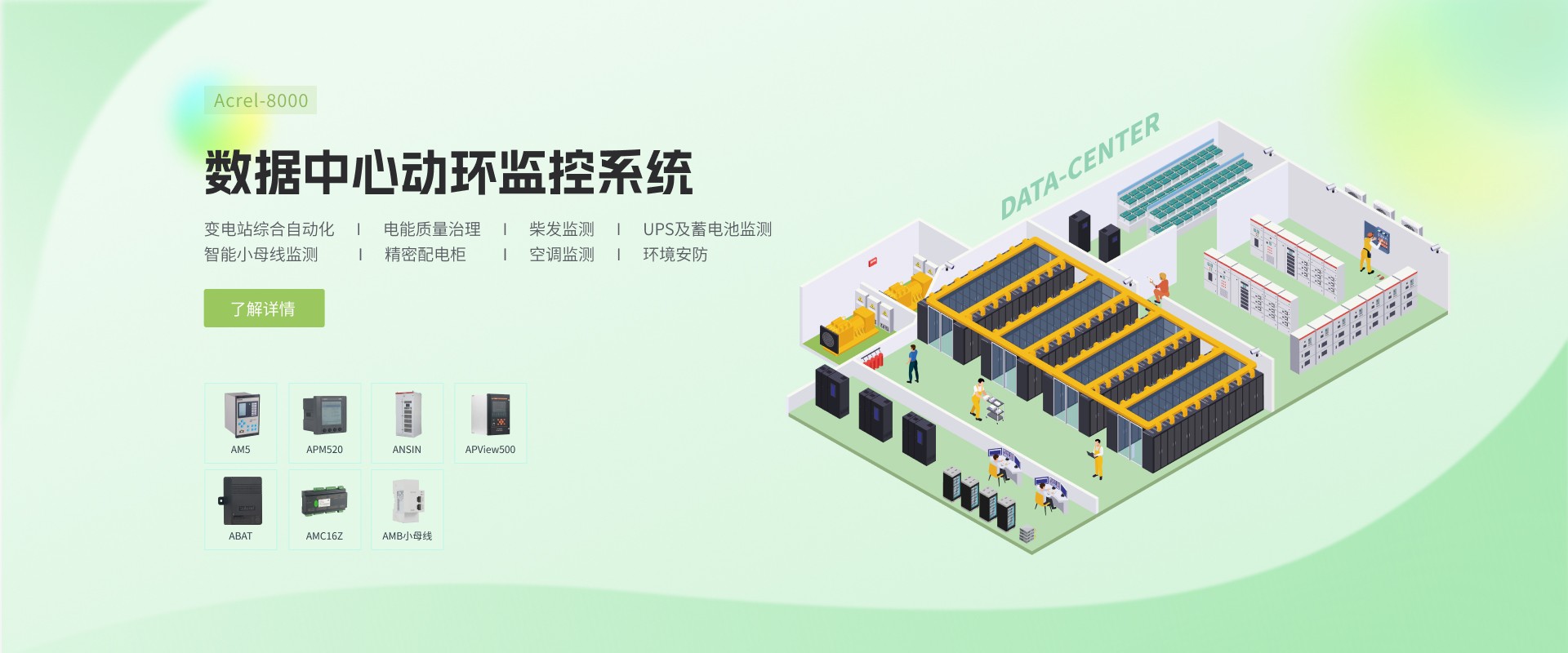
The integrated power distribution room monitoring system includes an intelligent monitoring screen, communication management unit, UPS power supply, video monitoring subsystem (pan-tilt dome cameras, bullet cameras), environmental monitoring subsystem (temperature, humidity, water leakage, smoke detection), control subsystem (lights, air conditioning, dehumidifiers, fans, water pumps), access control monitoring subsystem (card readers, door open buttons, magnetic locks), and security monitoring subsystem (dual-sensing detectors).
4.2 System Structure

4.3 System Features
3.4.1 Real-time Monitoring
The system can display the operational status of distribution room equipment, monitor real-time environmental parameters of the distribution room, and display real-time fault and alarm information.
4.3.2 Data Query
In the human-machine interface, operation data of various equipment in the power distribution room can be directly viewed.
4.3.3 Curve Query
You can directly view the curves of various electrical parameters.
4.3.4 Operational Reports
Review the operational data reports for the equipment within the electrical room.
3.4.5 Real-time Alerts
The system features real-time alerting capabilities, enabling it to issue warnings for events such as distribution room temperature, humidity, harmful gases, equipment failures, or communication issues.
4.3.6 Historical Event Inquiry
The company's news: The system is capable of storing and managing all generated event logs, facilitating users in tracing historical events, conducting queries and statistics, and analyzing incidents.
4.3.7 User Permission Management
We have implemented a user permission management feature, allowing for the definition of login names, passwords, and operational permissions for users of different levels.
3.8 Network Topology Diagram
Supports real-time monitoring and diagnosis of communication status for all devices, providing a complete display of the entire system's network structure.
3.9 Remote Control Feature
Remote control operations can be performed on equipment within the entire distribution system range.
5. Conclusion
The construction of an Ethernet-based meteorological network machine room environmental monitoring system allows network administrators to remotely view the operation status of instruments such as temperature and humidity, UPS, precision air conditioning, and power distribution equipment, simply by accessing a fixed internal IP address from their office. This eliminates the need for on-site presence, thereby sparing network staff from government department visits. After three months of operation testing, the system has performed well.
Reference:
Cheng Xiulan. Discussion on the Design of Electronic Governance Cybersecurity System[J]. Electronic World, 2012(5): 33-34
Zhang Xiaolei, Ge Lei, Ma Asia. Implementation of Real-Time Data Communication Based on PC04[J]. Electronic World, 2012(5): 32-33
Bao Leilei, Huang Liang, Wu Xinming, Wu Jiawei, Miao Mingrong. Monitoring System for Meteorological Network Room Based on Ethernet.
[4] 2022.05 Edition: Handbook for Microgrid Design and Application
