

This design utilizes the KeiluVision2 microcontroller debugging software, and the microcomputer's management database is developed using SQL Server 2000. After several software modifications and circuit adjustments, the project has been successfully tested. The electricity meter now meets the expected functions of the design, including reading and writing multiple user RF cards, communication with the host, electricity measurement, display, and storage.
1 Pre-Paid Remote Power Management System Structure
The pre-paid remote power management system utilizes Ankoray's intelligent management software, communicating with smart electricity meters via communication devices installed by users, enabling meter reading, control, and management of multi-user smart electricity meters. The composition structure is as shown in Figure 2:

Figure 7: Pre-paid Remote Power Management System Structure Diagram
1.1 Management
The management layer serves as the upper part of the system. It analyzes, calculates, and processes various data collected from the field, presenting the final conclusions in graphical, auditory, and other forms, enabling managers to keep abreast of the on-site operations at any time. It primarily includes system software and the associated hardware facilities, such as servers and radio frequency card readers.
1.2 Communication Layer
The communications management team serves as the bridge for inter-system data transmission, primarily responsible for centrally processing all instrument information on the 485 bus, accomplishing remote meter reading and data upload functions, as well as handling various remote control execution commands on the server side. Key equipment includes communication adapters, network adapters, and IoT modules.
1.3 Equipment Layer
The equipment layer serves as the foundation for data measurement and is a necessary element in system construction. It primarily includes various smart meters used for measuring electricity consumption within the system network.
2. Key Features of Pre-Paid Remote Power Management System Technology
The smart network electricity meters are manufactured using international ultra-large-scale integrated circuits and SMT technology, featuring high integration, compact size, low power consumption, and high accuracy.
The system employs lightning protection circuits for network communication, isolates high-voltage and low-voltage circuits with galvanized shielding plates, and separates communication circuits from other circuits, enhancing its anti-interference capability.
The smart network electricity meter employs a multi-CPU architecture, with one CPU responsible for metering, another for communication, display, and indication, and a third for status detection. Each CPU operates independently, without affecting one another.
Overload Protection (Current Limiting) Feature: When the load used by the user exceeds the specified limit, the system will activate overload protection and automatically cut off power supply to the user's equipment.
Control Function: The system allows for remote power on/off control for users; Power Off Auto-Recovery Feature: Within the specified number of power-off events, after the user triggers overload protection, the system will automatically restore power once the load drops to an allowable range; The system can be set for single-phase and three-phase connections based on actual needs, but cannot exceed the number of configured circuits on the meter.
Data Security: The system employs encryption algorithms to encrypt all data, ensuring information security.
3 Key Features of Pre-paid Remote Power Management System
This system utilizes the DD/TSY1352 intelligent electricity meter, which boasts exceptional features such as compact size, high accuracy, and robust management capabilities. It enables precise management of users' electricity consumption, including pre-paid services, identification of harmful loads, scheduled power on/off, electricity price adjustments, real-time monitoring of user consumption status, online control, overdraft usage, and data statistics and analysis. It effectively monitors and manages the energy consumption and real-time energy usage of the project.
Our products offer remote transmission and control, saving labor and enabling powerful management functions. They can easily form networks through various methods, such as RS485 dedicated lines, telephone networks, Ethernet, fiber optics, wireless, and GPRS. After setting up the network, only one person is needed to monitor and manage the electricity usage of all users via a computer, eliminating the need for a large number of staff to manually read meters or sell electricity on-site. This saves a significant amount of labor and energy, making it particularly suitable for electricity management in large commercial buildings and office towers with numerous users.
The system features分级authorization capabilities, with each software operator having their own account and permissions, ensuring accountability and enhancing work efficiency. The system automatically logs all actions performed by each operator after login, preventing staff from cheating.
The system employs a cardless electricity selling method, where the electricity purchased by users is directly credited to their electricity meters, eliminating the need to return and insert cards after buying power. This offers convenience; electricity is treated purely as a commodity, allowing for purchase and return, bulk sales, presetting, resetting, and printing of invoices.
The system features intelligent power management capabilities, allowing for online control of power on/off for individual rooms or the entire building, facilitating emergency responses or equipment maintenance; it also limits the maximum load each user can consume, ensuring the stability of the main power grid supply.
The system features a malicious load identification function. It defines appliances like fast-heating devices, electric kettles, and hair dryers, which are prone to fire hazards, as malicious loads. It can automatically identify such loads and either prohibit or allow their use. The system identifies load types through various parameters with high accuracy and can detect products like smart plugs on the market that alter the electrical characteristics of malicious loads, preventing users from utilizing these loads via smart plugs.
The system features a scheduling function, allowing for the setting of eight time slots each day to automatically execute power-on or power-off operations. This facilitates merchants' electricity management and eliminates the cumbersome task of manually flipping each switch.
The system features multiple circuit metering and branch management within the same room. Lighting, power outlets, air conditioning, etc., can each have a dedicated circuit, allowing for independent on/off control and management settings for each circuit, with unified billing.
The system allows for real-time monitoring of users' electricity usage status, power outages, and records, including the current working status and power, power factor, and the time and reasons for the last 10 power outages. This facilitates management in real-time oversight of users' electricity consumption and enables users to easily retrieve records when they have questions about their electricity usage.
The system features a low-battery alarm function. When the user's battery level falls below the warning threshold, the meter display window will flash continuously, and the user can opt to shut off power for one minute to trigger the alarm. Operators can also print out reports and post them to remind users to purchase electricity. If the project is equipped with auxiliary devices such as SMS or voice modules, LCD query terminals, and LED large screens, automatic alarms can be triggered through these devices, such as sending low-battery reminder SMS to customers.
The system features statistical query capabilities, allowing for the analysis of all management operations and users' electricity consumption data. The system automatically calculates and generates reports, such as sales records and electricity consumption logs, providing management with a clear and comprehensive basis for decision-making. It enables real-time monitoring of electricity expenses and facilitates timely adjustments to electricity usage strategies.
The system is equipped with comprehensive energy management functions for water, electricity, gas, and heating; through a single system and corresponding base tables, it can manage the entire project's energy consumption, such as electricity and water usage; the system also features card-based management, with each user assigned a contactless card (compatible with...).
Other manufacturers' all-in-one cards), you can check your electricity usage information at any time through the card, and it can also perform emergency functions such as purchasing electricity and restoring power supply when communication networks are down.
The product adopts standard interfaces and communication protocols, enabling data sharing with other systems like access cards, fire safety, access control, building automation, and finance through RS485 interfaces, interactive databases, or TCP/IP interfaces. This facilitates comprehensive group management, highlighting the intelligence and integration of management. Group departments can collectively manage the group's electricity usage via the interconnected network. Anywhere there's an internet signal, authorized accounts can access the energy consumption management system for management.
Anko Acrelcloud-3200 Pre-Paid Water and Electricity Cloud Platform Solution
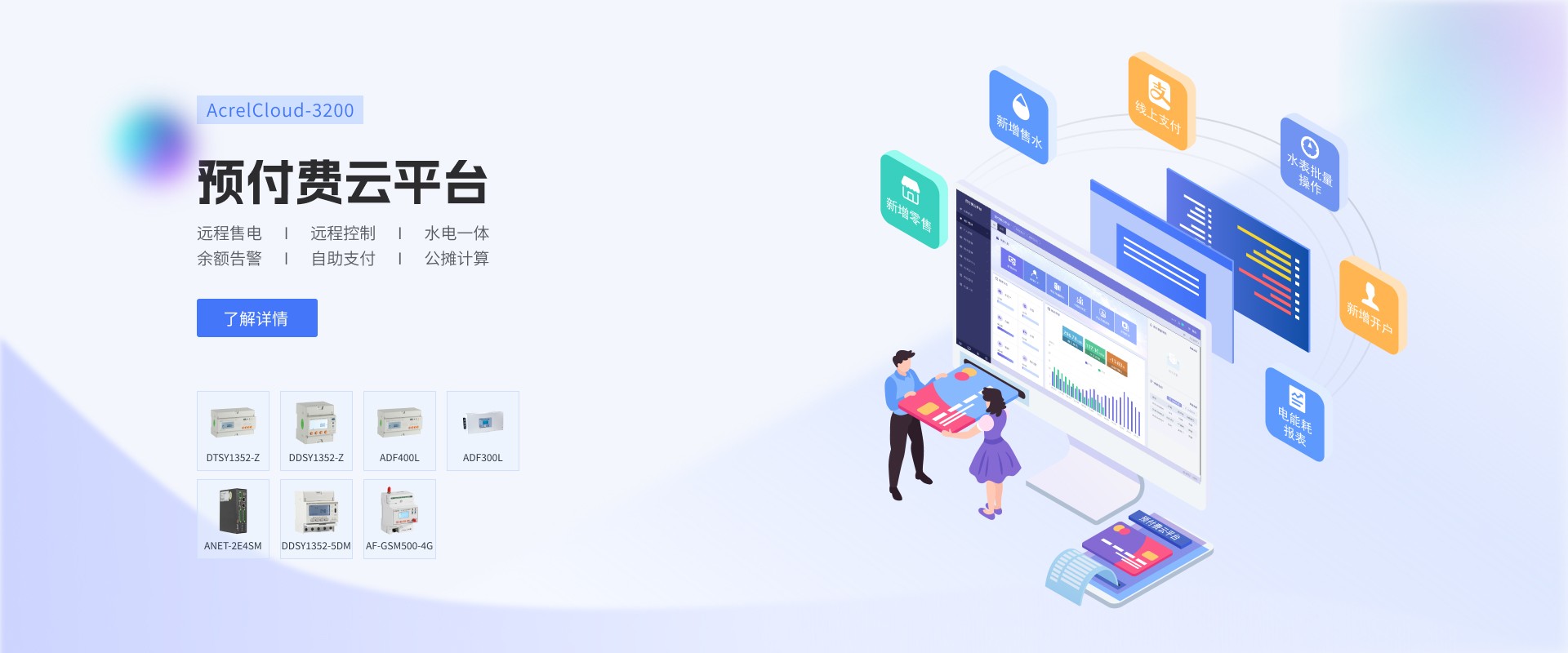
The AcrelCloud-3200 Pre-paid Electricity and Water Cloud Platform is a sales management system developed by Ankorui Company, designed to be paired with the DDSY-1352 Single-phase Electronic Pre-paid Energy Meter and the DTSY-1352 Three-phase Electronic Pre-paid Energy Meter. It also offers optional remote transmission of valve-controlled water meters to form an integrated pre-paid electricity and water system, achieving the goal of paying before using water, with the valve automatically closing when the remaining water is depleted. It primarily handles the parameter settings for energy meters/water meters, merchant electricity/water sales management, and energy consumption management. The system is easy to operate, enabling property management companies to remotely operate and monitor in real-time, featuring a user-friendly interface and effective data statistics and management. It is easy to install and is an ideal product for power and water management departments, commercial plazas, and property communities to improve the management of electricity and water usage and solve the problem of difficult billing.
4.1 Application Locations
This platform is suitable for apartment renters, shopping malls, apartment hotels, property communities, office buildings, logistics warehouses, universities, chain supermarkets, smart parks, and farmers' markets, among other venues.
4.2 System Structure

4.3 System Features
3.4.1 Room Surveillance
Our system provides a clear and concise display of all room status information, including the building and floor, online disconnection status, and billing status. Accessing room details allows you to view real-time information and understand the daily electricity consumption and usage costs. Various remote control operations for the room's electricity meters are available, such as account opening, electricity price settings, electricity sales and returns, alarm amount settings, and switch operations, among others.
3.4.2 Electrical Meter Installation
The system supports both single-account, single-meter setup and the need for multiple meters under one account; it allows for customizable electricity pricing plans, including single rate, peak-off-peak pricing, and tiered pricing. It enables pre-setting account information for one-click account opening later; it supports setting default tier 3 alerts for meter total amount, with customizable alert amounts and frequencies. Push notification methods include SMS, APP notifications, emails, voice calls, and WeChat public account messages.
3.4.3 Charging and Payment
Remote top-ups are available for meters that have already been activated, with electricity fees being real-time distributed to the meters. The meters deduct electricity costs in real-time based on the electricity consumption, and the system also supports early billing, with the amount being distributed to the system account for quick and stable settlement.
4.3.4 Financial Management
Order Overview includes all water and electricity top-up and refund records in the system, as well as property fee deduction records. Revenue Summary allows for the statistics of water and electricity income and its composition across various dimensions such as daily, monthly, yearly, and time span.
4.3.5 Report
The system also offers multiple reports for inquiry. The Comprehensive Power Consumption Report assists in financial statistics by tracking the total power consumption of shops each month, peak/off-peak power consumption, electricity bills, and year-on-year energy consumption analysis, which allows for a comparison of energy consumption gaps between each month and the same period last year. The Energy Consumption Daily, Monthly, and Annual Reports query the energy consumption of each meter stage from three different dimensions: daily, monthly, and annually.
4.3.6 Batch Operations
To facilitate user management and configuration of a large number of meters, you can create batch operation tasks in the system, such as setting electricity prices, meter control, instrument settings, and recharging. Batch tasks can be executed immediately or scheduled for later.
Customized Pricing Plans
To accommodate a variety of billing schemes, such as property fees, rent, and service charges, the system supports user-defined billing items. Billing methods can be set to directly deduct from the account or generate payment reminders. They can be configured for recurring or one-time payments, and can charge either a fixed amount or based on room square footage, etc.
3.8.4 Utility Allocation for Public Areas
A primary table is designated, followed by the allocation of associated sub-tables. The system automatically converts the electricity usage from the primary table into electricity costs on a monthly basis, which are then deducted from the sub-tables, eliminating the need for manual calculations. There are various methods for cost distribution, such as proportion-based, area-based, or usage-based. Charging methods include direct deduction or the generation of maintenance fee invoices.
Post-paid model as of 4.3.9
Generate post-paid electricity bills for customers on a per-date basis. After confirming the data, create payment invoices for easy tracking of customer payments. Exportable payment and past-due invoices to notify customers.
3.10.2023 WeChat Official Account Online Payment
Users can self-check their electricity meter usage and make payments via the WeChat Mini Program or Official Account.
Closing Remarks
This design addresses the issues with pre-paid IC card electricity meters, while also inheriting the management model of purchasing electricity before use. Post-product development, it holds a promising market prospect and will play a positive role in the planning and management of China's electricity market.
Reference:
[2] Shang Chenggan, Chai Bin, Yao Lei. High Integration TYPE A Reader Chip MFRC500 and Its Applications [J]. Foreign Electronic Components, 2004, (8): 34-37.
[3] Huang Lili. Electronic Energy Meter Designed with AD7755[J]. Instrument Technology, 2002, (4): 38-40.
Cheng Yuhong. Serial Display Driver MC14499 and Its Application in Single-Chip Microcontroller Systems [J]. Journal of Changde Normal University, 2002, (2): 3840.
[5] Xiang An, Gengjun Zhu. Principle of the 256K Serial EEPROM PROM24LC256 and Its Interface Application with DSP[J]. Electronic Quality. 2004, (5): 4.5.
Tian Yongjun, Zeng Jianping. Design of Multi-user Electric Energy Meters Based on Radio Frequency Identification Technology[J]. Microcomputer Information, 2007, (5z): 7.9.
Zhao Guangqiang, Tian Yongjun. Design of a Pre-paid Multi-user Electricity Management System[J]. Journal of Hunan University of Science and Technology. 2012.04, Vol. 33, No. 4.
[8] Ankerui Enterprise Microgrid Design and Application Handbook, 2022.05 Edition.
