

Summary
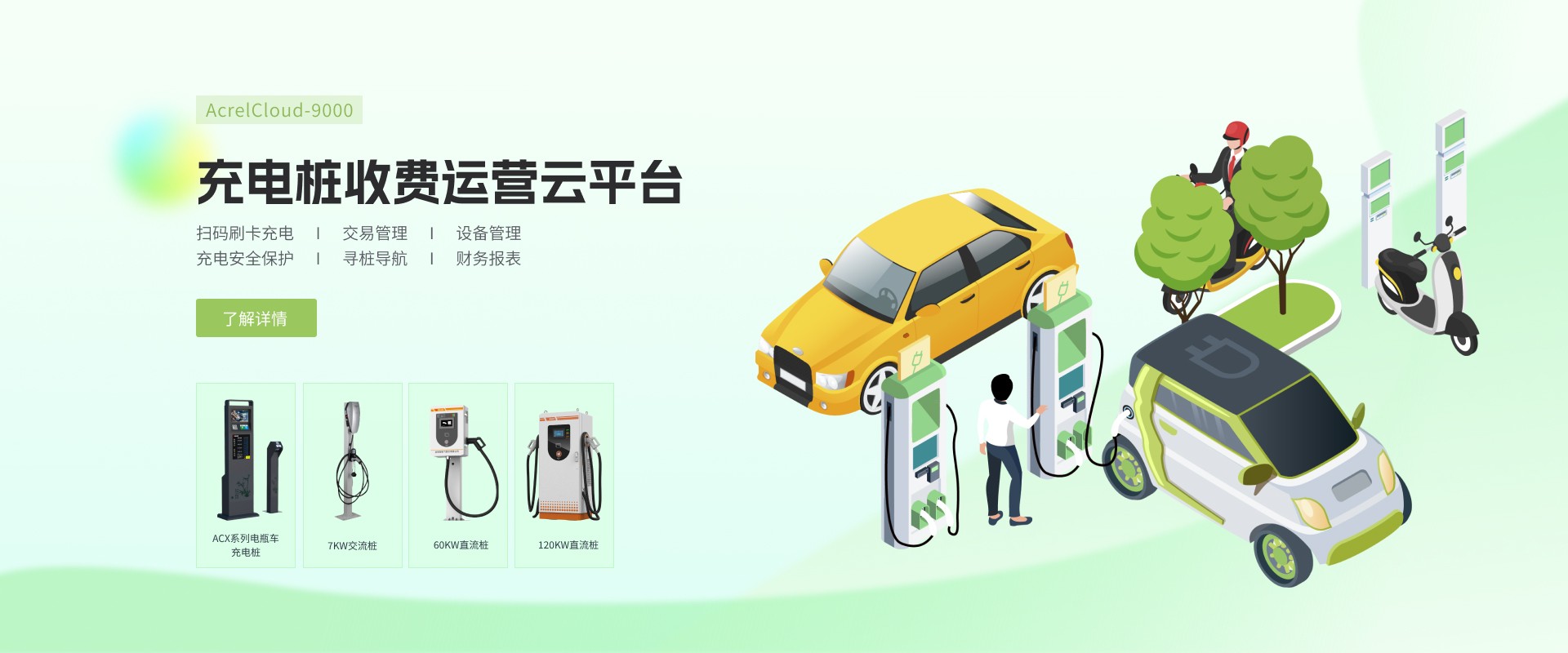
The AcrelCloud-9000 AnkoRi Charging Pole Cloud Platform System continuously collects and monitors data from electric bicycle charging stations connected to the system using IoT technology. It provides real-time monitoring of charging桩 status, including charging services, payment management, transaction settlements, resource management, power management, and detailed inquiries. Additionally, it issues early warnings for various faults such as overheating protection, leakage, input/output overvoltage, undervoltage, and insulation failure in charging machines. The charging桩 supports internet access via Ethernet, 4G, or WIFI, and users can scan to charge using WeChat, Alipay, or UnionPay QR codes.
2 Application Scenarios
Design for charging infrastructure applicable to civil buildings, general industrial buildings, residential communities, industrial units, commercial complexes, schools, parks, and other similar modes.
3-System Structure
3.1 The system is divided into four layers:
1) The data collection layer, network transmission layer, data middleware layer, and client layer.
2) Data Collection Layer: The intelligent electric bike charging桩 communication protocol is based on the standard Modbus-RTU. The intelligent electric bike charging桩 is used to collect power parameters of the charging circuit and to perform energy metering and protection.
3) Network Transmission Layer: Upload data to the established database server via 4G network.
4) Data Middleware Layer: Consists of application servers and data servers, where application servers host data collection services and WEB sites, and data servers are deployed for real-time databases, historical databases, and basic databases.
5) For client-side access: System administrators can access the electric scooter charging station billing platform via a web browser. End-user charging is initiated by swiping a card or scanning a QR code.
The community charging platform primarily covers functions such as intelligent large-screen charging facilities, real-time monitoring, transaction management, fault management, statistical analysis, and basic data management. It also provides an operation and maintenance APP for maintenance staff and a charging mini-program for charging users.
AnkoRe Charging Station Cloud Platform System Features
4.1 Intelligent Large Screen
The intelligent large screen displays the distribution of stations, providing statistics on equipment status, usage rate, charging times, duration, cost, energy level, and charging station failures. It also allows for viewing station information, charging station lists, charging records, revenue, energy consumption, and fault records for each station. It centrally manages community charging stations, monitors equipment usage rates, and allocates resources efficiently.
2.4. Real-time Monitoring
Real-time monitoring of charging facility operations, including charger status, circuit conditions, charging power during the charging process, charging voltage/current, and charger alarm information.
4.3 Transaction Management
Platform administrators can manage charging user accounts, performing operations such as account top-ups, refunds, freezing, and deactivation. They can also view detailed daily charging transaction information for community users.
4.4 Fault Management
Equipment automatically reports fault information, allowing platform administrators to view and dispatch fault handling through the platform. At the same time, maintenance staff can receive fault notifications via the maintenance APP, and report the results after completing the maintenance work. Charging users can also feedback on-site issues through the charging mini-program.
4.5 Statistical Analysis
Through the system platform, query statistics on charging transactions, energy consumption, and other information from various perspectives, such as charging stations, charging facilities, charging time, and charging methods.
4.6 Basic Data Management
Operators can establish and manage their required sites and charging facilities on the system platform, maintain charging facility information, pricing strategies, discounts, and promotional activities, while also managing online card users' top-ups, freezes, and unbindings.
4.7 Operations APP
For Operations Personnel: Manage websites and charging stations, handle fault closure, check traffic card usage, inquire about charging/recharge status, remotely set parameters, and receive fault notifications.


4.8 Charging Mini-App
Available for charging users, the app allows you to view nearby available devices, and includes features such as scanning to charge, account recharge, charging card binding, transaction inquiry, and fault appeal.

5 Conclusion
A novel multi-time dynamic charging price mechanism is proposed based on time-of-use electricity pricing and short-term load forecasting, guiding drivers to plan their vehicle usage, transforming the previously disordered charging behavior into an orderly one. The mechanism is designed to minimize load fluctuations within the distribution network, with the objective function being the reduced load variations. Utilizing MATLAB software for algorithm programming, the results show that the proposed multi-time dynamic pricing strategy can decrease load fluctuations within the network, significantly flattening peak loads and filling valleys, thereby reducing the drivers' charging costs by 21.17%. Additionally, it effectively reduces the network loss rate during the peak electricity consumption period by 2.77% and corrects the voltage offset rate at node 18 by 3.61%, achieving a balance between ensuring drivers' charging benefits and enhancing the operational safety of the distribution network.
Reference
Yu Yinghan, Chen Jiade, Han Zijiao, Yuan Shun, Ma Zhuo. "Analysis of有序Electricity Management in Electric Vehicles and Its Impact on Distribution Networks"
Chen Lidan, Zhang Yao, A Review of Electric Vehicle Charging and Discharging Load Forecasting Research [J]. Automation of Electric Power Systems, 2019, 43(10): 177-191.
Mei Zhe, Zhan Hongxia, Yang Xiaohua, et al. Optimal Operation Strategy for Distribution Network Electric Vehicles with Distributed Energy Considering Current Protection [J]. Electric Power Automation Equipment, 2020, 40(2): 89-102.
Wang Xia, Zhang Huajun, Zhang Shaohua. A game model of virtual power plants composed of wind power and electric vehicles participating in the electricity market [J]. Automation of Electric Power Systems, 2019, 43(3): 155-162.
Zhao Chuanli, Liu Li, Sun Feng, et al. The Impact of Electric Vehicle Discharge on Power Quality of Distribution Network [J]. Northeast Electric Power Technology, 2016, 37(9): 41-44.
Guo Shuai, Li Jiajue, Huang Xu, et al. Calculation Method for Time-Series Models of Power Grid Load Structure with Electric Vehicles [J]. Northeast Electric Power Technology, 2016, 37(9): 1-5
"Ankorree Enterprise Microgrid Design and Application Manual, 2022.05 Edition."
