
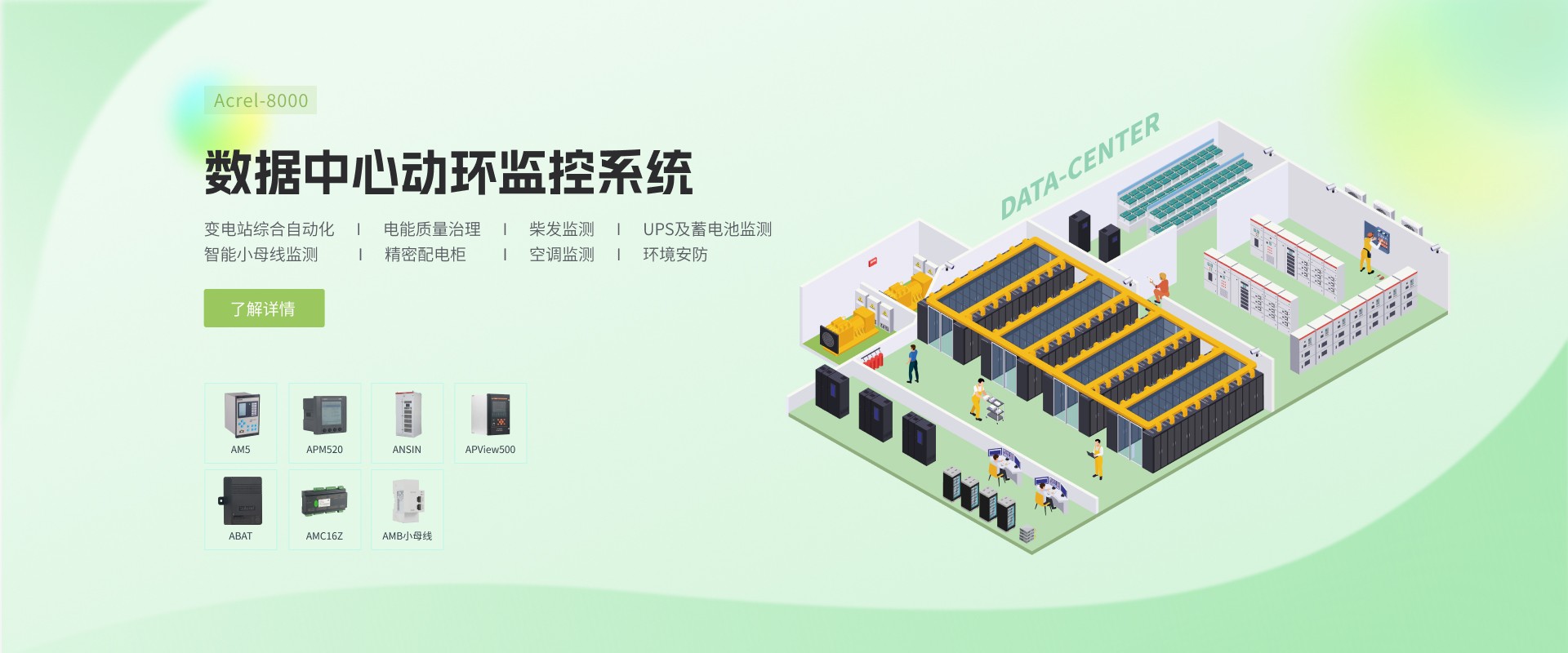

Summary: Within the entire power distribution management system, the integrated monitoring of the power distribution room plays a crucial role. Currently, power distribution rooms typically operate with unattended and scheduled patrol systems, which require substantial investment in materials and labor, yet fail to provide real-time monitoring of safety and environmental conditions in the room. The reliability and stability of the power distribution room environment directly impact the normal operation of equipment such as transformers. In response, this article mainly discusses the monitoring and management platform for the operational status and environmental indicators within the 10 kV substation cabinets.
Keywords: electrical room; monitoring management platform; key technologies
Introduction
The 10 kV substation cabinet's operation status and environmental index monitoring and management platform remotely measures and collects data from power equipment, environmental monitoring equipment, and security equipment distributed across various locations. It provides real-time monitoring of the operational status of these devices, records and processes relevant monitoring data, detects faults promptly, and implements necessary controls. It swiftly initiates alarm protocols and notifies relevant personnel via mobile SMS and audio-visual alarms to address abnormal events or emergencies in a timely manner, aiming to achieve unattended, minimal staffed, and efficient management of the power distribution room.
Design of a Monitoring and Management Platform for the Operation Status and Environmental Indicators in 10 kV Substation Cabinet
1.1 Station Equipment Integration System
To meet the requirements for sharing various information of equipment in the power distribution room, it is imperative to establish an environmental and physical system. The environmental and physical system primarily includes the integration of equipment and software, thereby effectively enhancing management efficiency, maximizing control operation costs, and avoiding the drawbacks of scattered maintenance and不便 management of multiple systems. Through the establishment of the environmental and physical system, the entire power distribution room forms a comprehensive system.
1.1.1 Equipment Integration
- Humidity and Temperature Sensors. Monitors temperature and humidity within the station room. ①The humidity and temperature monitoring sensor uploads temperature and humidity data via RS485 digital signal communication, with the communication protocol being Modbus; ②Real-time monitoring of temperature and humidity values in the intelligent power distribution room is achieved, with the data between the temperature and humidity sensor and the environmental control system being transmitted via wired transmission.
- Gas Sensors. Achieve real-time monitoring of sulfur hexafluoride (SF6) concentration levels and oxygen content within substation power rooms. ① Real-time monitoring of SF6 gas concentration and oxygen levels in smart distribution rooms, utilizing wired transmission between the gas sensors and the dynamic environment system; ② With accessories for installation with the main unit, they can be conveniently mounted on the walls of the power distribution room.
- Smoke Sensors. Function to monitor smoke conditions generated by fires within power distribution stations and emit audible alarm signals. ① Monitors smoke conditions in station rooms and electrical cabinets through smoke detectors and emits alarm signals; ② Connects to the system via wired nodes; ③ Automatically restores the detector's operating status when the smoke concentration in the nearby environment drops below the alarm level; ④ Features power and running indicator lights for direct observation of the device's powered-on and operational states; ⑤ Includes mounting accessories for installation with the main unit.
- Water Inundation Sensor. Achieves real-time monitoring of substation water levels. It can meet operational requirements by utilizing water level sensors at different heights to implement functions such as water level warnings and power shutdowns. ①Real-time monitoring of the substation's water level status; ②Water level sensors are connected to the system via wired node signals; ③Equipped with power indicator and running lights for easy observation of equipment's power-on and operational status; ④Comes with mounting accessories for easy installation on the substation wall.
- Temperature and humidity control equipment. Achieves the control of temperature and humidity inside the power distribution station. ① Equipped with manual and automatic control functions, both independent of each other; ② Features power failure auto-recovery function, with a digital display for humidity.
- Video Surveillance Unit. Network PTZ (Pan-Tilt-Zoom) Camera or Network Fixed Camera: Basic functionality for scene visualization, featuring remote video control capabilities, support for alarm signals (environmental, security, equipment status), and联动 with video preset positions. It can be integrated with environmental monitoring systems, focusing on alarm or early warning areas within the system, allowing for easy observation of specific areas, facilitating manual confirmation, and enabling联动 with security equipment systems. Additionally, it can be linked with equipment status systems to record and capture operations and running statuses of electrical equipment, providing evidence for maintenance personnel to judge the equipment's operational status.
- Door Status Sensor. Functions to collect status information of door opening and closing. ①The door status sensor uploads the opening and closing status signals of the power room door to the collection system via wired node signals; ②Choose sensors with mechanical limit switches with contacts or polarized magnetic switches; ③The door status sensor features a passive design, requiring no power lines or external power supply.
(8) Switchgear Partial Discharge Sensors. ① Main Function: Online monitoring of various cabinet partial discharge states using transient ground wave/ultrasonic combined technology, recording detailed historical data of various cabinets; ② Device Classification: Divided into transient ground wave and ultrasonic sensors based on monitoring technical indicators; ③ Protection Class of Sensor Housing Insulation Cover: IP65; ④ Reasonable structure of sensor device, easy to install and maintain, and convenient for grounding use.
1.1.2 Software Integration
Data management and advanced application features, centered around a real-time database, enable real-time data processing, event handling and notifications, internal calculations, and historical data archiving; system monitoring and operation by operators at all levels.
Figure 1 is the technical topology diagram.

Figure 1: Technical Topology Diagram
1.2 IT Execution for SAAS Edition
The project's hardware is deployed on-site, while demonstrations, reviews, and management are conducted remotely in the office. The software runtime (edge side) is locally deployed, while the software control center must operate in the telecoms room (cloud side).
"Collaboration between the 'Cloud Side' and the 'Edge Side' creates a foundational architecture of 'Edge-Cloud'. When deploying N Edge Sides, the cloud-based software must be upgraded to a SaaS version."
A customer with one or more environmental and physical site(s) is allocated an account in the SaaS version software, which is also referred to as a "tenant." Based on the current business model, the initial standard for this stage of the SaaS version software is to accommodate up to 1,000 tenant "environmental and physical sites" (as shown in Figure 2).

Figure 2: SAAS Version Software
2 Key Technology
2.1 MQTT Message Transmission Technology
The messaging transmission employs MQTT (Message Queuing Telemetry Transport, see Figure 3), which offers the advantage of providing more reliable and real-time messaging services for remote connections with limited bandwidth and minimal code.

Figure 3 MQTT Message Transmission Technology
MQ Telemetry Transport (MQTT) is a lightweight messaging protocol based on the agent-based publish/subscribe model, designed with principles of ease of implementation, lightness, simplicity, and openness. This characteristic makes it suitable for use in constrained environments. Due to its low bandwidth and low overhead consumption as an immediate communication protocol, MQTT is widely applied in mobile applications, small devices, and the Internet of Things.
The MQTT protocol is designed for communication between unreliable, low-bandwidth remote sensors and control devices, and it primarily features the following characteristics:
- By leveraging the publish/subscribe messaging pattern, we offer one-to-many message publishing, thereby decoupling application coupling. This is similar to XMPP, but MQTT has less information redundancy due to XMPP using XML formatted text for data transmission.
(2) Message content blocking for transmission loads.
(3) Utilizing TCP/IP for network connectivity. The commonly used MQTT pushes data based on TCP connections, but there is also a UDP-based version known as MQTT-SN. The two versions differ in connection methods and have varying advantages and disadvantages.
(4) We offer three service quality levels for message publishing: 1. "At most once," which relies solely on the underlying TCP/IP network for message distribution. This may result in message duplication or loss. This level is suitable for scenarios such as environmental sensor data, where a single missed read record is not critical since the data will be sent again shortly. This method is typically used for regular app push notifications; if a smart device is not connected to the internet during the push process and misses the notification, it won't receive it even after reconnecting. 2. "At least once," ensures message delivery, but message duplication may occur. 3. "Exactly once," guarantees that the message is delivered only once. This level can be applied in billing systems with strict requirements, where message loss or duplication can lead to incorrect results. This high-quality message publishing service can also be used in instant messaging apps to ensure users receive the message only once.
(5) Small transmission with lower costs (a fixed-length header of 2 bytes), protocol exchange minimized to promote reduced network traffic. This makes it particularly suitable for "communication between servers and sensors, as well as information collection in the field of the Internet of Things," as embedded devices typically have limited memory and computational power, making this protocol ideal for message transmission.
(6) Employed the "Last Will and Testament" features to notify all relevant parties of an abnormal interruption to client connections.
Last Will: A mechanism known as the testament mechanism, which notifies other devices under the same theme that the sending device has disconnected.
Testament: A will mechanism with similar functions to Last Will.
2.2 Web Application Software Suite Technology
The "LAMP package" incorporates a script component that involves the CGIweb interface. Leveraging this technology, web browser users can execute a program on the server while also accepting dynamic content as if it were static. Programmers create these programs using scripting languages due to their ability to effectively manipulate text streams, even when the streams are not originating from the program itself. For this reason, system designers often refer to these scripting languages as "glue languages."
2.3 RESTful Architecture
The Core Norms and Constraints of RESTful Architecture: The unified interface is divided into 4 sub-constraints: ① Each resource has a unique identifier, which can be used to mark the resource; ② Self-descriptive messages; ③ Self-descriptive resources; ④ HATEOAS - Hypermedia As The Engine Of Application State (Hypermedia as the engine of application state).
Ankore Distribution Room Environmental Monitoring System
3.1 Overview
The integrated power distribution room monitoring system includes an intelligent monitoring screen, communication management unit, UPS power supply, video monitoring subsystem (pan-tilt dome cameras, bullet cameras), environmental monitoring subsystem (temperature, humidity, water leakage, smoke detection), control subsystem (lights, air conditioning, dehumidifiers, fans, water pumps), access control monitoring subsystem (card readers, door open buttons, magnetic locks), and security monitoring subsystem (dual-sensing detectors).
3.2 Application Scenarios
Design, construction, and operation and maintenance services for 35kV and below power supply and distribution automation systems at user ends for rail transit, industry, construction, schools, and commercial complexes.
3.3 System Structure

3.4 System Function
3.4.1 Real-time Monitoring
The system can display the operational status of distribution room equipment, real-time monitor environmental parameters of the distribution room, and provide real-time display of fault and alarm information.

3.4.2 Data Query
In the human-machine interface, you can directly view the operating data of various equipment in the power distribution room.

3.4.3 Curve Query
You can directly view the curves of various electrical parameters.

3.4.4 Operational Report
Review the operational data reports for equipment within the electrical control room.

3.4.5 Real-time Alerts
The system features real-time alert capabilities, enabling it to issue alerts for events such as distribution room temperature, humidity, harmful gases, equipment failures, or communication failures.

3.4.6 Historical Event Inquiry
The system can store and manage all generated event records, facilitating users in tracing historical events, conducting query and statistics, and analyzing incidents.

3.4.7 User Permission Management
The user permission management feature has been set up, allowing for the definition of login names, passwords, and operational permissions for users of different levels.

3.4.8 Network Topology Diagram
Supports real-time monitoring and diagnosis of communication status for all devices, providing a complete display of the entire system network structure.

3.4.9 Remote Control Function
Remote control operations for equipment within the entire distribution system range are now available.

3.5 System Hardware Configuration


Conclusion
The 10 kV substation cabinet operation and environmental indicator monitoring and management platform can real-time monitor the working status and environmental conditions of the switchgear room, issuing alerts promptly to achieve the goal of unattended, lightly staffed, and efficient management of the switchgear room, effectively enhancing its reliability and safety. In this regard, relevant personnel should fully recognize the advantages of the 10 kV substation cabinet operation and environmental indicator monitoring and management platform and actively utilize it for efficient operations.
Reference:
- Chen Weifan, Chen Xiaoliang, Gao Wei, et al. Design of a Substation 10KV Switchgear Operation Environment Monitoring System [J]. Electrical Technology, 2016, 17(9): 83-87.
- Guo Hechuan, Ren Xiaoyong, Pan Haomeng, Zhou Wei, Huang Shayi. Analysis of the Monitoring and Management Platform for the Operating Status and Environmental Indices Inside the 10kV Substation Cabinets.
- Ankorri Enterprise Microgrid Design and Application Handbook, 2022.05 Edition.
