

SummaryTo keep pace with the rapid social development, the power supply network has introduced new requirements in the new environment. The past method of single power distribution rooms and manual monitoring of power supply conditions is no longer adaptable to the current demands. The design, development, and application of a comprehensive intelligent monitoring system for power distribution rooms has become an inevitable trend. The design and application of the power distribution room intelligent monitoring system aim to achieve three objectives: first, to implement electronic intelligent monitoring, eliminating the need for human supervision or reduce the number of staff on duty, thereby enhancing efficiency; second, to integrate with the five-remote system for real-time monitoring to improve work efficiency and ensure stable power supply; third, to build an intelligent power management system based on this system, providing information and data for effective power management. This article elaborates on the necessity of developing the power distribution room intelligent monitoring system, the system design framework, and its application.
KeywordsPower Distribution Room; Intelligent Monitoring; Design
0. Introduction
The substation, as part of the power grid system, though located at the end of the power system, is crucial to the entire grid. It provides users with normal electricity supply. A minor fault can lead to the paralysis of the entire distribution network, resulting in power outages or even fires, severely affecting daily life and production activities. The reason for these situations lies in the traditional substation distribution network, which relies heavily on manual maintenance for its normal operation. Manual maintenance cannot perform real-time inspections, leading to the inability to identify issues promptly or receive immediate repairs. To ensure stable power supply and the normal operation of the distribution grid system, it is highly necessary to implement real-time monitoring of the distribution network. Real-time monitoring of equipment operation ensures the normal operation of equipment and lines. Achieving the intelligence of the distribution grid has become a development direction for the power grid network.
1. Smart Distribution Room Construction Concept
The key to the intelligent construction of power distribution rooms lies in the integration and management of informatization. It takes communication management as the main connection and is designed around the integration of station data, with the core being the automation monitoring and integration management of station information. This intelligent system features centralized monitoring, early warning detection, protection control, equipment information integration, data collection, analysis, and processing optimization. The construction of an intelligent power distribution room can be summarized in a few words: data collection and analysis, evaluation, and solution development. What is collected and analyzed are the basic information, operating data, and operating environment of the power supply equipment in the power distribution room; what is evaluated is the status of the equipment and the reliability of the power supply guarantee. Ultimately, based on reliable data analysis and assessments of status and capabilities, strategies for operation, maintenance, and renovation of the power distribution room equipment are formulated, with the ultimate goal of achieving the best equipment status and ensuring safe and stable power supply in the power distribution room.
2. Research on the Intelligent Monitoring System for Power Distribution Rooms
2.1 Overall Structure of the Intelligent Monitoring System
The intelligent substation monitoring system relies on an intelligent power grid, with strict management and high-standard key technologies and equipment supporting the realization of an intelligent power grid. Reliable communication and security technologies ensure its reliability. The substation intelligent monitoring system, through its monitoring service system, creates a technical and integrated platform for real-time monitoring of equipment operations, recording data information at all times, eliminating potential hazards, and ensuring the normal operation of distribution equipment. The intelligent substation monitoring system features integration, compatibility, and self-healing capabilities. Its ultimate goal is to achieve safe and stable power supply, meet user electricity demands, and ensure the smooth operation of the substation.
2.2 Video Environment Monitoring System
The primary function of the video environmental monitoring system is to collect, store, and upload environmental information such as video, audio, and alarm signals within the power distribution room. The system can automate联动 operations based on this information and existing programs, transmitting data to other subsystems.
The intelligent video environment monitoring system boasts the following features: First, it provides real-time monitoring of all activities within the power distribution room, achieving video surveillance functionality. Second, it detects environmental information within the room, excluding equipment operation, and promptly initiates alarm measures upon detecting anomalies, thereby realizing environmental data monitoring. Third, by utilizing computer technology, cameras are installed in the power room, enabling comprehensive and flexible rotation as well as strong focusing capabilities to monitor dynamic conditions in all corners of the room; with the computer-based video monitoring system, remote control of the power room is achieved. Fourth, the video monitoring system can be connected to other systems via walkie-talkies and other devices, allowing for immediate communication with other on-duty personnel in case of emergencies. Fifth, the monitoring video content features real-time storage, enabling playback and review of the footage in the event of accidents or other incidents. Sixth, the video remote monitoring system for the power distribution room allows for remote operation, modifying equipment parameters for maintenance without the need for on-site presence, thereby enhancing work efficiency and saving on human and material resources. Seventh, for system access personnel, access permissions are set for administrators and staff based on their job content and nature, with login, access, and operation conducted through account and password settings, achieving clear separation of duties and accountability.
2.3 Fault-tolerant Operating System
The误Operation Prevention System is a simulation training system designed for the entire circuit connections in power distribution rooms, used for rehearsals before actual operations to prevent errors during work. Operators can prevent incorrect wiring by conducting simulation training on the main host of the误Operation Prevention System. The system automatically activates an analysis program during the simulation wiring training process. If the wiring is correct, it will issue a pass command; otherwise, the system will prompt the operator in text or image form that the operation does not meet specifications, requiring them to identify and correct the errors before re-wiring. The system also records correct operation steps for the operator's reference, as operators follow computer-generated operation prompts to perform related operations on equipment and circuits. The误Operation Prevention System allows for pre-preparation and operation simulation training, significantly reducing the likelihood of errors in actual work, minimizing human error, and as it can be used repeatedly, there are no limits to the number of simulation training sessions until the operation is correct and passes, thereby reducing the cost of trial and error.
2.4 Power Quality Monitoring System
The monitoring system for electrical power quality demands high technical standards. The two key criteria for evaluating detection technologies are: first, the ability to capture interference waveforms, both rapid and instantaneous, without missing any; second, the establishment of an effective automatic analysis and identification system that can fully reflect the characteristics of various electrical power quality indicators and analyze the changing patterns of these indicators over time. The installation of the electrical power quality monitoring system enables the collection and analysis of electrical power quality indicators through monitoring of power data, automatically generating relevant tables and reports for power system staff and users, facilitating inquiries and checks on whether the power quality meets requirements, ensuring the quality of power supply.
2.5 Utilizing Smart Distributed Technology
Intelligent distributed technology does not require the participation of a central station, primarily determining through grid switches between adjacent stations and non-trunk feeders. It represents an automated approach as an alternative to the management style of a central station. In the event of a fault in the power grid lines, changes to the feeders are made directly via relevant communication information. Non-trunk feeders are isolated and handled according to pre-set plans in the accident area, without the need for centralized control from the main power station. The greatest advantage of the automated detection mechanism formed by this intelligent distributed technology lies in its ability to quickly isolate and handle fault areas, with zonal control that does not affect the normal power supply and operation of other areas. The automated detection mechanism has a high degree of reliability, enabling fault areas to be addressed and restored in the shortest possible time.
2.6 Voltage and Current Type Automation Technology
Voltage and current type automation technology is an enhancement of the time-voltage technology with an added obstacle-assistive determination system. It primarily relies on the interaction between voltage and current, demanding a higher standard from the time-voltage technology. The additional obstacle-assistive determination system can detect problematic lines in the shortest time possible, effectively coordinating with reclosing to reduce the time for the second switch closure, and can promptly handle many emergencies. Its advantages lie in preventing circuit obstructions, reducing the total number of generator trips at the source, and improving the efficiency and success rate of distribution operations.
2.7 The system is fully functional
The design and implementation of an intelligent monitoring system for power distribution rooms feature the following functions:
(1) Monitoring Interface.
The video surveillance subsystem provides a monitoring interface, allowing staff to accurately understand the overall operation of the distribution network system at any time. It displays the working fault status of all equipment in the substation and provides feedback on environmental information. It also enables remote operation, allowing for the viewing and modification of system equipment parameters to maintain the normal operation of the equipment.
- Historical data storage and query functionality.
The computer system features a memory function, allowing for scheduled storage of monitoring data, making it convenient for staff to retrieve historical information in the future.
- Fault alert and alarm signal inquiry and tracking function.
The monitoring system can issue alarm signals for fault conditions, providing fault alarm information in the form of images and text. Staff can use the alarm information emitted by the system to investigate the possible causes of the fault, trace the fault location, and facilitate the repair personnel in fixing the fault in the shortest possible time.
- Electrical energy statistics and report management features.
The monitoring system can track users' electricity consumption and automatically generate reports to reflect this, clearly displaying their usage. It also provides users with search and print functionalities.
- Additional auxiliary features.
The system camera is equipped with environmental sensing capabilities. It triggers an alarm signal upon detection of movement or obstruction, preventing criminals from disrupting the normal operation of the power distribution network by exploiting the camera's blind spots. The system also offers network communication signal status testing and user file management.
3. Ankelei Distribution Room Environmental Monitoring System
3.1 Overview
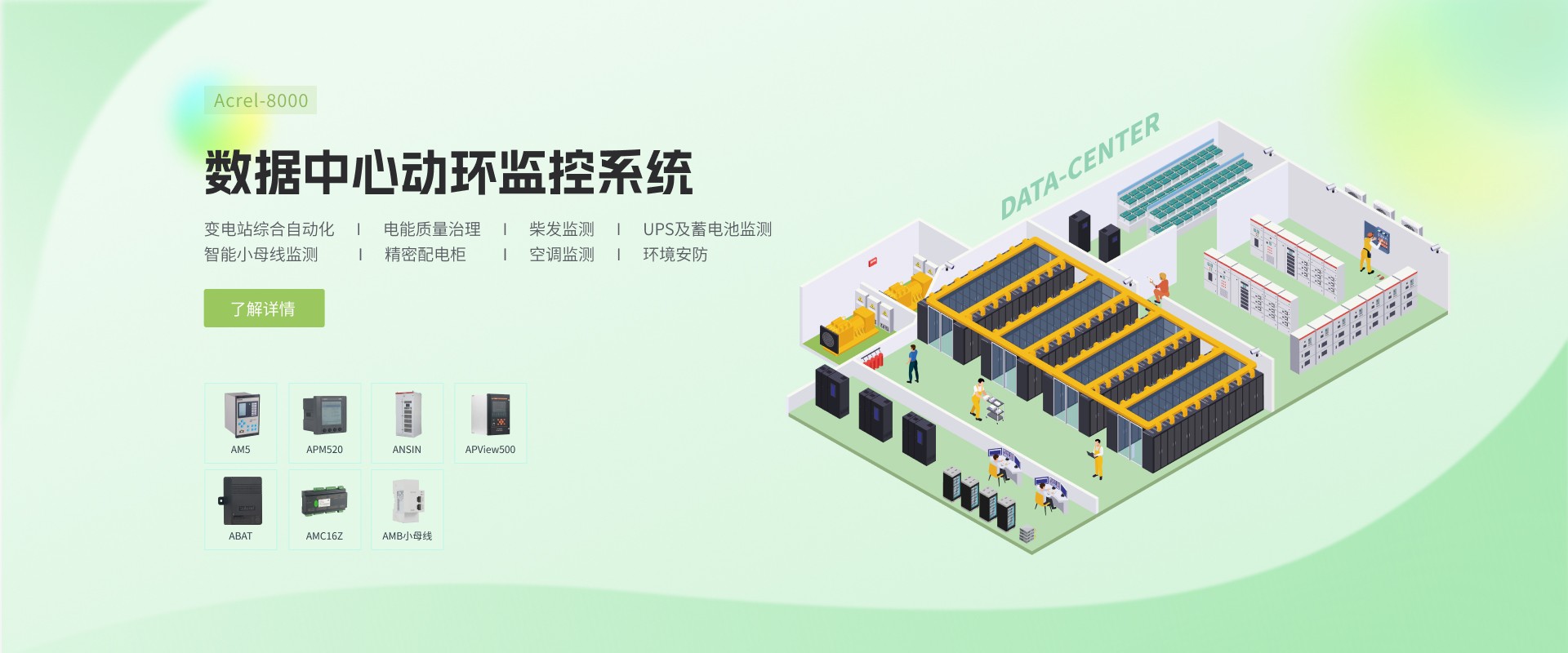
The integrated power distribution room monitoring system includes an intelligent monitoring screen, communication management unit, UPS power supply, video monitoring subsystem (pan-tilt dome cameras, bullet cameras), environmental monitoring subsystem (temperature, humidity, water leakage, smoke detection), control subsystem (lights, air conditioning, dehumidifiers, fans, water pumps), access control monitoring subsystem (card readers, door open buttons, magnetic locks), and security monitoring subsystem (dual-sensing detectors).
3.2 Application Sites
Design, construction, and operation and maintenance services for 35kV and below power supply and distribution automation systems for rail transit, industry, construction, schools, commercial complexes, and other users.
3.3 System Structure

3.4 System Features
3.4.1 Real-time Monitoring
The system can display the operational status of distribution room equipment, monitor real-time environmental parameters of the distribution room, and show real-time fault and alarm information.
3.4.2 Data Query
In the human-machine interface, you can directly view the operational data of various equipment in the power distribution room.
3.4.3 Curve Query
Users can directly view the curves of various electrical parameters.
3.4.4 Operational Report
Inquire about the operational data reports for the equipment within the electrical control room.
3.4.5 Real-time Alerts
The system features real-time alert capabilities, capable of issuing alerts for events such as transformer room temperature, humidity, harmful gases, equipment malfunctions, or communication failures.
3.4.6 Historical Event Inquiry
The company can store and manage all event records generated, facilitating users in tracing historical system events, conducting query statistics, and analyzing incidents.
3.4.7 User Access Management
We have implemented a user permission management feature, allowing for the definition of login names, passwords, and operational permissions for users of different levels.
3.4.8 Network Topology Diagram
Supports real-time monitoring and diagnostics of communication status for all devices, providing a complete display of the entire system's network structure.
3.4.9 Remote Control Feature
Remote control operations can be performed on equipment throughout the entire distribution system range.
3.4.10 System Hardware Configuration


4. Conclusion
The research and design of an intelligent substation monitoring system is of guiding significance for the construction and operation of smart substations, providing a certain theoretical framework. With the continuous innovation and maturity of related technologies, the realization of intelligent substations is certain to be achieved in the future power distribution network, offering strong support for the operation and development of the distribution network. The realization of substation intelligence is conducive to the streamlining of personnel in power supply enterprises, improving work efficiency, and maximizing the performance and operational status of various power supply equipment.
Reference:
Shen Peiqi, Li Weimin, Chen Tang. Research on the Implementation Model of Intelligent Power Distribution Rooms [J]. Electrical Manufacturing, 2014, 9: 90-94.
Liu Wei. Key Technology Research of Intelligent Power Distribution Room [J]. Digital Technology and Application, 2013, 1: 69-72.
Yang Dong. Analysis of Construction Scheme for Smart Power Distribution Rooms [J]. Electric Power Safety Technology, 2015, 7: 31-33.
[4] 2022.05 Edition: Handbook on Microgrid Design and Application for Enterprises.
Yang Haitao: Design and Implementation of an Intelligent Monitoring System for Power Distribution Rooms
