

Summary
In our country's new energy power system, the installed capacity of new energy sources is increasing year by year. However, new energy sources such as photovoltaic and wind power are unstable. Therefore, to maintain grid stability and promote the consumption of new energy power generation, energy storage will be a crucial component. It is essential for the consumption of distributed photovoltaic, wind energy, and other new energy sources, as well as for grid safety. It is also an effective means to flatten peak loads and balance the load. The country encourages and supports the construction of energy storage projects, with many provinces and cities implementing specific energy storage subsidy policies, clearly defining the standards and limits for energy storage subsidies.The adjustment of domestic time-of-use electricity pricing has also expanded the arbitrage opportunities for energy storage projects, allowing multiple provinces to achieve two charges and two discharges daily, significantly reducing the investment payback period for energy storage projects, propelling the sector into the limelight.
Energy Storage Power Station Profit Model
As statistics show, January 2023...- In April, a total of 73 electrochemical energy storage projects were commissioned, with an installed capacity of 2.523GW/5.037GWh. Among them, there were 69 lithium iron phosphate energy storage projects, with an installed capacity of 2.52GW/5.019GWh; and 4 flow battery energy storage projects, with an installed capacity of 3.1MW/18.1MWh. The storage scale in East China, Northwest, and North China regions ranked first, second, and third respectively, accounting for 78.5% of the total scale, with 814.94MW, 623.6MW, and 541.55MW respectively. The East China region had the largest scale of energy storage projects commissioned from January to April, reaching 814.94MW/1514.2MWh, with the highest total number, a total of 26 projects.
From the perspective of application scenario distribution, "large-scale energy storage" still holds a significant position. The combined proportion of energy storage in the power and grid-side projects reaches 98%, with a total of 24 grid-side energy storage projects in operation, boasting an installed capacity of 1,542MW/2,993MWh, including 7 centralized shared storage projects. The power-side energy storage projects have 23 in operation, with an installed capacity of 922MW/1,964.5MWh, most of which are new energy-side storage projects, totaling 19, accounting for 88% of the power-side capacity. On the user-side, although the scale is smaller than "large-scale energy storage," the reform of electricity price mechanisms in various regions has led to increased peak electricity prices and widened peak-valley price differences, raising electricity costs and presenting significant challenges. User-side storage can charge during off-peak hours and discharge during peak hours, which can alleviate or even resolve peak purchasing pressure. Additionally, surplus stored energy can be connected to the grid, participating in the electricity market as a user-side participant and leveraging peak-valley price differences to achieve profits, highlighting the value of energy storage. A total of 20 user-side projects were put into operation from January to April, and with the increase in investment returns, more user-side energy storage projects are expected to emerge.
Energy storage presents various profit models across different stages. The main profit models of energy storage include: assisting power operators and end-users in all stages of generation, transmission, and distribution to reduce costs and improve efficiency; delaying infrastructure investments; and profiting from peak-valley price differentials, participating in demand response of virtual power plants, and engaging in auxiliary service markets, capacity leasing, and the electricity spot market.
Power Side
Peak Load Shaving: Achieving load leveling by means of energy storage, which involves charging batteries at times of low electricity demand for power plants and releasing stored electricity during peak demand periods.
Delivered Capacity: Provides generation capacity through energy storage to handle peak load demands, enhancing the operational efficiency of traditional power generation units.
Renewable Energy Grid Integration: By configuring energy storage in wind and solar power stations, we achieve smooth control of the random, intermittent, and fluctuating output of renewable energy generation based on power station output predictions and energy storage charge/discharge scheduling, meeting grid connection requirements.
Peak Shaving in Renewable Energy Generation: Store discarded wind and solar energy from renewable sources and then integrate it into the grid during other time periods, enhancing the utilization rate of renewable energy.
Frequency adjustments can impact the safe and efficient operation, as well as the lifespan, of power generation and utilization equipment, making frequency regulation crucial. Electrochemical energy storage systems offer rapid frequency adjustments and can flexibly switch between charging and discharging states, thus becoming a high-quality frequency regulation resource.
Virtual Power Plant: Provides emergency capacity during peak grid times through demand response of the virtual power plant, and retains active power reserves to ensure power quality and system safety and stable operation during unforeseen circumstances.
Black Start: Restarting power generation units without self-starting capabilities in the absence of grid support during major system failures or a complete system-wide blackout, gradually expanding the scope of system recovery until the entire system is restored.
Profit Strategies: Increase revenue through enhanced power generation efficiency; reduce wasted wind and solar energy; and exploit peak-valley price differentials.
Transmission Grid Side
Relieving Grid Congestion: By installing energy storage systems upstream of the lines, electricity that cannot be transmitted can be stored during line blockages. Once the line load is less than the line capacity, the energy storage system discharges back into the line.
Delaying Power Transmission and Distribution Equipment Expansion: In power transmission and distribution systems where the load is nearing the equipment's capacity, energy storage systems can be utilized to effectively enhance the grid's transmission and distribution capabilities with a smaller installed capacity, thereby delaying the construction of new transmission and distribution facilities and reducing costs.
Profit Model: Enhance transmission and distribution efficiency, defer investments.
User-Side
Capacity Management: Industrial users can store energy during off-peak hours using energy storage systems and discharge it during peak load times, thereby reducing overall load and achieving the goal of lowering capacity electricity costs.
Capacity Lease: Storage power stations are leasing to new energy service providers. Currently, the domestic storage capacity lease fees range from 250 to 350 yuan/kW·year, with specific pricing negotiated between the storage power station and the project returns of the new energy power station, followed by the signing of a long-term lease agreement.
Self-generated Power: Families and commercial-industrial users with photovoltaic installations can better utilize solar power through energy storage configurations, enhancing self-generated use and reducing electricity costs.
Peak-Valley Price Spread Arbitrage: In a power market with peak-valley electricity pricing, by charging energy storage systems during low electricity prices and discharging them during high prices, we achieve peak-valley price spread arbitrage, reducing electricity costs.
Utilize Green Electricity: Store electricity when renewable energy sources like photovoltaic and wind power exceed demand, to facilitate the consumption of green electricity.
Profit Methods: Reducing capacity electricity costs, saving energy consumption expenses, and profiting from peak-off-peak price arbitrage.
Relevant Standards
"Code for Grid Connection of Electrochemical Energy Storage Systems" GB/T 36547
"Code for Design of Electrochemical Energy Storage Power Stations" GB 51048
"Design Standards for Electrochemical Energy Storage Power Stations (Draft for Comments)"
"Technical Specification for Energy Storage Converters of Electrochemical Energy Storage Systems" GB/T 34120
"Li-ion Batteries for Energy Storage in Electricity" GB/T 36276
"Energy Storage Power Station Monitoring System Technical Specification" NB/T 42090
"Technical Specification for Lithium-ion Battery Technology in Electrochemical Energy Storage Power Stations - NB/T 42091"
"General Requirements for Electric Power Quality Monitoring Equipment" GB/T 19862
"Code for Design of Electrical Installations in Explosive Hazardous Environments - GB 50058"
Technical Code for Relay Protection and Safety Automatic Equipment: GB/T 14285
"Technical Specification for Lithium-ion Battery Management System for Energy Storage Power Stations" GB/T 34131
"Design Code for High-Voltage Distribution Equipment from 3~110kV, GB 50060"
"Design Specifications for Substations of 20kV and Below" GB 50053
"Guidelines for the Safety and Stability of Power Systems" GB 38755
"Guidelines for Safe and Stable Control Technology of Electric Power Systems" GB26399
"Code for Design of Automatic Power System Dispatching: DL/T 5003"
"Code for Design of Electric Energy Measurement System - DL/T 5202"
"General Technical Conditions for Electrochemical Energy Storage Systems in Electric Power Systems" GB/T 36558
Electrochemical Energy Storage Power Station Classification
In the GB 51048-2014 "Code for Design of Electrochemical Energy Storage Power Stations" (hereinafter referred to as)StandardizedOur electrochemical energy storage power stations, categorized by battery type, include lead-acid (lead-carbon) batteries, lithium-ion batteries, flow batteries, sodium硫 batteries, and multi-type electrochemical energy storage, etc. However, in the "Design Standards for Electrochemical Energy Storage Power Stations (Draft for Comments)" issued in 2022 (hereinafter referred to as the "Standard"),StandardThe sodium硫 battery energy storage has been removed, and it is explicitly specified as lead-acid (lead-carbon) batteries, lithium-ion batteries, and flow batteries. The Comprehensive Department of the National Energy Administration has issued the "Twenty-Five Requirements for Preventing Power Generation Accidents (2022 Edition) (Consultation Draft)," proposing that medium and large-scale electrochemical energy storage power stations should not use ternary lithium batteries, sodium硫 batteries, and should not be suitable for using secondary-use power batteries.ZhongdaTypically, electrochemical energy storage power station batteries can be selected from various types.Lead-Acid (Lead-Carbon) Battery、Lithium Iron Phosphate BatteryNo Chinese content provided.Vanadium Redox FlowBattery.
In addition, the scale classification, regulations, and standards for electrochemical energy storage power stations also vary.

Table 1: Regulations and Standards for Defining the Scale of Energy Storage Systems
The comparison reveals that the upper limit definition for energy storage power stations significantly exceeds previous standards. This is due to the substantial growth of energy storage power stations in recent years. The relaxation of power standards and simplification of construction requirements for electrochemical energy storage power stations facilitate further development in energy storage.
Energy Storage System Design and Selection
The GB 51048 "Design Code for Electrochemical Energy Storage Power Stations" does not specify the grid voltage level requirements clearly; it merely suggests that large and medium-sized energy storage systems should connect to the grid at 10kV or higher voltage levels. The "Design Standard for Electrochemical Energy Storage Power Stations (Draft for Comments)" proposes the following requirements for voltage levels: small-scale energy storage power stations should use voltage levels of 0.4kV to 20kV or below; medium-sized energy storage power stations should use voltage levels of 10kV to 110kV; and large-scale energy storage power stations should use voltage levels of 220kV or above.
GB/T 36547-2018 "Technical Regulations for Grid Connection of Electrochemical Energy Storage Systems" specifies detailed requirements for the grid connection voltage levels of energy storage systems of different capacities. The voltage level for connecting electrochemical energy storage systems to the grid should be determined based on the rated power of the energy storage system, the grid structure, and other conditions. The voltage levels for different rated power energy storage systems connecting to the grid are shown in the following table:
Table 2 Voltage Grade Requirements for Energy Storage System Grid Connection
8kW and Below Energy Storage Systems
The 8kW and below energy storage systems are commonly used in residential photovoltaic-plus-storage systems, complemented by rooftop photovoltaic panels and integrated photovoltaic and storage inverters, to enable both grid-connected and off-grid operations. When electricity transmission to the grid is not permitted, a reverse current prevention device can be used to automatically charge the system during excess photovoltaic generation, maximizing the consumption of green electricity. The distribution structure is illustrated in Figure 1. Data from residential photovoltaic-plus-storage systems can be uploaded to a cloud platform for viewing on mobile devices.

Figure 1: 8kW and Below Residential Energy Storage Photovoltaic Integrated System
Table 3: Residential Energy Storage Management System Hardware Recommendations
8kW-1000kW Energy Storage Systems
The 8kW-1000kW energy storage systems typically use a 380V grid connection for capacities below 500kW. For systems between 500kW and 1000kW, the grid structure determines whether a 0.4kV multi-point grid connection or a 6kV-20kV voltage grid connection is used. However, using a 6kV-20kV voltage grid connection requires additional equipment like step-up transformers and medium-voltage switchgear, significantly increasing the cost of the energy storage system. Therefore, under permissible conditions, a 0.4kV multi-point grid connection can be employed to reduce costs.
For instance, when a company requires the installation of high-power charging stations internally but the transformer capacity is insufficient, a photovoltaic and energy storage system can be installed to expand electrical capacity. Without replacing the transformer, an energy storage system can be connected to the 0.4kV busbar. Charging during periods of surplus photovoltaic generation or low load, such as off-peak hours, and discharging during peak load times, can expand the company's internal electricity usage capacity at the lowest cost. This scenario is particularly typical for urban fast-charging stations or companies needing transformer capacity expansion, as shown in Figure 2. By integrating multiple 250kW/500kWh distributed energy storage cabinets into the 0.4kV busbar, the company's internal power distribution capacity can be expanded by 1000kW for a period, meeting the company's power expansion needs.

Figure 2: 8kW-1000kW Industrial and Commercial Energy Storage Photovoltaic Charging Integrated System
In a 0.4kV multi-point grid-connected energy storage system, a protection device against islanding and an electric power quality analysis device are required at the 10kV property boundary point. If power is not to be fed into the grid, an inverse power protection device must also be installed. Energy quality treatment and reactive power compensation devices should be installed on the low-voltage side at 0.4kV. After data from the energy storage system is collected via an intelligent gateway, it can be uploaded to a local management system or cloud platform, ensuring reliable and orderly power use for the enterprise and reducing energy costs.
Under this model, Ankerui Electrical can provide the following equipment for energy storage monitoring systems below 1000kW, as shown in Table 4.


Table 4: Recommended Hardware for Energy Storage Monitoring Systems Under 1000kW
Energy Storage Engineering Energy Management System
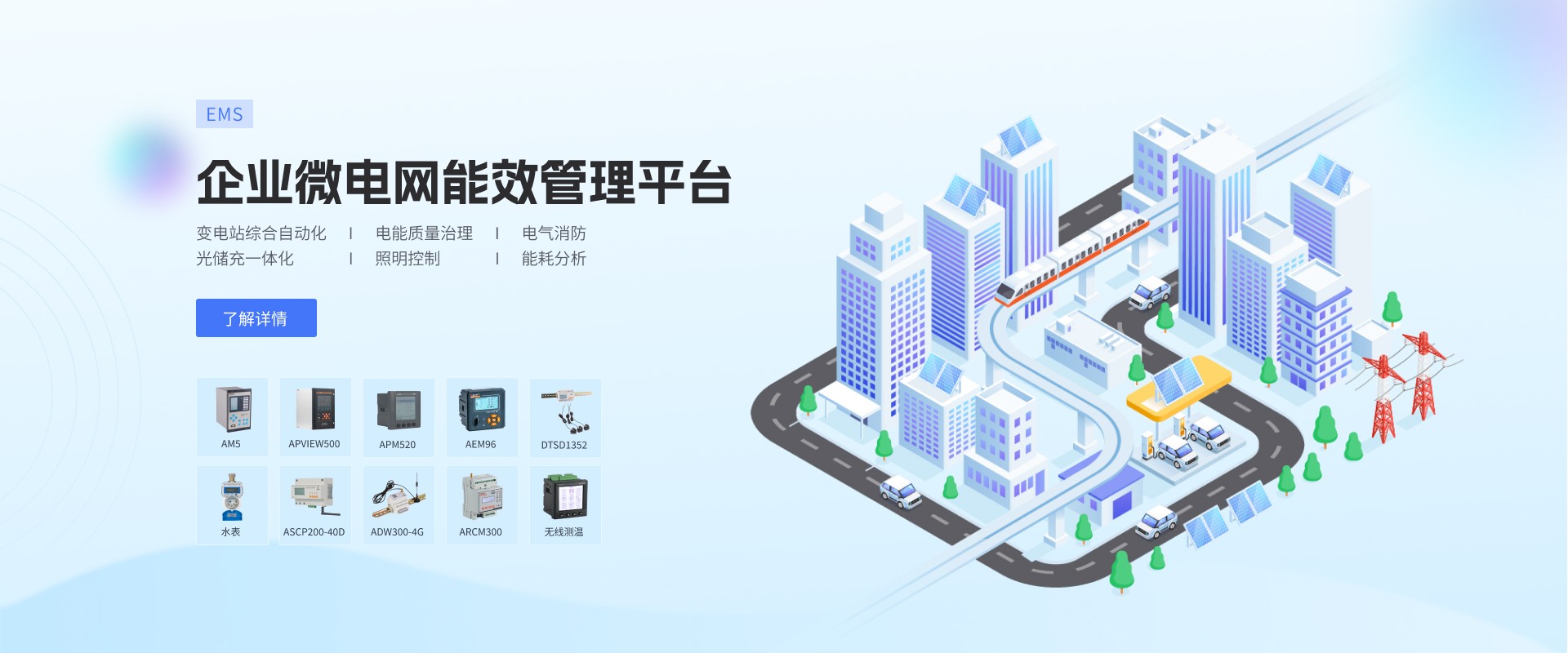
The Acrel-2000MG Energy Management System for Energy Storage Systems and the AcrelEMS Energy Management Platform can monitor and optimize the sources (mains power, distributed photovoltaic, micro wind turbines), networks (corporate internal distribution networks), loads (fixed and adjustable loads), energy storage systems, and new energy vehicle charging loads in real-time for microgrids. This ensures the safe operation of the microgrid's energy storage systems, facilitates flexible interaction among the source, network, load, and storage resources under different objectives, and enhances system stability with multi-strategy control. Additionally, it promotes the consumption of new energy sources, optimizes peak shaving and valley filling, reduces investment in grid construction, improves the safety of microgrid operation, and lowers operational costs. The Acrel-2000MG Energy Management System is suitable for local deployment for real-time monitoring, anomaly alerts, and strategy management. The AcrelEMS Energy Management Platform is designed for integrated management of corporate source, network, load, and charging operations, and also provides mobile data services and anomaly alerts.
Data Presentation
Display capacity information, revenue, charging and discharging quantities, as well as the change curves of voltage, current, and charging/discharging power.
Exception Alert
The energy management system for energy storage systems should have both accident alarm and early warning alarm functions. Accident alarms include circuit breaker tripping and protective device action signals caused by abnormal operations; early warnings include general equipment changes, status anomalies, or cell overvoltage, cell undervoltage, temperature anomalies, battery cluster overvoltage alerts, and battery cluster undervoltage alerts, ensuring the safe operation of the energy storage system.
Real-time monitoring
Energy Storage BMS monitors the voltage, current, temperature, SOC, and location of over-limit cells for battery cells, modules, and clusters, and issues alarms for over-limit information. It also oversees the AC/DC side operation of energy storage inverters, issues charging and discharging commands, and sets parameter limits.
Photovoltaic Operation Monitoring
Monitoring the operation of corporate distributed photovoltaic power stations, including inverter operating data, photovoltaic power generation efficiency analysis, electricity generation and revenue statistics, as well as power control for photovoltaic generation.
Power Quality Monitoring
Monitor voltage fluctuations and flickers, voltage sags/swells, and short-term interruptions in critical circuits of microgrids, record events in real-time and capture fault waveforms, providing data sources for power quality analysis and management. Take timely measures to enhance the reliability of the distribution system and reduce the occurrence of power supply accidents caused by harmonics.
AcrelEMS Energy Management Platform
The AcrelEMS Energy Management Platform aggregates distributed power generation, energy storage systems, controllable loads, electric vehicles, and power routers using advanced technologies like control, measurement, and communication. The platform adjusts microgrid control strategies flexibly based on the latest grid prices, power consumption loads, and grid dispatch instructions, and then distributes them to systems such as energy storage, electric vehicle charging stations, and power routers, ensuring efficient and stable operation of the enterprise's microgrid and providing mobile data services.
