
公司主营:Tailor-Made Wastewater Treatment Solutions
15673122666


企业资质
Tinplate Plant Develops Tl and Heavy Metal Removal Treatment for Waste Water
2025-01-22
I. Background Introduction:
Zinc oxide monohydrate refers to zinc waste containing Zn2O and ZnO components. It is one of the main surplus waste materials in the zinc smelting industry, named for its primary component, zinc oxide monohydrate. The chemical composition of zinc oxide monohydrate varies significantly with different ore sources, generally containing metals such as zinc, aluminum, arsenic, antimony, tin, silver, lead, and tin. Elements like lead and arsenic are toxic and can cause severe pollution to water bodies and soil. Moreover, zinc oxide monohydrate contains abundant valuable metals. Conducting research on the comprehensive recovery and utilization of zinc oxide monohydrate from zinc smelting waste not only makes full use of secondary resources but also benefits environmental protection, offering significant economic and social benefits. The conversion of zinc waste into zinc oxide monohydrate primarily involves direct reduction and melt reduction methods, with domestic practices predominantly using rotary kilns and bottom-firing furnaces. The rotary kiln is more suitable for small and medium-sized enterprises, while the bottom-firing furnace is better suited for large smelting and steel mills. Some domestic methods use high-furnace dust as raw material to extract zinc oxide monohydrate via leaching, but these methods are expensive and inefficient, so the rotary kiln remains the primary choice.
Secondly, Source of Wastewater:
Zinc peroxide waste water for removing harmful impurities, including defluorination and dechlorination, ion exchange waste water from zinc liquid, boiler steam waste water, smelting acid gas purification system, containing lead, arsenic, cadmium, thallium, and other heavy metals; significant pollution, with a small amount originating from furnace cooling waste water, floor, filter material, floor washing waste water, and initial rainwater.
Company Handles Case of Thallium Removal and Weight Reduction for Electrolytic Zinc Enterprises:
A zinc refining plant in Xiangxi faced the challenge of unresolved thallium-containing wastewater. After on-site investigation and technical negotiation by our company's professor team, combined with our experience in treating heavy metal wastewater and national requirements, we employed our two-stage sedimentation and two-stage return treatment process. Following a thirteen-day trial and verification, the pollutant discharge levels were below the GB31573-2015 standard of 0.005 mg/L. This was achieved through the addition of (nano) NM-3 thallium removal agent, flocculant, and (nano) NM-1 heavy metal capture agent.
The de-thallium agent prepared through nanotechnology coordinates with heavy metal ions in wastewater to form bio-complexes, compressing colloidal heavy metals and the double-layer of medium and small particles into amorphous compounds. These compounds then aggregate into large flocs through bridging and sweeping actions, settling rapidly and achieving deep removal of heavy metal ions. This method can form stable precipitates with thallium ions, effectively removing thallium from wastewater. Capturing Adsorption Co-precipitation Treatment Technology: Utilizing heavy metal capture agents, which have lone electron pairs on their coordination atoms, can capture metal cations and tend to form bonds, generating chelates that are difficult to dissolve in water, thereby achieving the removal of thallium and heavy metals.
1) Under the condition that the existing water treatment process remains unchanged, only the addition of thallium removal reagents is required for deep thallium removal. The改造 investment is minimal, the operation is simple, and the treated effluent thallium content can be consistently maintained at the national discharge standard. The average dosage of thallium removal reagents is only 0.05~0.1 kg/m3, significantly lower than that of other treatment processes in the market.
2) Broadly applicable, suitable for treating various complex heavy metal wastewater
3) Easy to operate, cost-effective, and adjustable dosage of chemicals based on wastewater volume.
4) Short reaction process, mature technology, stable effects, compliant with national or local emission standards.
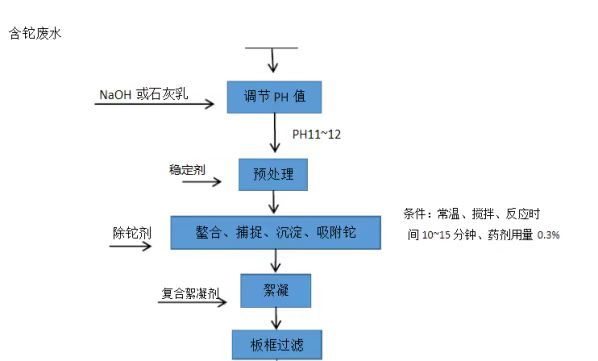
5) Attached: Process Flow
夏经理 (Mr.)
15673122666
15673122666
Changsha Kaifu District, Zhongqing Road, Jiahai Industrial Park
b2b.china9.net © Zhongshang 114 Hebei Network Technology Co., Ltd.Address: Room 6009, Oriental New World Center, No.118 East Zhongshan Road, Qiaoxi District, Shijiazhuang City, Hebei ProvincePlatform Service Hotline: 4006299930