



ink" target="_blank">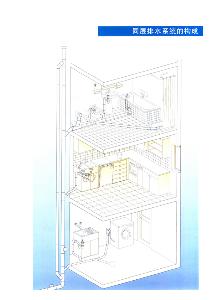
1-Side Drainage System
Same-level drainage system
What is the same-level concept? What is the policy basis for the same-level concept?
In simple terms, it refers to the same level or the same floor. The basis for the same-level arrangement design of residential drainage pipes is:
The "Residential Design Code" (GB50096-1999) Article 6.1.6 stipulates: The wastewater drainage transverse pipes of residential buildings should preferably be installed within the same floor unit.
Section 4.3.8 of the "Code for Design of Water Supply and Drainage of Buildings" (GB50015-2003) stipulates: Drainage pipes of sanitary appliances in residential bathrooms should not pass through the floor into other units.
Section 2.7.4 of the "Key Points for the Construction Technology of Healthy Residential Buildings" (2004 Edition) stipulates: Drainage branch pipes should be demarcated by the household boundary.
The terminology used in the above provisions includes both "should" and "should be." However, they all convey the same concept: the design of residential bathroom drainage should adopt same-level drainage.
The National Standard Atlas "Installation of Kitchen and Bathroom Drainage Pipes in Residential Buildings" 03SS408 also includes some standard designs for same-level drainage. The document issued by the Jiangsu Provincial Department of Construction, No. 510 of 2006, approves the TTC same-level drainage system as the standard design atlas for engineering construction in Jiangsu Province.
What is level drainage? What are the advantages of level drainage?
Same-level drainage refers to the plumbing pipes (waste cross pipes and water branch pipes) of sanitary equipment in the bathroom not crossing through the floor to enter other rooms. The flat construction within the same floor ensures the discharge of wastewater and waste meets or exceeds that of similar and other drainage methods, smoothly entering the main drainage main (main waste vertical pipe). In the event of a need for clearing and cleaning, the issue can be resolved within the same floor. Abbreviated as "same-level installation," it is also known as same-level drainage.
Same-level drainage is a novel technology in the toilet drainage system, where the drainage pipes are laid within the same floor. It uses a shared water seal pipe fitting in place of numerous P-bends and S-bends, ensuring a rational overall structure that is less prone to clogs and easy to clean and unblock. Users can personalize the arrangement of toilet fixtures according to their preferences and wishes.
Its advantages include: 1. Clear property rights of the house: The drainage pipeline system of the bathroom is located within the owner's unit, allowing for pipeline maintenance to be conducted within the unit without disturbing the residents below. 2. Unrestricted arrangement of sanitary equipment: Since there are no pre-drilled holes for sanitary equipment drainage on the floor, users can freely position the equipment to meet personalized requirements. Developers can offer a variety of bathroom layouts, enhancing the home's aesthetics. 3. Low drainage noise: The drainage pipes are laid on the floor and covered by backfilling, providing good sound insulation and significantly reducing drainage noise. 4. Reduced risk of leakage: The bathroom floor is not penetrated by sanitary equipment pipes, minimizing the risk of leakage and effectively preventing the spread of diseases. 5. No need for old-style P-bends or S-bends: The "toilet adapter," "multi-functional floor drain," and "multi-functional straight-through tee" replace the traditional P-bends or S-bends for each sanitary fixture. The drawbacks associated with old-style P-bends and S-bends can now be fully addressed by the ttc removable same-level installation drainage method.
What are the different methods of same-level drainage installation?
The same-level drainage installation method aims to install pipes rationally based on the same-level drainage principle, catering to various bathroom layouts, to achieve effective drainage and waste disposal standards.
1. The installation methods for wall structures are divided into three different approaches: 1) Drop plate: the method of using the lower layer of the bathroom floor (or a partial floor); 2) Wall drainage (characterized by the concealed pipe installation system); 3) Substrate method.
(1) Subflooring: The drainage method for the下沉 sanitary facilities refers to the "Residential Sanitary Room" 01SJ914 standard. The specific method involves using a 300mm space beneath the structural floor of the toilet (locally) for pipe installation. The sunken floor is cast-in-place concrete with a waterproofing layer, and supply and drainage pipes are laid according to the design elevation and slope along the lower floor. The space is filled with lightweight materials like cement slag for the subfloor, then leveled with cement mortar before applying the waterproofing and ceiling layers. The 01SJ914 catalog suggests using a "multi-functional patent floor drain" pipe fitting when employing this method. Existing subflooring typically refers to the first waterproofing layer of the toilet, which is lower than the raw surface of the living room. Distinctions in height can be made: 350mm, 450mm, etc. TTC's same-level subflooring is 200mm, while comparative subflooring is 350mm and 450mm, which can increase the clear height by 200mm to 300mm, with less backfilling of 200mm to 300mm. The smaller backfill volume and guaranteed compactness save labor and materials, reduce the overall construction cost, facilitate leak repair, eliminate the need for ceiling in the toilet, increase the overall clear height, and most importantly, reduce the structural load on the building.
(2) Wall drainage, commonly known as "pipe shaft" wall internal pipe drainage, refers to the construction of a false wall behind the toilet fixtures to create a dedicated space for laying pipes with a certain width. The drainage branch pipes are not crossed through the floor but are laid and installed within the false wall, connecting to the main pipe in the same floor. The wall drainage method requires the use of suspended lavatories and backwater toilet bowls. This method meets the requirements of hygiene, aesthetics, and cleanliness. However, its drawbacks include limited options for sanitary fixtures, difficulty in setting up floor drains, high construction costs, and challenging pipe maintenance. The key issue addressed by the GB50015-2003 specification is that this wall drainage method is not yet suitable for our national conditions. Moreover, it involves significant building investment, numerous wall pipe fittings, and is unable to address surface water in the bathroom. It is not recommended for promotion.
(3) Underlayment Method: Refers to the underlayment method for raising the ground level of the bathroom. This method is not commonly used due to the potential for "water leakage from inside to outside." It is occasionally employed in the selection of renovations for old houses out of necessity. However, new projects have ceased to use this method due to its complexity, labor and material costs, aesthetic impact, and increased load on the building structure.
The main components of TTC's same-level drainage system include: main trunk, multi-channel connectors, branch pipes, toilet connectors, multi-functional floor drains, and multi-functional waterway tees, etc.
What is the difference between TTC's same-level drainage and the traditional downward drainage method?
The fundamental difference lies in the fact that same-level drainage does not require the old-style P-bends and S-bends with water traps, whereas traditional drainage systems necessitate a P-bend or S-bend water trap for each fixture. The old-style P-bends and S-bends are the most prone to clogs, which is a major drawback of the traditional drainage method. The misunderstanding of same-level drainage often stems from a conventional mindset. The second distinction is that the horizontal pipes for same-level drainage are installed within the same floor, whereas traditional drainage pipes, including their P-bends and S-bends, pass through the floor to be installed in the lower level, occupying space within the lower unit. The third difference is that in the event of a clog, same-level drainage can be cleared and unblocked within the same floor unit (by lifting the cover of a multi-functional floor drain or an access point), whereas traditional drainage requires clearing and unblocking in the lower unit. The fourth difference is that under traditional drainage, when an upper-level user operates a fixture, a noticeable noise can be heard on the lower level, whereas with same-level drainage, the noise is almost inaudible.
Will adopting the sinking floor slab drainage system increase the construction cost?
This is the most concerning issue for construction companies and real estate developers.
The adoption of the sinking floor drainage system within the same level in existing buildings slightly increases the engineering costs, but the increase is not substantial and can be negligible when compared to the overall project expenses. From the perspective of the floor structure, the amount of reinforcing steel used in the lower part of the bathroom remains the same as that in the surrounding areas that have not sunk. In other words, the additional cost of the sinking floor drainage system is solely attributed to the backfilling layer. Currently, architectural design standards in Jiangsu, Shanghai, Guangdong, Shaanxi, and other provinces all employ this technology.
