



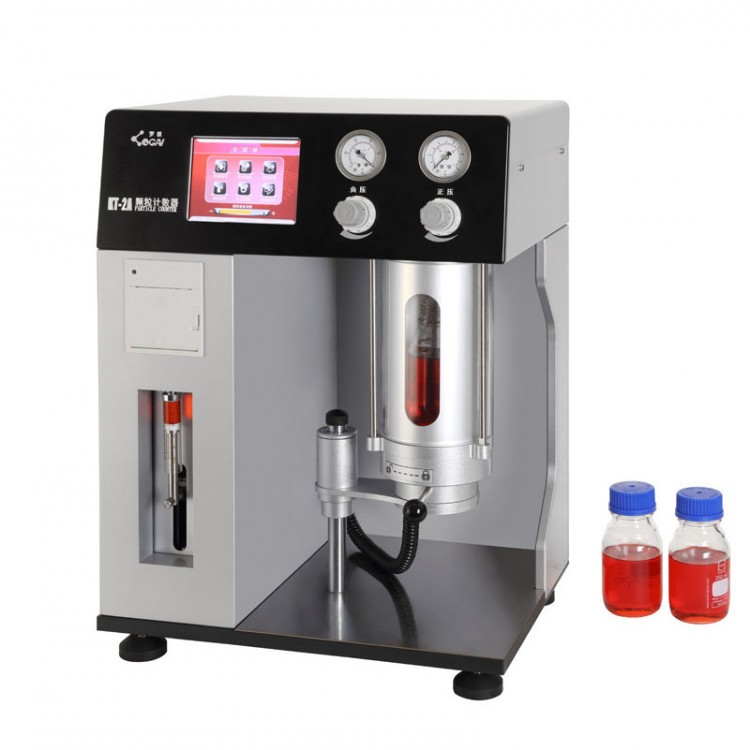
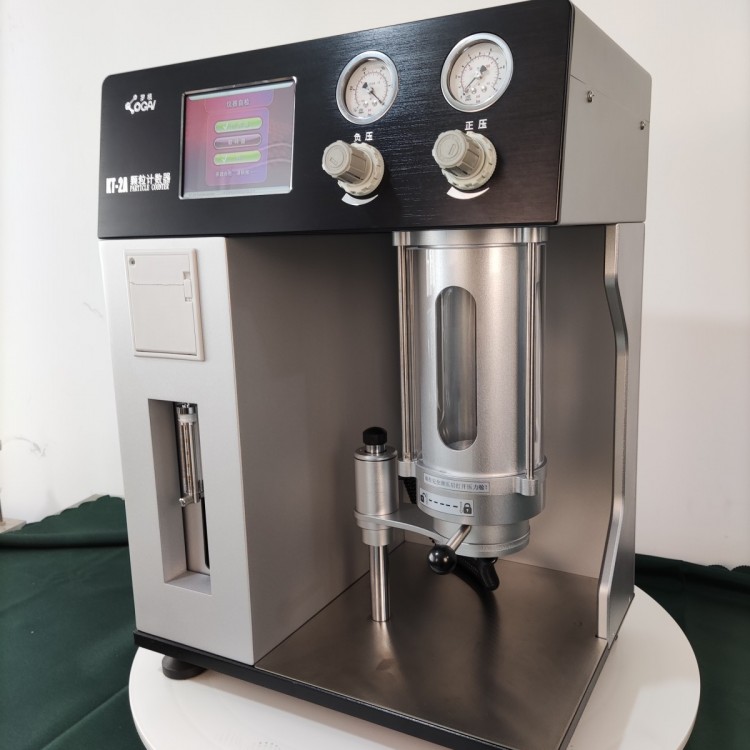
Supplying KT-2A particle counter for Tianjin Logan Lab, photoelectric particle counter
Overview: The KT-2A Desktop Particle Counter is developed based on the principle of optical resistance (light blocking method) and is used to detect the size and quantity of solid particles in liquids. It can be widely applied in fields such as aviation, aerospace, aero-engine, heavy industry machinery, electricity, oil, chemical industry, transportation, ports, metallurgy, machinery, and automotive manufacturing. It is used for testing the contamination level of solid particles in oils such as hydraulic oil, lubricating oil, rock oil, transformer oil (insulating oil), steam turbine oil (turbine oil), gear oil, engine oil, aviation kerosene, and water-based hydraulic oil. It also serves for sampling and testing of insoluble particles in water-based samples, chemicals, organic liquids, and polymer solutions.
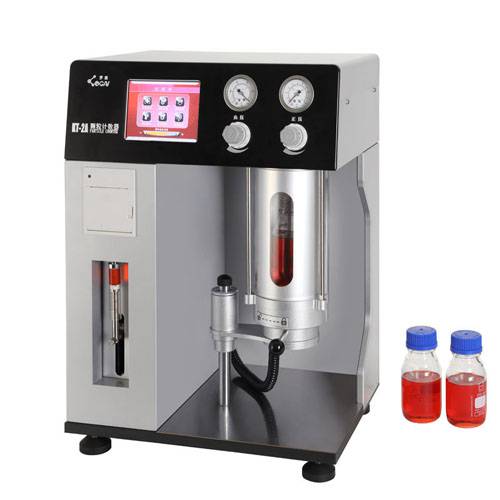

Performance Features:
?Utilizes the principle of photoresist (light blocking) method, featuring fast detection speed, strong anti-interference ability, high accuracy, and good repeatability.
High-resolution and accuracy sensors.
Stopcock sampling system, ensuring constant sampling speed and precise volume control.
Positive/Negative Pressure Pressure Vessel Unit for degassing samples and testing high viscosity samples.
5.6-inch color LCD display with touch screen operation.
Integrated NAS1638, ISO4406-1999, ISO4406-2007, ISO4406-1987, GB/T 14039-2002, GJB420B-2006, GJB420B-2015, GJB420A-1996, AS4059E, AS4059F, ROCT17216-1971, ROCT17216-2001, JTS-005, SAE749D-1963, NAS1638/ISO4406 particle cleanliness levels, and can be customized with user-specified standards.
Integrated with a "Custom" standard, adjustable at 0.01μm intervals, allowing for arbitrary particle size settings, with up to 9900 particle sizes available for easy grain size analysis.
?Store up to four calibration curves (Latex Ball Calibration Curve, ACFTD Calibration Curve, ISOMTD Calibration Curve, GOST Calibration Curve) simultaneously and easily switch between them to minimize conversion errors.
?Function for storing test data, facilitating the archiving, retrieval, and analysis of test data.
Built-in printer, capable of directly printing out test reports.
Built-in Chinese input method for Chinese labeling on inspection reports.
RS-232 interface and powerful data collection software, enabling external computers to annotate, store, query, and generate PDF inspection reports for test data.
Features magnetic stirring for even particle distribution.
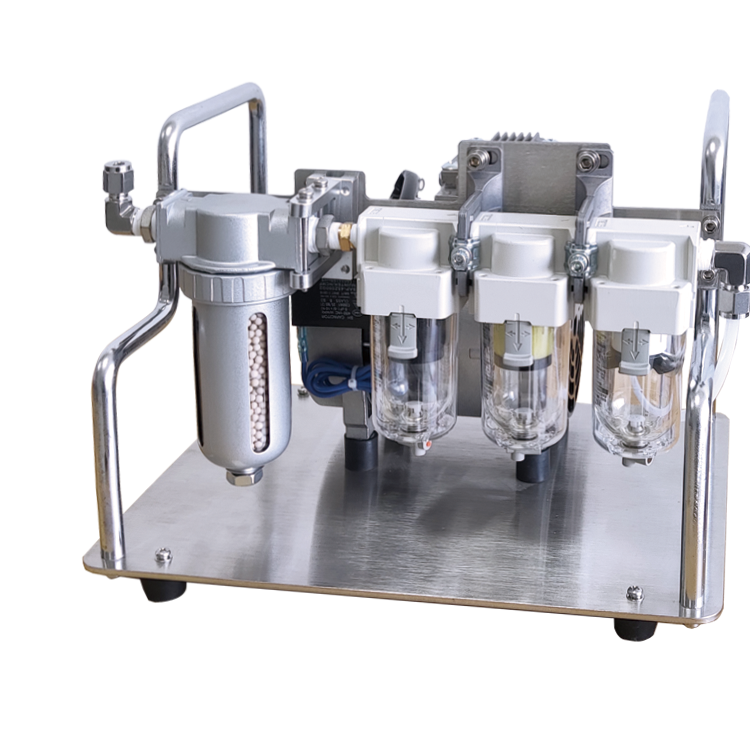
The pressure pump is equipped with four-stage gas filtration and a water purification unit, preventing environmental air from contaminating the samples.
Technical Specifications:
1. Light Source: Semiconductor Laser
2. Detection Range: 0.8μm to 600μm (depending on the selected sensor)
3. Particle size range: 1-100 μm (ISO 4402) or 4-70 μm (c) (GB/T 18854, ISO 11171)
4. Sensitivity: 0.8μm (ISO 4402) or 3μm (c) (GB/T 18854, ISO 11171)
5. Inspection Channels: 16, with particle size dimensions that can be arbitrarily set at intervals of 0.01μm.
Sample Volume: 0.2~100ml, in increments of 0.1ml
7. Relative Error of Sample Volume: Better than ±0.5%
8. Testing Speed: 5~80 mL/min (default 15 mL/min)
9. Washing Speed: 5-80 mL/min (default 15 mL/min)
10. Resolution: Better than 10% (GBT18854-2002, ISO11171)
11. Overlay Error Limit: 12,000-40,000 particles/mL (depending on the selected sensor)
Particle count repeatability: RSD < 2%
13. Relative Particle Count Error: ±5%
14. Pressure Vessel Negative Pressure: ≤-0.08 MPa
15. Pressure cabin positive pressure: ≤1 MPa
16. Test Sample Viscosity: ≤650 cSt
17. Sample Temperature Testing: 0℃ to 80℃
Operating Temperature: 0℃~60℃
Storage Temperature: -30℃ to 80℃
20. Power Supply: 100-245V, 49-62Hz
21. Dimensions: Main Machine 430×320×590mm
Pneumatic pump, 330×266×255mm
21. Net Weight of Instrument: Main Unit 30kg, Air Pump 10kg
