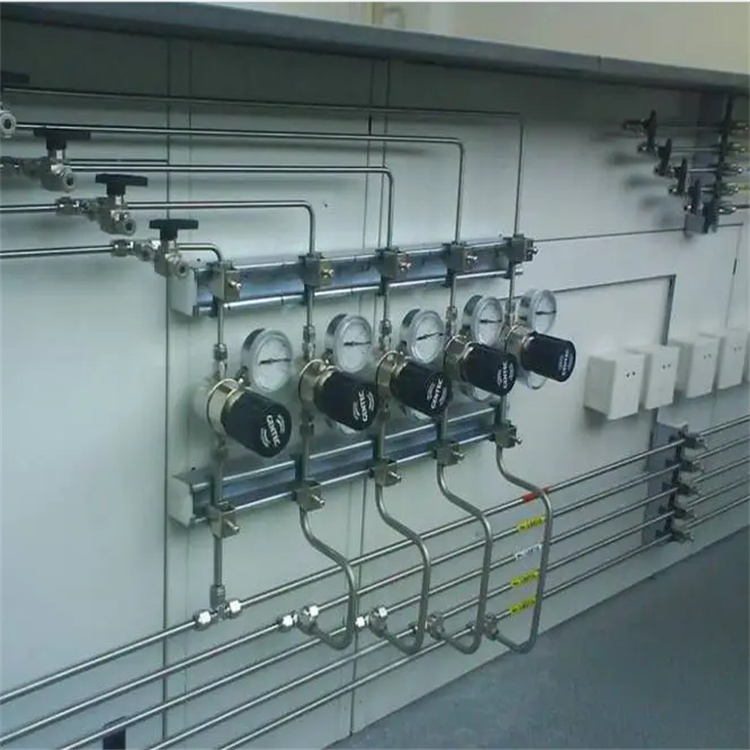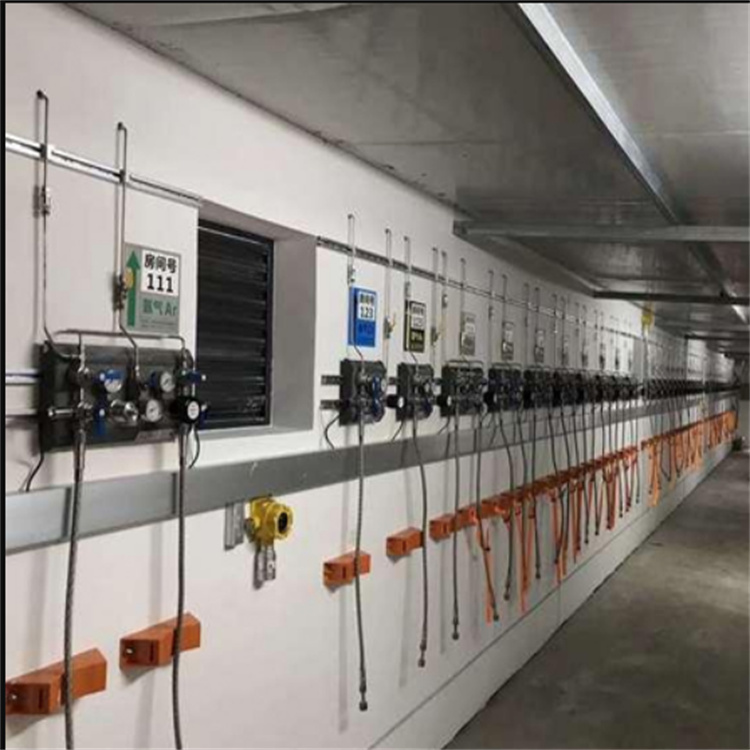

Lab Gas Cylinder Storage Room Pipeline Installation Standard
Pipelines for conveying dry gases should be installed horizontally. Pipelines for conveying wet gases should have a slope of no less than 0.3% and incline towards the condensate collector.
2. Oxygen pipelines and other gas pipelines can be installed on the same frame, with a spacing of not less than 0.25 meters. The oxygen pipeline should be above the other gas pipelines, excluding the oxygen pipeline.
3. When laying pipelines parallel to flammable gas pipelines, the distance between them must not be less than 0.50 meters. When crossing, the spacing should not be less than 0.25 meters. When laying in layers, the pipeline should be positioned above. Indoor pipelines should not be laid in ditches or buried directly. Avoid passing through unsuitable rooms.
4. Gas pipelines should not be installed on the same frame as cables and wiring laid on-site.
5. Seamless steel pipes should be used for gases. Pipes for gases with a purity of 99% or higher should be made of stainless steel, copper, or seamless steel pipes.
6. The connection sections of pipelines and equipment should be made with metallic pipes. For non-metallic flexible hoses, polytetrafluoroethylene (PTFE) pipes and polyvinyl chloride (PVC) pipes should be used instead of rubber hoses.
7. Valve and accessory materials: Copper materials must not be used for gas pipelines. Other gas pipelines may be made from copper, carbon steel, malleable cast iron, and other materials.