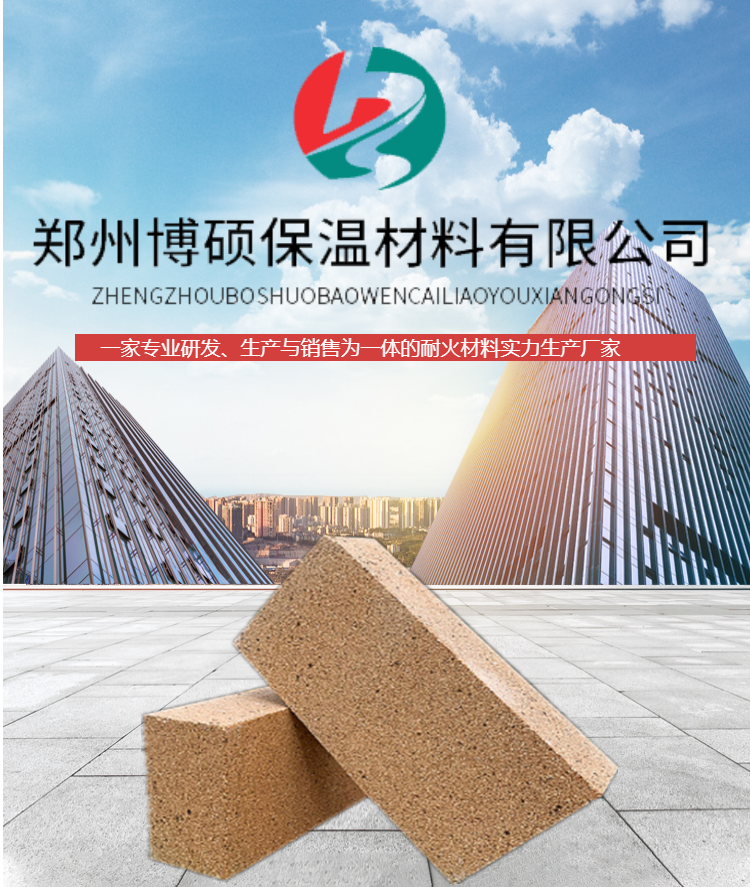


Firebrick
· Product Index
· Color: Yellow
· Dimensions: 230/114/65
· Firing Temperature: 1300°C
· Compressive Strength: 30 MPa
· Product Features
1. Abrasion Resistance: Excellent weathering resistance, making it an ideal building material.
2. Thermal Conductivity: The rate of heat flow through a material per unit area under a unit temperature gradient, related to porosity.
3. Impact Resistance: High strength and excellent impact resistance ensure a longer service life.
4. Refractoriness: The ability to withstand the erosive action of slag at high temperatures without being destroyed.
Fire bricks are differentiated based on their content of aluminum oxide (Al2O3), with commonly used percentages including 48%, 55%, 60%, 65%, 73%, 75%, and 80%.
Clay bricks, named as such due to their content below 55%, are a neutral refractory material, formed and fired from bauxite or other materials with high aluminum oxide content. They boast high thermal stability with a refractory temperature around 1700°C, and are used as lining for glass melting furnaces, cement rotary kilns, and steelmaking electric furnaces. Of course, there are also high-alumina clay bricks with high load softening, low creep, and low porosity. The finished high-alumina bricks are crucial in production for their material ratios, depending on different application needs.
High-alumina bricks and clay bricks differ not only in their alumina content, but also share similar production processes. However, clay bricks have a higher proportion of clinker in the mixture, reaching 90-95%. The firing temperature is also significantly higher for high-alumina bricks. During actual testing, first and second-grade high-alumina bricks are predominantly used in tunnel kilns, blast furnaces, roof linings, reflector furnaces, and other refractory lined furnaces, operating at temperatures ranging from 1500 to 1600°C.