
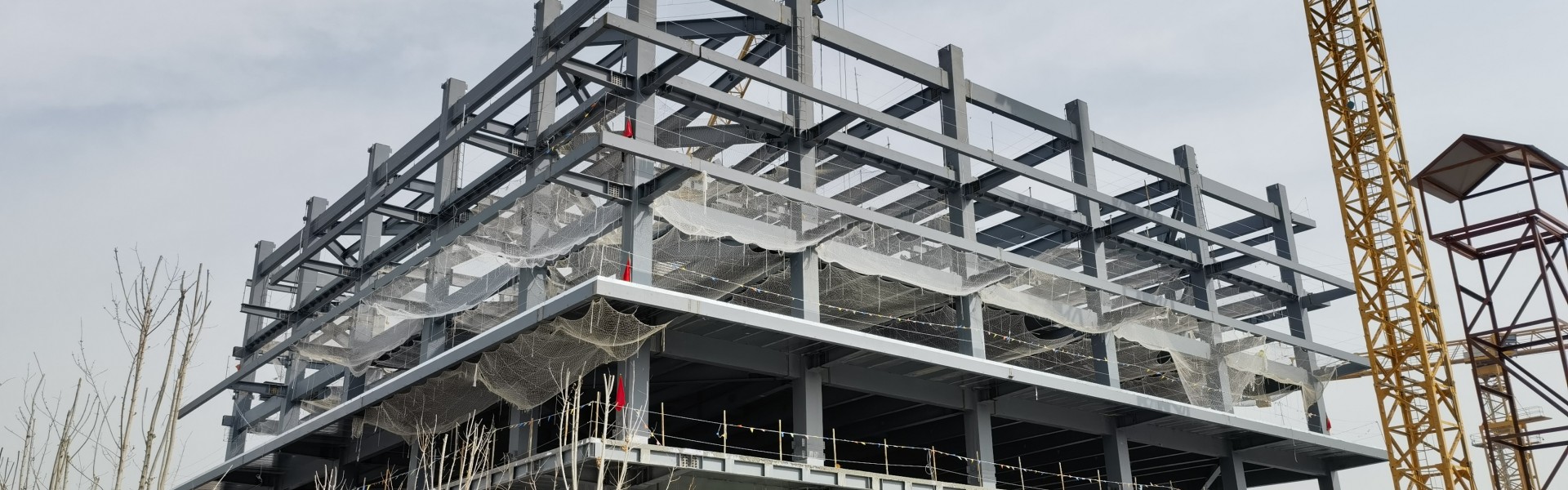

Section 1: Roofing Construction Process
Demolish the original cement tile roof → Coat25Thick1:2Cement mortar → Pre-installed components installation → Color steel tile installation → Watering test → Project acceptance
II. Key Control Points for Roofing Projects
1、 Due to the steep pitch and numerous ridge lines, precise elevation control was required during construction for the ridge beams, eaves, skylights, and the starting and ending points of the water runoff lines; as well as the positioning of slope shadow angles, slope sunlight angles, eave lines, corner points, and the starting and ending points of the water runoff lines. When erecting or dismantling scaffolding, construction should be carefully attended to, ensuring the normal progression of work.
2、 The roof slope is significant; during the base treatment and tile installation, strict technical briefings are conducted with workers, and protective measures are implemented.
3、 Maintain strict control over the arrangement of color steel tiles, ensuring proper handling of internal and external corners, end tiles, and intersections with roof structures to prevent leakage.
4、 Perimeter guards and safety nets or other fall prevention measures are installed around the roof and pre-drilled holes.
Fine Aggregate Concrete Leveling Layer Construction Technique
Material Requirements:
Leveling layerC25Fine aggregate concrete is mixed on-site, strictly following the mixing ratio, and good sand and stone materials are preferably used.
2. Flatten the search for the flat layer :
The consistency of the fine-grained concrete should be maintained around 7 cm. Lay the fine-grained concrete according to the elevation control points, then flatten it using an aluminum alloy trowel. Gently rub and compact it with a wood trowel. Due to the high temperatures during the construction period of this project, to avoid excessive heat affecting the construction quality, the leveling layer should be constructed at night.
After the thin stone concrete is slightly dried, use a trowel to compact it three times. The first pass is to raise the paste and flatten it, ensuring it is even and dense; as the thin stone concrete begins to set, when stepped on it leaves footprints without sinking, use the trowel to compact it a second time, making the surface smooth and dense; be careful not to miss any spots, and smooth out any dead corners, sand eyes; when the thin stone concrete starts to fully set, perform three passes of compaction, flattening and compressing the paste lines, slightly roughening the surface, making the leveling layer denser. Avoid smoothing over after the concrete has fully set.
3. Maintenance:
Due to the tendency of the leveling layer to lose moisture during construction on the layer, it is necessary to enhance maintenance to prevent sanding. After the fine aggregate concrete leveling layer is smoothed and compacted, watering and maintenance should be conducted 24 hours after normal temperature, with the maintenance period generally not less than7d。
Four: Pre-buried Iron Component Construction
The key to the construction of embedded ironwork is the correct placement and secure installation. The embedding of embedded parts is carried out using...C20Cast-in-place embedding with bidirectional wire alignment prior to embedding, the embedded components are secured using tie-back methods to the surrounding fasteners, ensuring the stability of the embedded components. During casting, continuous alignment is performed as casting progresses, and a final wire alignment correction is made before the concrete starts to set, guaranteeing the accuracy of the embedded component positions. The embedded iron components are used...4φ12Reinforcement bars are anchored to the parapet wall.2*M16Expansion bolts are embedded in the original reinforced concrete slab and welded.2φ12Anchor embedment in the parapet ensures the stability of precast components. The embedded iron pieces are fully welded with anchor bars, and after rust removal, they are coated with anti-rust paint. Another coat of anti-rust paint is applied after welding is completed.
Lumber Installation
Lumber specifications □40*40*2Please provide the Chinese content to be translated into American English.@500Tong Chang Deployment.
Leveling: Conduct inspections and leveling of rafter supports prior to installation. Verify the flatness of each rafter individually, and control the height difference between installed rafters to ±5mmScope of Operation
The beam support points should be fixed at the designated positions as required by the design. Therefore, these support points should be marked out with lines, aligned with the beam installation, and then inspected according to the beam layout drawing.
Statically: Weld or bolt according to design requirements; reposition before fixation, deviation ≤ ±5mm。
Inspection: After the joists are installed, the project technical person is responsible for notifying the quality inspector or the inspector to confirm the work is up to standard and proceed to the next phase.
