
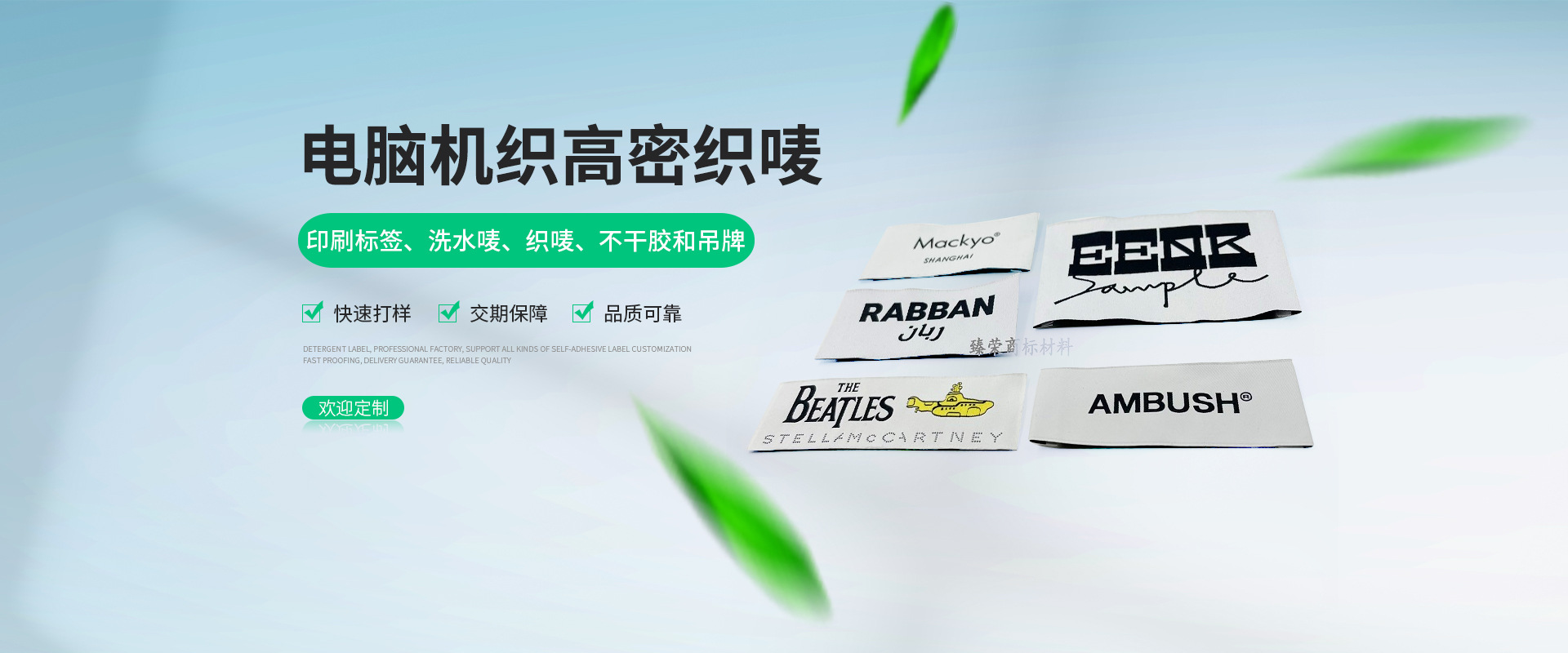


Many are familiar with woven labels as a common clothing accessory, but few are aware of the different classifications of woven labels. Let's explore the various categories of woven labels.
By cutting technique classification
Edge-stitched fabric labels: When the required width of the logo is specified all at once, it is referred to as an edge-stitched label. This process avoids many of the drawbacks of cutting edges, but has a lower yield.
Edge-cut Fabric Labels: Utilizes German machinery. As the name implies, on high-speed machines, it is woven in a continuous piece like fabric, and then cut into strips according to the label width. Due to the heat-melting characteristics of polyester, the threads will stick together during cutting, preventing fraying.
By knitting technique classification
Flat Fabric Banners: Fabric banners, resembling the weave of fabric, are simply created by interlacing one thread vertically and one thread horizontally, which is known as a simple flat banner. Generally, the warp threads are fixed, either black or white, hence the distinction between black flat and white flat. Light-colored background banners usually use white flat, while dark-colored ones typically use black flat. The patterns and colors of fabric banners are mainly expressed through the weft threads, with the expressed colors differing from the effect of crossing with warp threads.
Satin Fabric Labels: The fabric, woven from intersecting warp and weft threads, can be enhanced in quality by doubling the weft threads. Additionally, doubling the warp threads creates the satin weave structure. By doubling the warp threads, the label's texture becomes soft and smooth.
