


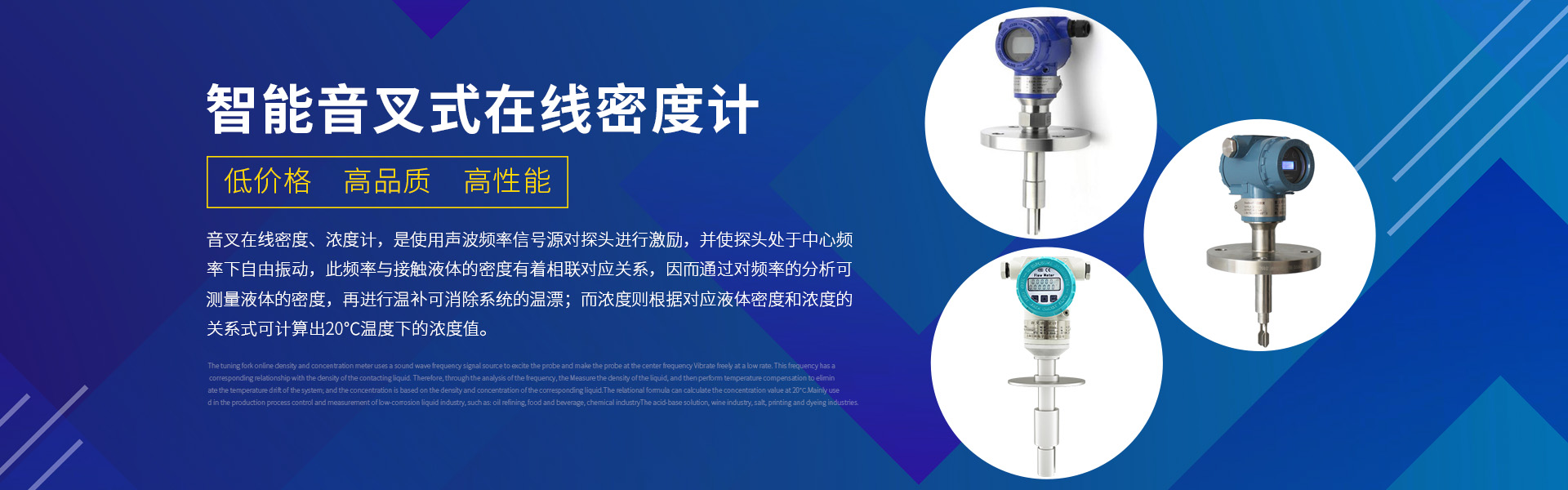

There are two commonly used online density meters: one measures the density of liquids heavier than pure water, known as a heavy meter; the other measures liquids lighter than pure water, referred to as a light meter. Earth's gravity pulls objects towards the ground, but if an object is placed in a liquid, buoyancy will exert a reverse force on it. The magnitude of buoyancy is equal to the weight of the liquid displaced by the object. The density meter rises or sinks based on changes in the balance between gravity and buoyancy.
Working Principle of Online Density Meters
A fully functional hydrometer can only float, which means the upward force of buoyancy must be slightly greater than the downward force of gravity. However, in a state of balance, the weight it experiences is equal to the buoyancy.
The online density meter maintains the same volume as before, thus displacing an equal volume of water. However, due to the increased water content, it becomes heavier. When the weight exceeds the buoyancy, the density meter sinks. Since the weight of the density meter is less than the gravitational pull of an equivalent volume of water, it floats back up.
The readings of an online densitometer are larger at the bottom and smaller at the top. When immersed in different liquids, the volume remains constant but the readings change. The iron sand or lead shot at the bottom of the densitometer is used to maintain balance.
Physical analysis instruments used to measure the density of fluids. Similar to it is the hydrometer, an instrument for measuring the specific gravity of fluids. An online density meter is the mass per unit volume of a substance; specific gravity is the ratio of the density of a liquid or solid to water, or a gas to air, at a specified temperature and pressure. The density of water and air at a certain temperature and pressure is known, so specific gravity and density can be interchanged under specified conditions. The density or specific gravity of a substance is related to its composition, hence density meters and hydrometers are commonly used to test the quality of substances like alcohol, petroleum products, acidic and alkaline solutions, and coal gas. Online density meters can also be used for monitoring and control during the production and processing of such products.
