

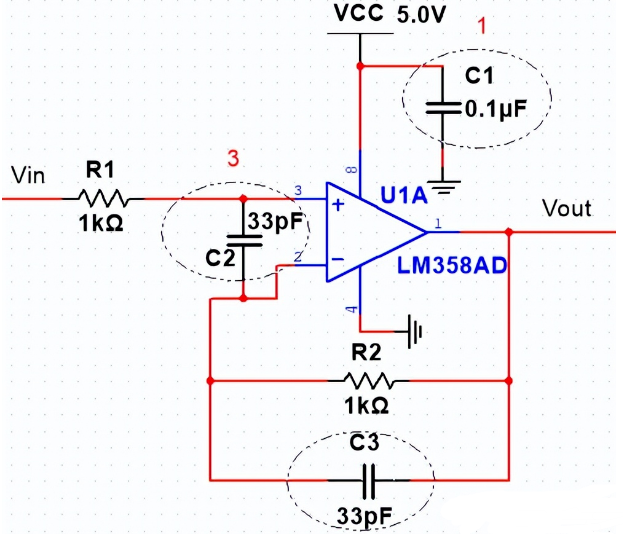
In operational amplifier circuits, you've probably definitely seen a few capacitors, such as:
Power VCC Ground Wire
2. Feedback input/output pins
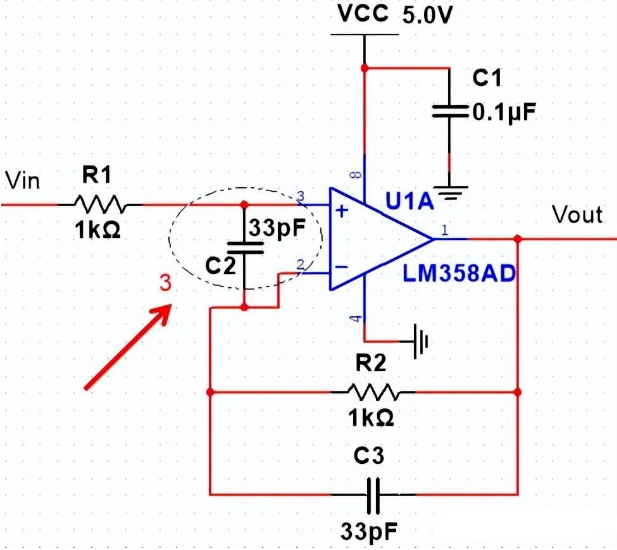
3. The capacitor between the positive and negative input terminals
Although the circuit seems to function without these capacitors, they are generally included during circuit design. So, what exactly are these capacitors used for?
Capacitance of VCC ground wire for power supply
This capacitor primarily serves as a filter, ensuring our power network remains cleaner and suppressing interference signals.
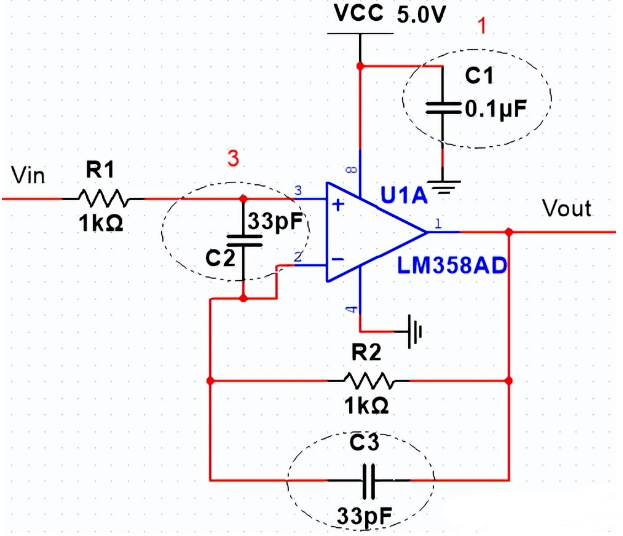
When selecting values, it's usually 103, 104, or 105 and the like. Mainly, it depends on the operational frequency of the operational amplifier; typically, a smaller capacitor is chosen for higher frequencies, and vice versa for larger capacitance.
II. Input and output pins of feedback
This capacitor serves two functions:
1. The compensation effect on frequency, addressing the slow response issue caused by the input capacitor, and preventing the op-amp from oscillating unnecessarily.
2. Filtering out high-frequency interference signals to prevent them from affecting the subsequent circuitry.
Selecting the value usually results in a level of tens of picofarads (PF).
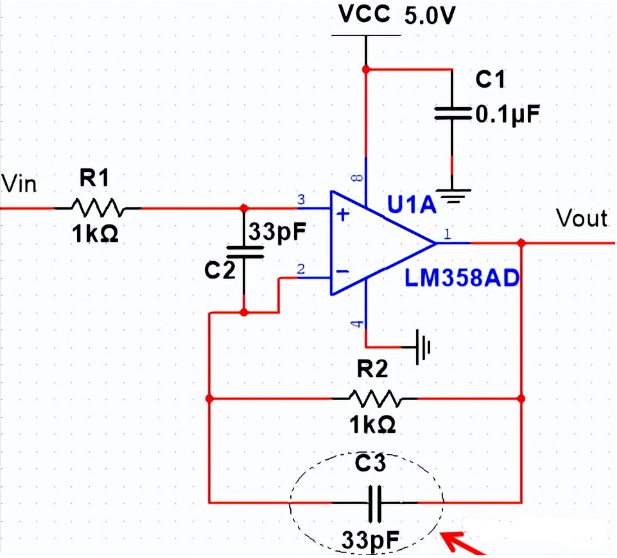
The capacitor between the positive and negative input terminals.
The capacitor's function is to mitigate interference.
Understanding this can be illustrated with an example. Suppose a strong interference signal suddenly appears at the in-phase input terminal, causing the voltage at the in-phase input to exceed that at the opposite phase input. This will immediately result in a disturbance signal at the output. However, as long as there is a capacitor present, the output can quickly feed back to the opposite phase input via the capacitor. This is because the voltage across the capacitor's terminals cannot change instantaneously. Consequently, the signal is fully added to the opposite phase input, allowing the two positive and negative input terminals to cancel each other out.
The selection of capacitance values usually ranges from a few picofarads (pF) to several tens of picofarads.
In summary, the capacitors surrounding the operational amplifier are primarily for noise reduction and filtering. They are not strictly necessary for operation, but including them allows the op-amp to run more stably. Therefore, we typically include these capacitors in our circuit design.
