
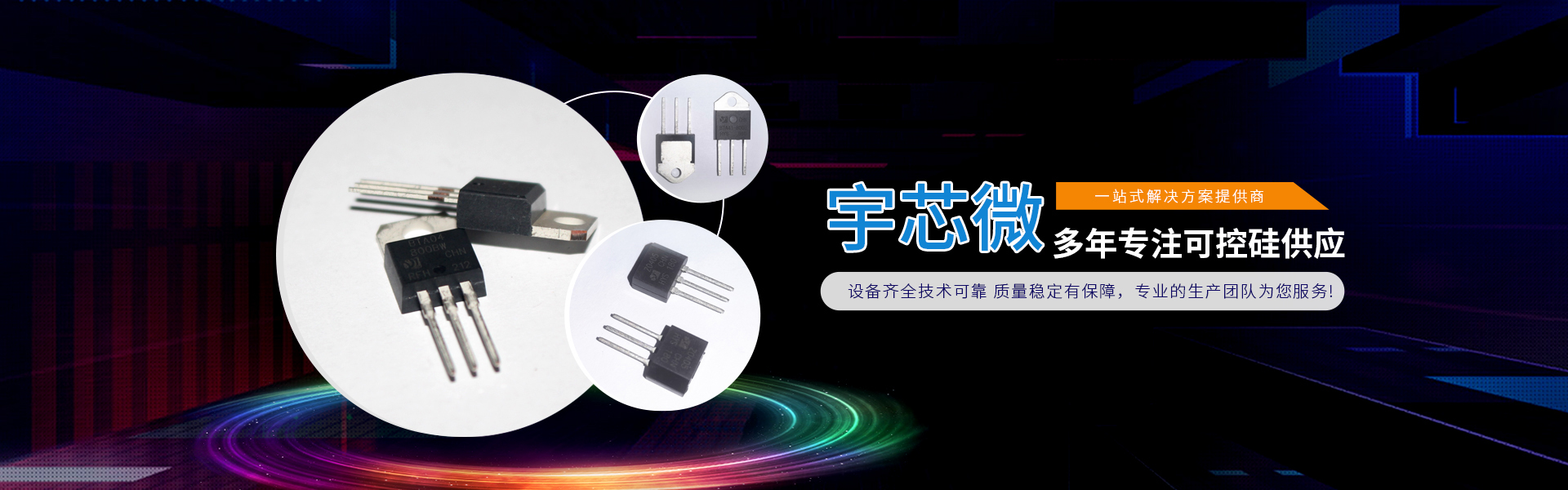

Silicon Controlled Rectifier (SCR), commonly known as a thyristor, is a high-power electrical component with advantages such as small size, high efficiency, and long lifespan. Domestic SCR commonly includes phase-shifting bridge trigger circuits using resistors and capacitors, single-crystal trigger circuits, transistor trigger circuits, and trigger circuits that utilize small thyristors to trigger large thyristors, among others. What are the key characteristics and parameters of domestic SCR?
1. The average current IT in the rated state, under certain conditions, is the mean value of a 50 Hz sine half-wave current that can continuously pass through the anode-cathode.
2. In the case of an open control electrode and without a triggering signal, the forward blocking peak voltage (VPF) can be repeatedly applied across the thyristor when the anode forward voltage has not exceeded the conduction voltage. The peak forward voltage that the thyristor can withstand must not exceed the parameter value specified in the manual.
3. Reverse Blocking Peak Voltage (VPR) - When the thyristor is applied with reverse voltage and in the reverse blocking state, the reverse peak voltage can be repeatedly applied across the thyristor terminals. During usage, this parameter value provided in the manual must not be exceeded.
4. The trigger voltage VGT, which is the small control current and voltage required for a thyristor to switch from the off-state to the conductive state when a certain voltage is applied between the anode and cathode at a specified environmental temperature.
5. Maintain the IH current at the specified temperature, controlling the anode circuit to sustain the necessary small anode forward current for the conduction of silicon-controlled rectifiers (SCRs). Many new types of SCR components have been introduced, such as fast SCRs suitable for high-frequency applications, bidirectional SCRs that can be controlled to conduct in both directions with either positive or negative trigger signals, and SCRs that can be turned on with a positive trigger signal and off with a negative trigger signal, etc.
