
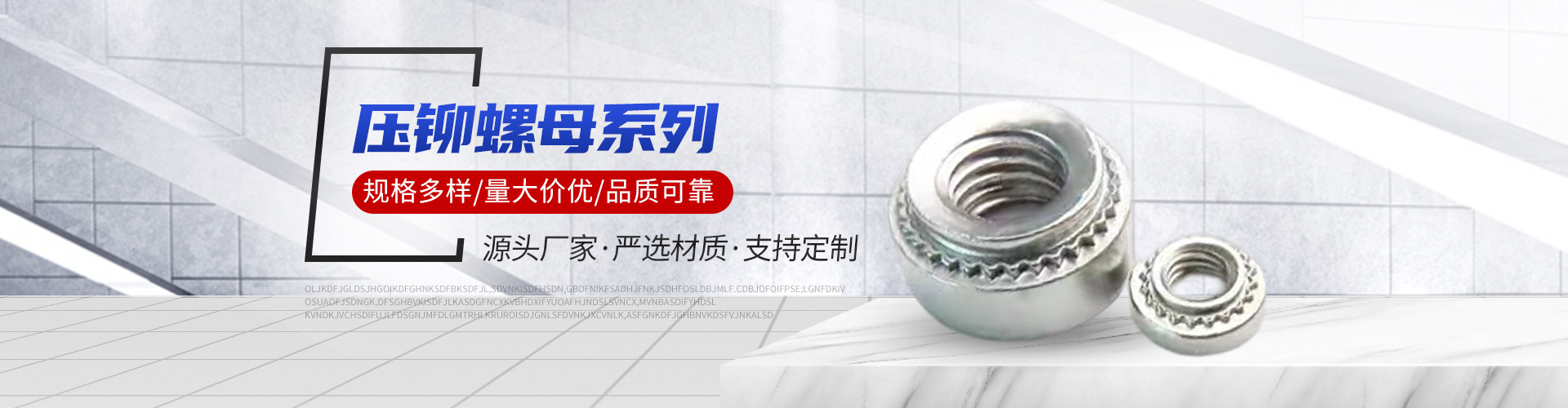



First, screw the rivet nut into the threaded mandrel and apply the working load as specified in Table 1 according to the social standards, maintaining it for 15 seconds. The rivet nut should not come loose or crack. When using PEM press rivet nuts, it is necessary to confirm the size A and the corresponding tail number Z based on the sheet thickness and nut standard. Users should select the tail number from the table according to the sheet thickness.
A new type of fastener, the press-fitting screw, is used for thin plates or sheet metal. Its principle involves pressing the screw into a pre-drilled hole in the sheet metal. Typically, the diameter of the pre-drilled hole is slightly smaller than the outer diameter of the press-fitting screw. Through the application of pressure, the outer diameter of the screw is pressed into the plate, causing the edges of the hole to undergo plastic deformation. The deformed material is then forced into a guide groove, resulting in a locking effect.
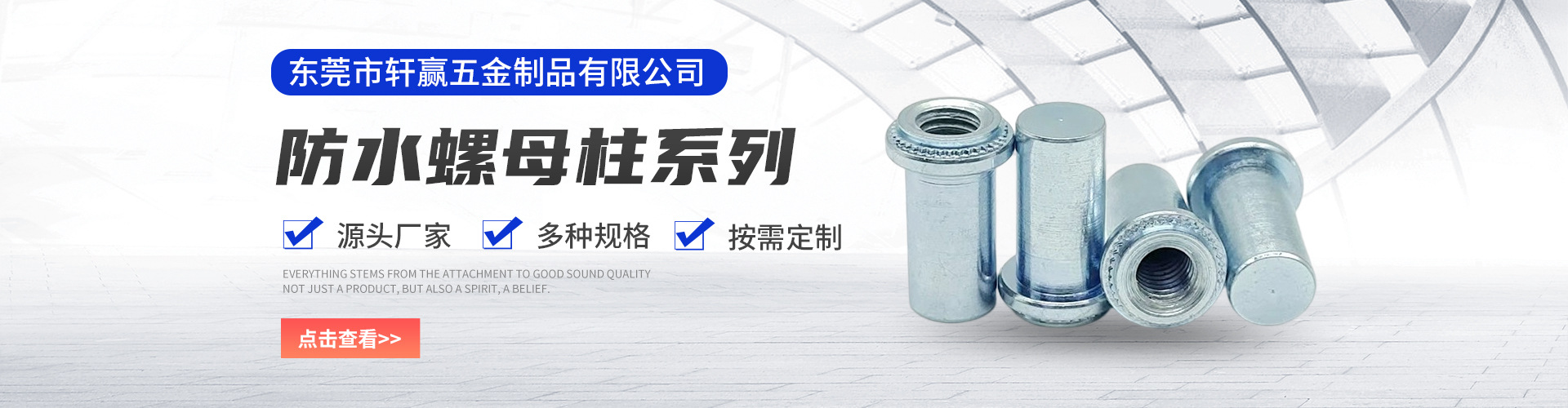
The press-nut stud, also known as the press-nut bolt or stud nut, is a fastener used in sheet metal, thin plates, enclosures, and cabinets. The stud nut has a hexagonal shape at one end and a cylindrical shape at the other, with a chamfer between the hexagonal edge and the cylindrical section. The internal shape features an internal thread, and it is pressed into a pre-drilled hole in the thin plate using a press machine, causing the periphery of the hole to undergo plastic deformation.
After removing different loads, the rivet nut should be able to be turned out by hand, or it can be lightly riveted and then turned out by hand. During the analysis test, the movement speed of the chuck should not exceed 3mm/min. In the test, if the threaded mandrel is damaged, the test is invalid. The hardness of the threaded mandrel should be 45HRC. The thread tolerance is 5h6g, but the larger diameter should be controlled within a quarter of the international range near the lower limit of the 6g tolerance band.
Next, the bolt and nut are threaded onto the core rod, loaded until they crack; there should be no cracking at the junction of the head and the cylindrical section; the load values should comply with the specifications in Table 1. During the test, the speed of the chuck movement should not exceed 3mm/min. If the core rod is damaged during the test, the test will be invalidated.
The fourth step involves riveting nuts onto the rivet plate and bolts without any smooth conditions. Apply torque until the rivet nut breaks or the threads are not sealed. The torque measurement error of the selected torque testing machine or tool should not exceed 2% of the relatively larger additional torque. The thickness of the rivet plate and the thickness of the holes are recommended according to the product standards for a relatively larger rivet thickness h and d0 or s0 specifications.
After comparison, rivet nuts are riveted onto the riveting panel and then拧入试验螺栓 without any lubrication. Apply torque until relative rotation occurs between the rivet nut and the riveting panel. The torque testing machine or device used in the test should have a torque measurement error not exceeding the specified amount for the dimensions h and d0.
