
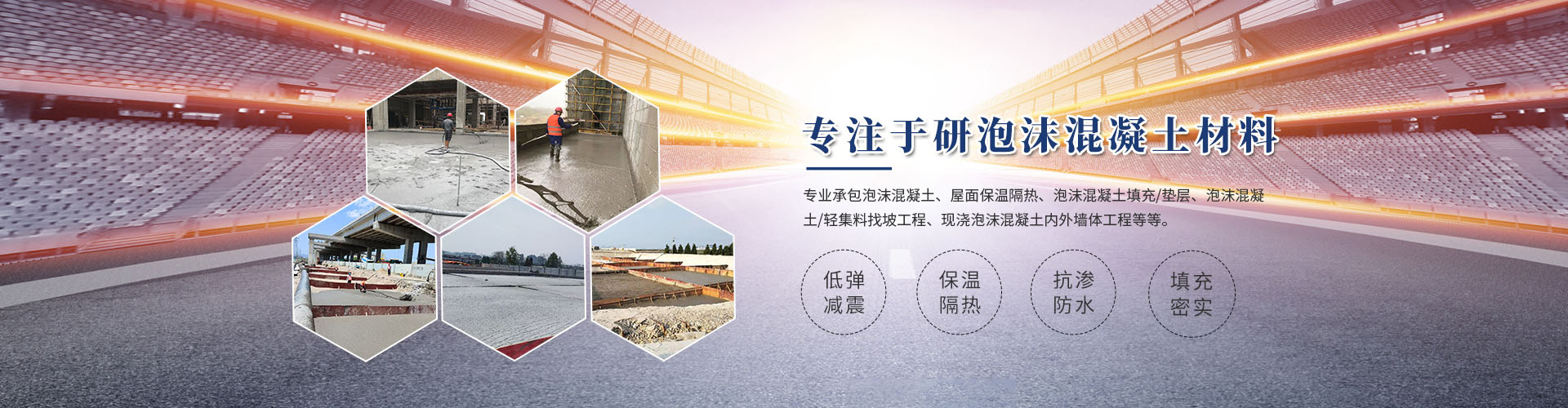


Foam concrete is one of the major technological advancements in the 100-plus years since the birth of cement concrete. It lightens and functionalizes heavy-duty cement concrete, endowing it with numerous properties such as lightness, thermal insulation, heat insulation, sound absorption, sound insulation, fire resistance, fireproofing, impermeability, waterproofing, shock wave resistance, electromagnetic wave resistance, corrosion resistance, water retention, energy absorption, ease of construction, environmental friendliness, time-saving, and efficiency enhancement. It is one of the most functional bulk inorganic lightweight materials to date. Its invention and application have opened up a special application field for concrete. In the future, foam concrete will profoundly impact people's lives and benefit society in various aspects. Its significance will soon become apparent.
Insulation and Thermal Retention Applications
Foam concrete contains a large number of sealed air pockets, with the air inside serving as an excellent insulating medium that interrupts heat exchange. The lower its density and the more air pockets it has, the better its insulating properties. Particularly, foam concrete with a density below 500 kg/m³ has a thermal conductivity coefficient less than 0.09 W/m.k. Materials with a thermal conductivity coefficient below 0.23 are typically called insulating materials, while those below 0.14 W/m.k are referred to as thermal insulation materials. Most foam concrete has a thermal conductivity coefficient below 0.14 W/m.k, with many below 0.09 W/m.k, making it an excellent thermal insulation material.
Insulation and thermal insulation applications
Insulation and thermal insulation are the primary applications of foam concrete, currently accounting for 80% of its total production. Its excellent insulation properties, coupled with the policy push for energy-saving in buildings, have led to its large-scale adoption in the insulation sector. The focus of development and application is now shifting to walls, with the next wave of popularity expected to be self-insulating walls. Various types of foam blocks, foam panels, foam cast-in-place walls, and various composite exterior wall insulation panels have been launched in various regions, marking the beginning of their large-scale production and application. Nationally, the use of foam concrete in building insulation has evolved from the initial stage to the promotion phase, with a peak in application expected within 3 to 5 years.
If all building insulation is applied with foam concrete, including roof and wall insulation layers, as well as ground heating insulation (or cushioning layer), it's as if the entire house is wrapped in foam concrete. Approximately 0.2m³ to 0.5m³ of foam concrete is needed per square meter of building area (with a 5cm insulation layer for the roof, ground, and all walls), meaning a building of 10,000 square meters would require 2,000m³ to 5,000m³ of foam concrete. If all new construction and existing energy-saving renovations across the nation were to use foam concrete, the demand would be astronomical.
2. Application of Insulating Blocks for Building Thermal Conservation
Insulating Masonry Units: With a density of 300 kg/m³, thermal conductivity of 0.05-0.08 W/m·k, and compressive strength of 0.5 MPa. These blocks offer excellent insulation properties, filling a gap in the market for high demand in building energy-saving solutions. The advantage of foam concrete lies in its ultra-lightweight blocks, which are the direction of development as China intensifies its focus on building energy efficiency. They can achieve integrated insulation, with the walls themselves meeting the energy-saving requirements of 65%, eliminating the need for external insulation treatment, and reducing the cost of building insulation by 40%-50%.
Load-bearing Insulation Blocks: Density 1000-1200 kg/m³, Compressive Strength > 10 MPa, Thermal Conductivity 0.18-0.22; they are one-third lighter than red bricks and twice as insulating. These blocks can completely replace red bricks in load-bearing walls, integrating insulation, load-bearing, and lightweight properties, offering significant advantages over red bricks and a larger market potential.
Insulation for Cold Storage Facilities
Insulation in cold storage facilities is now predominantly using foam plastic. However, due to the aging, shrinkage, and flammability of foam plastic, developed countries have switched to foam concrete for insulation layers, a transition that China has also initiated. The primary method involves the cast-in-place construction of foam concrete for roofs, walls, and floors, eliminating cold bridges and gaps.
Insulation for Industrial Furnaces and Kilns
Our main products are refractory insulation bricks.
Large industrial furnaces such as steel mills, glass factories, ceramic factories, non-ferrous metal smelting plants, and cement kilns require the construction of a layer of insulating refractory bricks on the outer side of the refractory bricks to reduce energy consumption. Traditionally, these were often made from expanded polystyrene bricks or alumina foam bricks, which were expensive. However, China has begun to adopt foamed concrete refractory bricks as a substitute for these high-priced traditional products, offering a price that is less than half as much, making it highly competitive.
Acoustic and soundproofing applications
Hollow foam concrete is an excellent sound-absorbing material, while closed-cell foam concrete serves as a great sound-insulating material. Both have a significant market presence, with sound-absorbing materials showing even brighter prospects.
Materials with an average sound absorption coefficient greater than 0.2 are typically referred to as sound-absorbing materials. Traditional products include fiber types (such as rock mineral wool boards) and porous types (like foam plastics and foam glass). Foam concrete is a new type of porous sound-absorbing material with an average absorption coefficient of 0.8 to 1.4, classifying it as a strong sound-absorbing material, reaching Level 1 or Level 2 standards. It has significant market and competitive advantages in the following applications.
2.1 Outdoor Acoustic Absorption Materials (Highway and Rail Noise Barriers)
The outdoor acoustic material market for foam concrete is primarily for sound-absorbing barriers alongside highways and railways. With the future development of railway and highway infrastructure in our country, there is at least a 30 million square meter demand for sound-absorbing barriers. Currently, the main materials for road use are wood chip cement boards and foam glass panels. The former has a low sound absorption coefficient, failing to meet the needs of high-speed railways and being aesthetically unappealing, while the latter is too expensive. Foam concrete, however, offers excellent sound absorption properties and can meet any road acoustic requirements at a low cost. We should seize the opportunity to develop this material.
2.2 Indoor Wall Sound Absorption
Acoustic absorption in indoor spaces includes acoustic ceilings and walls. Foam concrete has a significant market advantage in wall acoustic absorption. Compared to fiber acoustic boards like rock and mineral wool, it does not cause itchy skin during cutting and installation, and it also offers good strength at a lower price. This product will have a large market in subway walls, as well as in other building walls such as large shopping malls, waiting rooms in stations, cinemas, and conference halls.
2.3 Soundproof Core Composite Panel (Partition Thin Plate)
The current partition walls are installed with 5~10mm thick gypsum board on both sides of the wooden frame, leaving the interior hollow and soundproofing ineffective. They are also not sturdy and cannot support nails. The new foam concrete composite soundproofing panels are only 5cm thick, occupying less space. Their two surfaces are colored decorative layers, with a 4cm thick foam concrete core in the middle, providing both partition and soundproofing functions. Installation is twice as fast and has been well-received by consumers.
