
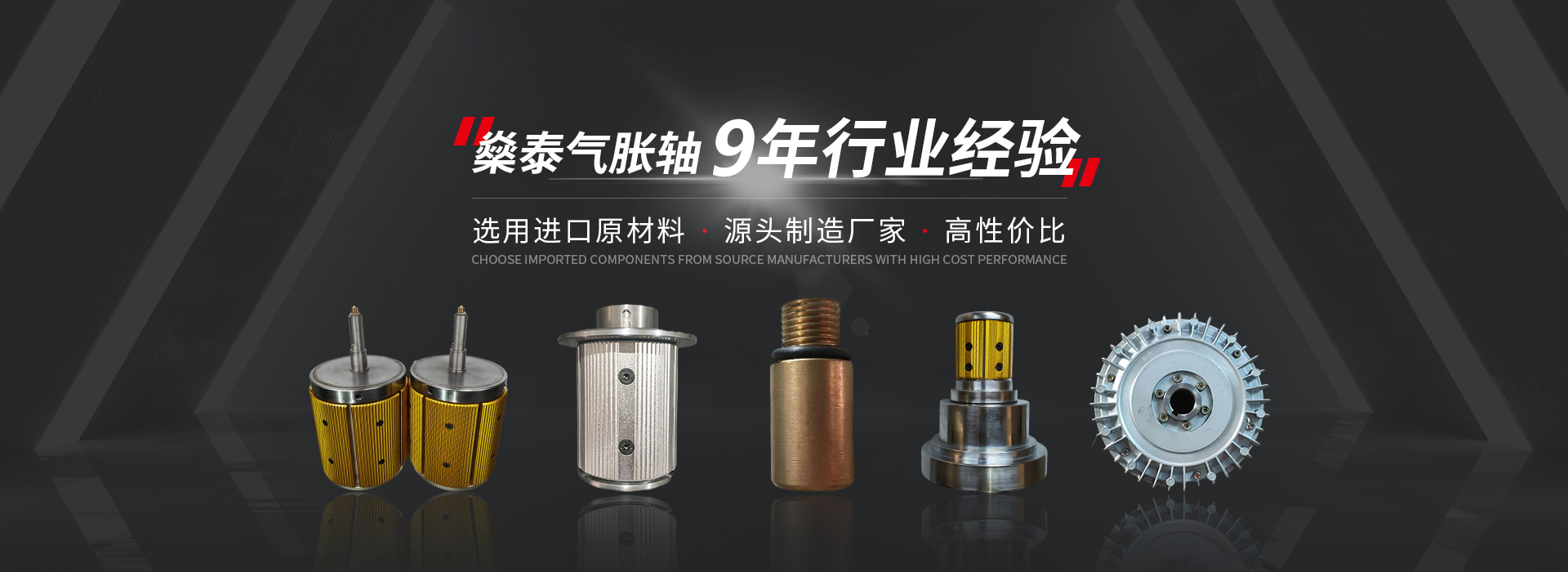


The sliding shaft, also known as the differential shaft or friction shaft, is primarily used as the winding shaft for slitting machines and unwinding shafts for special products. The friction force of the sliding shaft is adjusted by the air pressure introduced.
The sliding shaft is primarily composed of the shaft core, friction components, and several sliding rings. Each sliding ring can rotate independently. The torque is controlled by the central air pressure or side-pressure transmission, ensuring a constant and even tension from the inner to the outer roll diameter of each coil. The end faces are neatly arranged, and the constant tension winding and unwinding guarantee the orderly material.
The main application is in the winding section of the slitting machine, which is a device that cuts large rolls of material into smaller ones. It requires accurate segmental control of tension on the same take-up shaft to effectively adjust the product's elongation rate and ensure flatness of the end face.
Due to thickness variations across the entire material, during the strip winding process, significant cumulative diameter errors occur among the rolls, leading to varying speed and tension discrepancies between the rolls. This results in uneven tension, uneven ends, and some rolls experiencing stretching deformation due to excessive tension.
The sliding shaft can overcome these phenomena. Various sliding rings slide with a certain sliding torque, perfectly compensating for the speed difference and accurately controlling the tension of each roll of material. By selecting the appropriate sliding shaft model based on the material, width, thickness, and elongation, ideal results can be achieved.
The differential shaft enables slitting machines to be designed for automatic unwinding, with user-friendly operation. This significantly improves the precision of slitting and winding, operating speed, and production efficiency. The differential shaft enhances yield rates and reduces costs, making valuable materials (such as metal foil, lithium battery separators, lithium battery anodes, and photographic paper, etc.) indispensable. The differential shaft also simplifies the slitting of narrow-width rolled materials.
