

A countersunk rivet is a component used in riveting that relies on its own deformation or interference fit to join parts. Countersunk rivets are widely used in automotive and vehicle applications, mechanical and electrical products, construction and decoration, as well as household appliances. They are suitable for situations with lower strength requirements, where the thread diameter is less than 10mm, and where screws are inserted and tightened. The screw head is fully or partially countersunk into the connected part, a structure often used in smooth and flat surfaces, such as instrument surfaces.
Surface cracks that affect usage are not permitted on sinker rivet; metal burrs on the top of the rivet head are not allowed to affect usage; rounded, burrs, dents, scratches, rust, and flattened ends of the rod are not permissible if they affect usage. There is a high requirement for coaxial tolerance of the rivet rod.
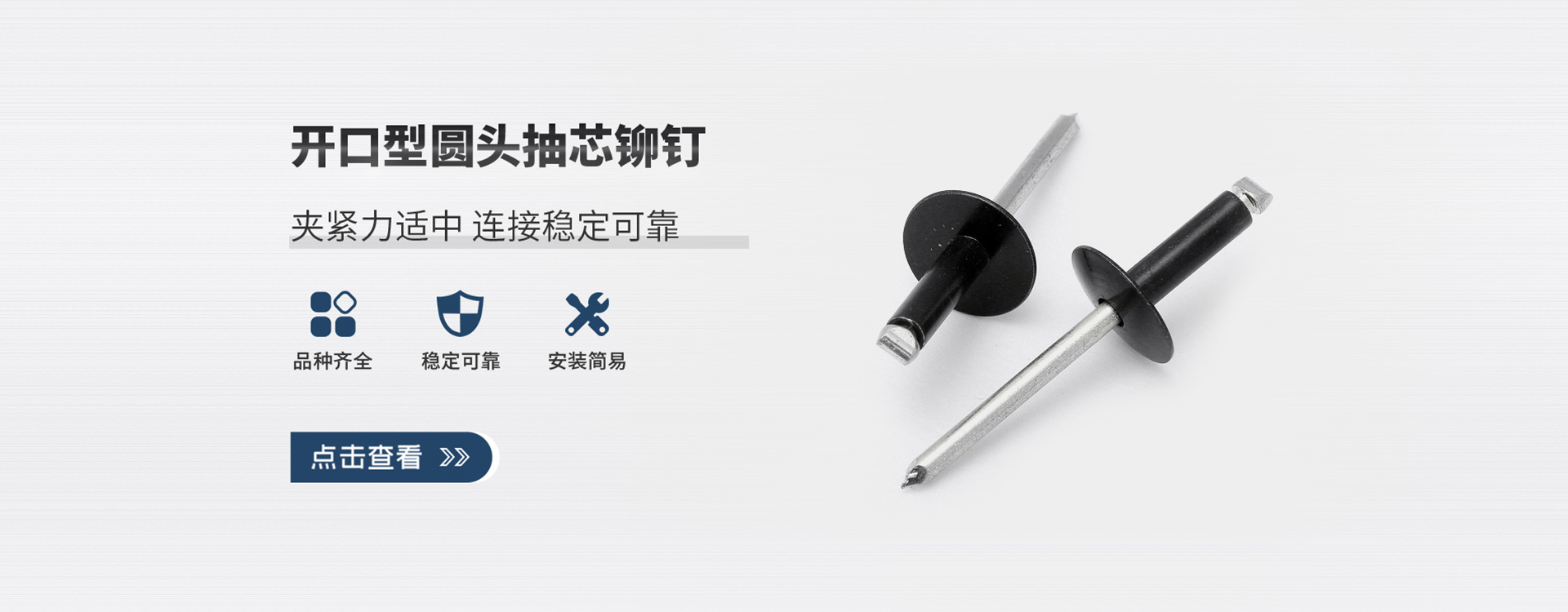
There are many different styles of headed rivets, commonly used. A common type is the round-head rivet. The round-head rivet has a shape that resembles half of a sphere, with both a head and a face. When these rivets are properly in place, the head is clearly visible on the surface of the object. Other common types, such as pan-head or flat-head rivets, also adhere to the surface of the object being connected.
A countersunk rivet features a head shape that makes the top of the rivet flush with the surface of the connected object. This requires a specially formed countersunk hole. Other rivets are different because, as long as they are the correct size, they will fit into any hole. The top of a countersunk hole allows the head to move down further and expand. It effectively lowers the rivet into the connection, making its top level with the material's surface.
The countersunk rivet holes have the same shape. This common shape allows the rivet to sit flush with the object while seated in the hole. In almost all cases, the rivet head takes on the shape of a funnel. Rivets with beveled edges are superior to those with straight edges, as they are less likely to trap water or air within the connection.
Manufacturers utilize countersunk rivets to maintain a smooth surface on the objects being connected. The surface of the placed rivet is then a common covering surface, concealed by sealant or paint, with the rivet head hidden. This makes the surface aesthetically pleasing as it can be completely smooth. Additionally, it reduces resistance compared to when air needs to flow over a common rivet head, making these common rivets widely used in high-performance vehicles.
