




Several technical data of high-energy radiographic inspection
Inherent Uncertainty
The high-energy X-ray device has a small focal point. To achieve a sufficiently large irradiation field during high-energy X-ray photography, a larger focal length is typically used. Consequently, the geometric unsharpness is minimal, but the inherent unsharpness is larger due to the high ray energy. Contrary to low-energy X-ray photography, inherent unsharpness becomes the primary factor affecting the clarity of high-energy X-ray photography. Table 8-1 provides the values for the inherent unsharpness of high-energy X-ray photography.

2. Sensitivity
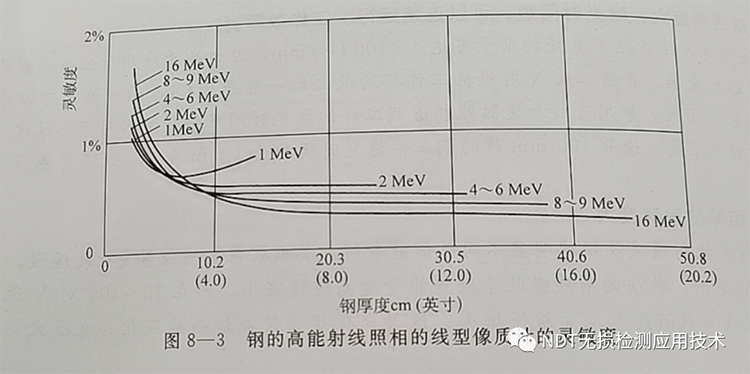
In most materials and thickness ranges, with proper technique, high-energy radiographic sensitivity can reach or fall below 1%. Figure 8-3 illustrates the sensitivity curve of a linear image quality indicator for high-energy radiographic steel.
3. Sensing Screen
In high-energy radiographic applications, the thickness of the front screen significantly affects both the sensitization and filtering effects, whereas the thickness of the rear screen is relatively unimportant for sensitization. Therefore, a rear screen can be omitted during high-energy radiographic procedures.
Research has shown that under certain conditions, the sensitivity of high-energy radiographic imaging can be enhanced without the use of a back screen, which differs from conventional radiographic methods.
During actual photography, a lead intensifying screen with a thickness of approximately 0.25mm is typically used on the front screen. If the rear screen is utilized, its thickness can be the same as the front screen.
The thickness of the intensifying screen for high-energy X-ray radiography can be selected according to the data in Table 8-2.
Besides lead, copper, tantalum, and tungsten materials can also be used for the sensitized screens based on actual needs, to meet various flaw detection requirements.

Radiation Protection for High-Energy Ray Acceleration
High-energy rays produced by the accelerator are not only high in energy but also possess great intensity. For instance, the Linatron 400 produced by the U.S. company Varian, at a distance of 1 meter from the target, the device outputs a dose of 4 Gy of radiation per minute with an energy of 4 MeV.
The half-lethal dose for the whole-body radiation is 4 Gy. If personnel are mistakenly exposed to this device, it is extremely dangerous; therefore, adequate safety precautions must be taken.
The radiation shield for the accelerator primarily employs shielding protection. The shielding room of the accelerator must undergo specialized safety design, with the dose rate outdoors being lower than the national health standards.
Due to the harmful ozone and nitrogen oxides produced by the ionization of air by high-energy X-rays, it is necessary to install ventilation fans for air exchange indoors.
3. For linear accelerators, in addition to protecting against unintended harm from high-energy X-rays, microwave radiation protection should be implemented, and precautions must be taken against the hazards of high voltages, Freon gas, and other harmful substances to human health.
