


Choice of Transparency Method
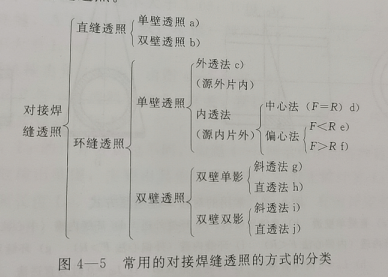
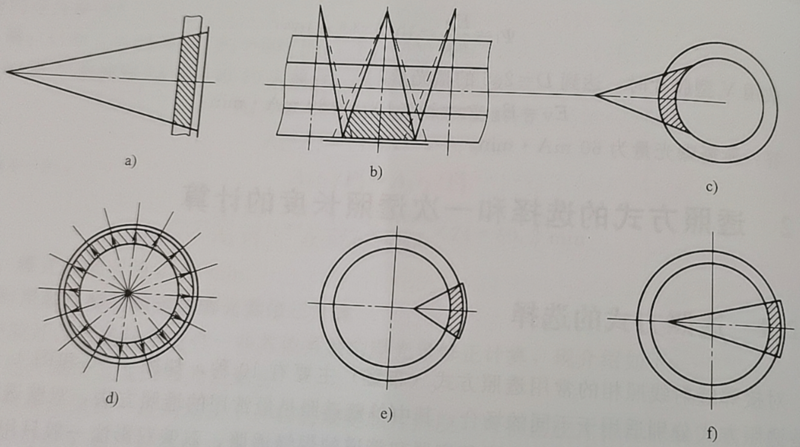
Common radiographic methods (arrangements) for seam radiography include ten main types, as shown in Figures 4-5 and 4-6.
These radiographic methods are suitable for different scenarios. Single-wall radiography is a commonly used method, while double-wall radiography is generally used for weld radiography in small-diameter containers and pipes where the source or film cannot enter the interior. Double-shadow double-wall radiography is typically used for annular weld radiography in pipes with diameters below 100 mm. Double-shadow straight-through radiography is more commonly employed for pipes with a wall thickness (T) greater than 8 mm or a weld width (g) greater than D0/4.
When selecting the X-ray method, various factors should be thoroughly considered and weighed to choose the best option. Relevant factors include:
Transillumination sensitivity
When there is a significant difference in radiographic sensitivity, it is advisable to choose a radiographic method that benefits sensitivity enhancement. For instance, the sensitivity of single-wall radiography is notably higher than that of double-wall radiography. Undoubtedly, the former should be selected when both methods are viable.
2. Defect Detection Characteristics
Some radiographic methods are particularly suitable for detecting certain types of defects, which can be selected based on the actual requirements for detecting the defects.
For external radiographic inspection, the detection rate of surface cracks on the inner wall of the container is higher compared to internal radiographic inspection; the direct transmission method in double-wall radiography is easier to detect incomplete welds or root mismelt defects than the oblique transmission method.
3. Detecting thickness variations and transverse crack detection angles
Reduced radiographic thickness and crack detection angles in the transverse direction are beneficial to enhance film quality and crack detection rates. During ring seam radiography, with the same focal length and single radiographic length, the source-internal radiographic method exhibits a smaller difference in radiographic thickness and a narrower crack detection angle compared to the source-external method. From this perspective, the former is superior to the latter.

4. One-time exposure length
Different radiographic methods have varying single exposure lengths. Selecting a radiographic method with a longer single exposure length can enhance detection speed and work efficiency.
5. Ease of operation
Generally speaking, the operation is more convenient for container radiography with the source on the outside. For spherical tanks, it's easier to perform X-ray radiography with the source on the outside for the upper hemisphere, and on the inside for the lower hemisphere.
6. Specific details of the specimens and inspection equipment
The choice of radiographic method is also related to the specimen and the flaw detection equipment. For instance, when the specimen diameter is too small, internal radiography may not meet the requirements for geometric unsharpness, necessitating the use of external radiography. Mobile X-ray machines can only be used with external radiography. When using gamma ray sources or circular X-ray machines, choosing the internal central radiography method for circumferential exposure of the annular weld can better utilize the equipment's advantages.
It is worth emphasizing that among various radiographic methods for circumferential welds, the center-pierced radiographic technique with the source inside is the most preferable. This method ensures uniform thickness radiography, a 0° detection angle for transverse cracks, excellent film density and sensitivity, high defect detection rates, and the ability to radiograph the entire circumferential seam in one go, significantly enhancing work efficiency. It should be chosen as much as possible.
