
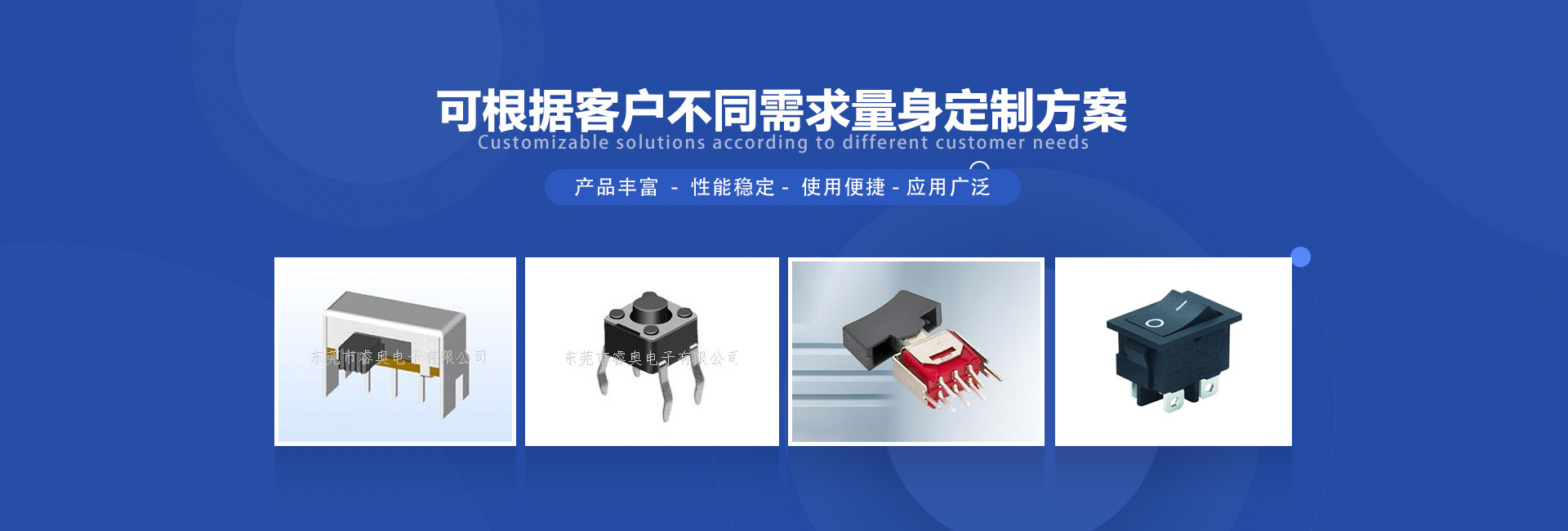


The switch mechanism primarily includes the toggle switch, the housing, and the electronic device's toggle switch housing. This utility model improves the uniformity of the cooperation gap between the toggle switch and the nested housing, also enhancing the appearance's quality. It optimizes the arrangement and method of assembly, as well as the assembly power, reducing costs and the failure rate of assembly, while improving the reliability of the toggle switch usage.
The switch includes an interconnected housing and base cover, surrounding a cavity inside which are mounted a push seat, a touch bridge, and terminals. The touch bridge is a one-piece molded elastic metal touch bridge.
Typical elastic elements are springs or leaf springs, which are relied upon for touch switches and toggle switches. This has simplified the assembly process, streamlining the installation of touch bridges and elastic elements, and also simplified the parts. Consequently, it has reduced the cost of materials.
Switches are examined based on their shell materials. Major switch brands on the market typically use PC material, also known as bulletproof plastic. Its properties of resistance to impact, high-temperature tolerance, and resistance to discoloration are crucial for electrical switch control. High-quality switches have both the front panel and the back base made of PC material, whereas most switches replace the PC material with black nylon on the base, significantly reducing costs.
Next, consider the contact points during the switch operation, which are the touching points of the conductive components. The contact points should be checked for size (the larger, the better) and material. Currently, there are mainly three types of contact points: silver-nickel alloy, silver-cadmium alloy, and pure silver. Silver-nickel alloy is a more ideal material for contact points, offering good conductivity, hardness, and resistance to oxidation and rust.
