
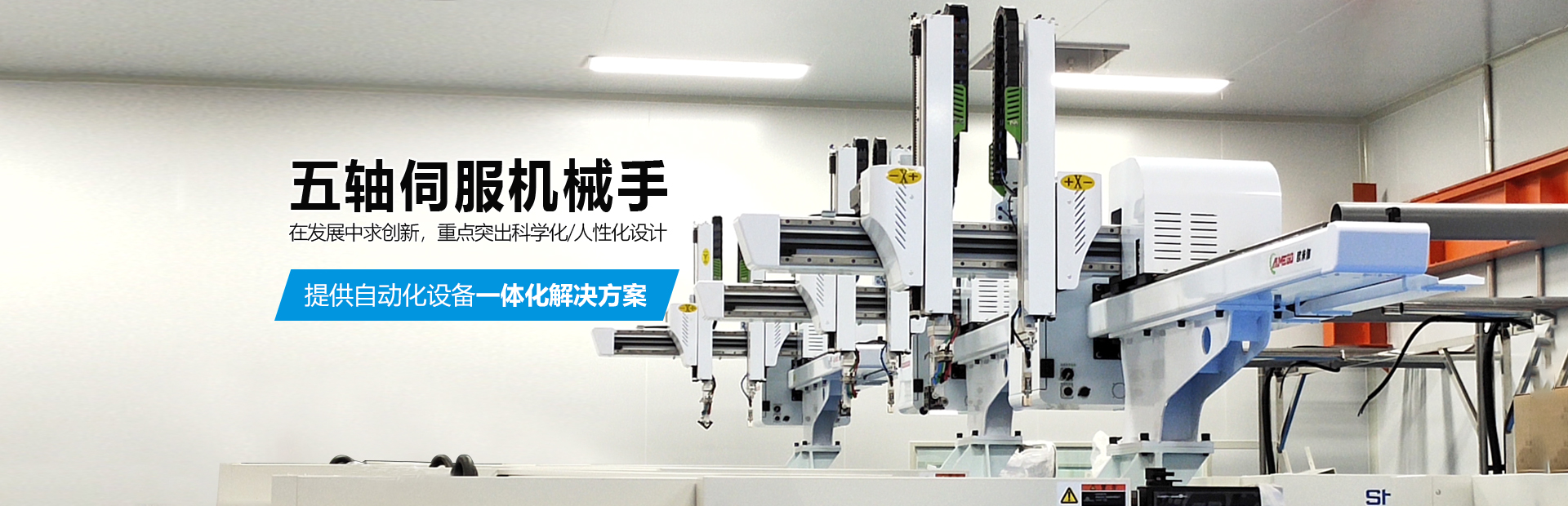


The Servo Energy-Saving Series Injection Molding Robots are equipped with a high-performance servo variable speed power control system. During the molding process of the injection molding robots, they provide different frequency outputs for varying pressure and flow rates, and effectively implement closed-loop control over pressure and flow. This achieves rapid response and matching, as well as automatic adjustment, of the energy demands of the servo motors for the injection molding robots.
1. Employing high-performance servo controllers and energy-saving components such as servo motors.
2. A sensitive servo control system with a rapid startup response time of only 0.04 seconds.
3. Servo motors and hydraulic systems are integrated into a closed-loop control, significantly enhancing the repetitive accuracy compared to traditional models.
4. Reduce the impact on the unlocking mold to extend the service life of mechanical parts and molds.
5. Reducing electricity consumption, this model can achieve a power-saving efficiency of 20% to 80% compared to traditional injection molding machine robots under ideal working conditions.
6. The system generates significantly less heat than traditional injection molding machine arms, saving approximately 30% of cooling water usage and extending the lifespan of oil pathway seals and hydraulic components.
7. The operation noise is significantly lower during full-line operation compared to traditional injection molding machine robots.
Vertical Injection Molding Machine Robot
The injection unit and clamping unit are aligned on the same vertical centerline, and the mold opens and closes vertically. The footprint is only about half that of a horizontal machine, resulting in a production capacity approximately twice as high when converted to floor space.
2. Easy to achieve insert molding. Due to the mold surface being upward, inserting the inserts is straightforward. By using a machine with a fixed lower mold plate and a movable upper mold plate, when combined with a conveyor belt and a robotic arm, full automation of insert molding can be easily achieved.
The mold's weight is supported by the horizontal template, allowing for smooth up and down opening actions without the occurrence of front tilting due to mold gravity, as seen in horizontal machines. This prevents the template from failing to open or close properly. It is beneficial for maintaining the precision of both the machinery and the mold over the long term.
4. The simple robotic arm allows for the removal of various plastic mold cavities, facilitating precise molding.
5. Generally, the mold locking device is open around the periphery, which facilitates the integration of various automated devices. It is suitable for the automatic molding of complex and delicate products.
The conveyor belt system is easily installed through the mold center, facilitating automatic molding production.
7. Ensures consistent resin flow and mold temperature distribution within the mold.
Equipped with rotating, sliding, and tilting platforms, it facilitates easy component forming and in-mold assembly.
During the small batch trial production, the mold structure is simple, low-cost, and easy to disassemble.
10. After enduring multiple earthquakes, the vertical machine has shown superior seismic resistance compared to the horizontal machine, due to its lower center of gravity.
News Center Co., Ltd.
