
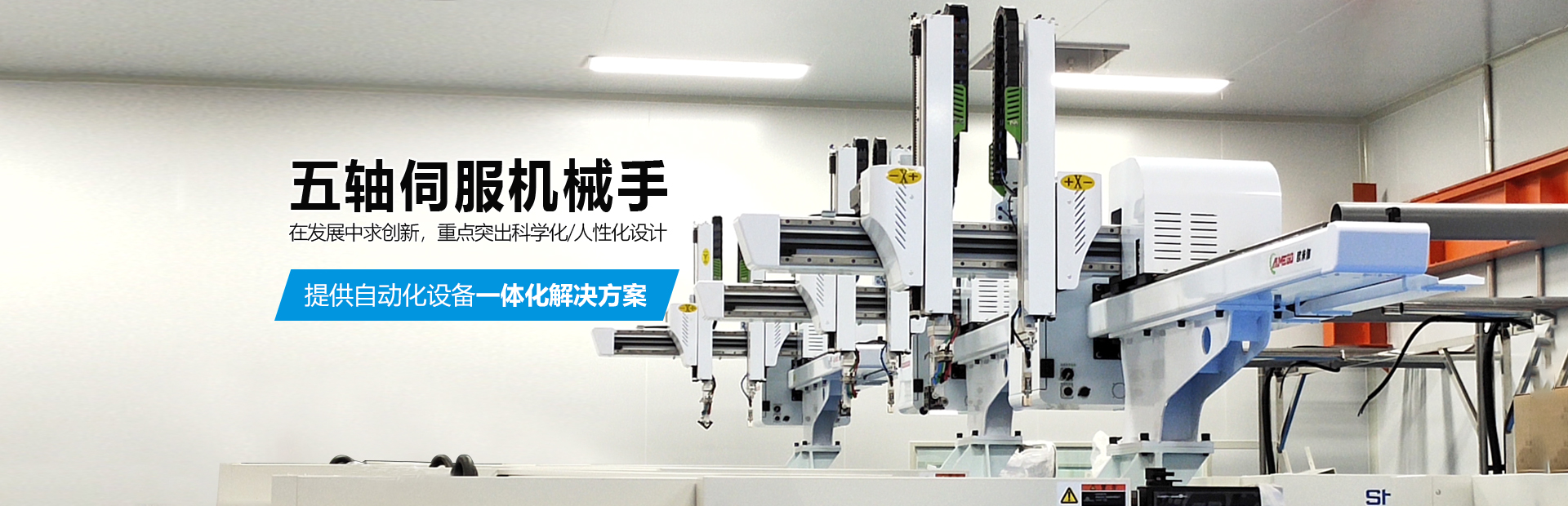


The use of injection molding machine automated robots in production can significantly enhance production efficiency and product quality, as well as reduce production costs. Many machinery manufacturers are now opting to use injection molding robots as the primary production method. However, whether the injection molding robots can accurately operate in production is essentially a three-dimensional positioning issue, involving a combination of linear and angular measurements. In many simpler cases, a single measurement may be the primary factor. Factors affecting the accuracy of individual linear or angular measurements include:
1. Positioning Methods -- Different positioning methods are influenced by various factors. For instance, when using mechanical stop blocks for positioning, the positioning accuracy is related to factors such as the rigidity of the stop block and the speed of contact during positioning.
2. Positioning Speed – The positioning speed significantly affects positioning accuracy. This is due to the varying energy dissipation required for different positioning speeds among moving parts. Typically, to minimize positioning errors, it is essential to control the positioning speed appropriately, such as enhancing the cushioning performance and efficiency of the cushioning device, and regulating the drive system to decelerate moving parts at the right time.
Precision – The manufacturing accuracy of the mechanical arm and the installation speed regulation accuracy directly affect the positioning accuracy.
4. Rigidity — When the structural rigidity and contact rigidity of the robotic arm itself are low, it is prone to vibration, resulting in generally lower positioning accuracy.
5. Weight of Moving Parts – The weight of moving parts includes the weight of the robotic arm itself and the weight of the item being handled. Changes in the weight of moving parts significantly affect positioning accuracy. Generally, as the weight of the moving parts increases, the positioning accuracy decreases. Therefore, during the design process, it is not only necessary to reduce the weight of the moving parts themselves but also to consider the impact of changes in the weight being handled during operation.
6. Drive Source – Pressure fluctuations in hydraulic and pneumatic systems, as well as fluctuations in voltage, oil temperature, and ambient temperature, can affect the repeatability accuracy of the robotic arm. Therefore, necessary measures for voltage stabilization and oil temperature regulation are implemented. This includes using accumulators to stabilize oil pressure, heaters or coolers to control oil temperature, and during low-speed operation, using temperature and pressure compensation flow control valves.
7. Control Systems -- The positioning accuracy of switch control, electro-hydraulic proportional control, and servo control is different. This is not only due to the varying precision and sensitivity of the various control components but also related to the presence or absence of position feedback devices.
