

霖龙 Company reveals that EVA foam has the elasticity of rubber, is very soft and has great resilience. It maintains good flexibility at temperatures as low as -50°C, excellent transparency, and a glossy surface. The foam boasts excellent chemical stability, resistance to aging and ozone, and is non-toxic.
Excellent blending properties with fillers, good coloring and molding processing. EVA foam is reusable and has a relatively low environmental impact. With the advancement of social forms and the growing environmental awareness of people, EVA foam plays a crucial role in the packaging industry. In the future, EVA foam materials will be ubiquitous in people's lives.
A factor to be aware of during the EVA low-density extrusion molding process is that the melt should flow smoothly through the mold cavity to form a smooth surface that is less prone to cracking. Lubricants affect the finish of the mold cavity surface, the mixing and distribution of the foaming gas, which in turn influences the bubble structure of the EVA foam body.
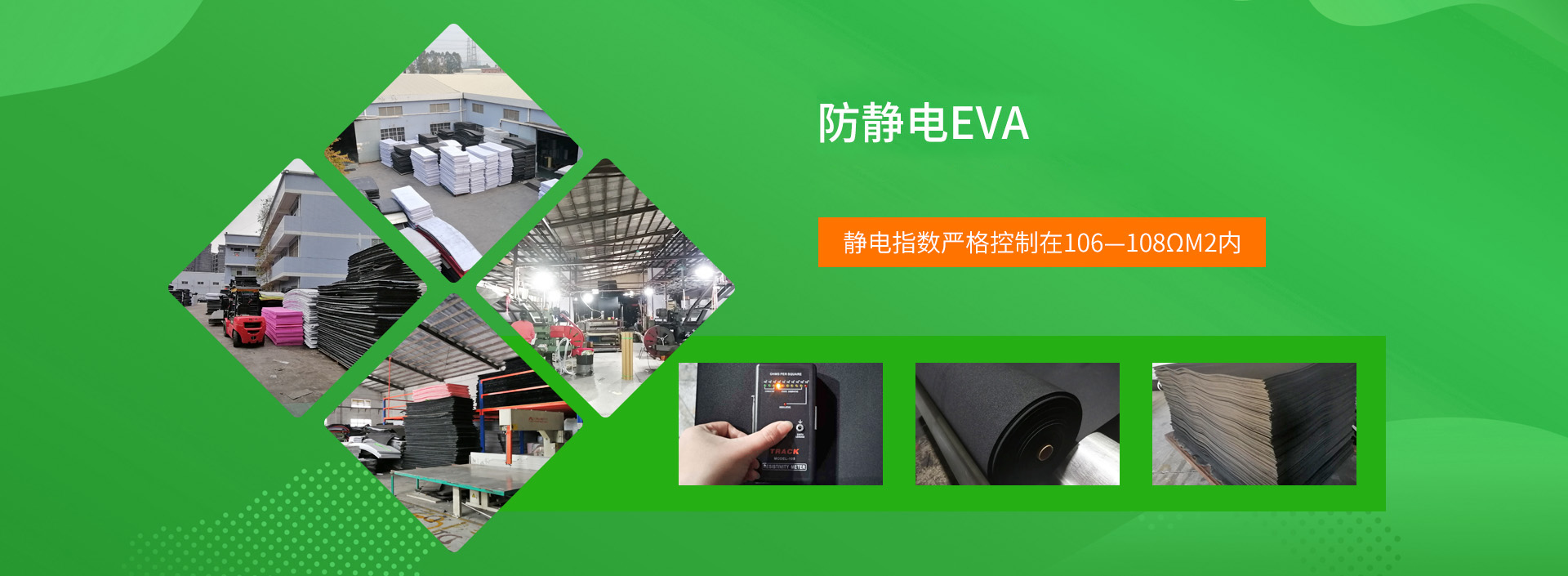
Anti-static EVA foam product specifications: Sizes can be customized according to customer requirements. Features include good barrier, heat-sealability, light-blocking, high and low temperature resistance, oil resistance, fragrance retention, non-toxic odorless, and softness.
Product Structure: PA/AL/PET/PE. Customizable to various composite materials and thicknesses as per requirement. Application Range: Suitable for packaging of various circuit boards, electronic products, precision mechanical accessories, consumer goods, industrial products, and more.
Static-Dissipative EVA foam compression tests using a spectrometer microscope on two foam plastic samples with different pore sizes showed that when the large-pored (0.5-1.5mm) foam plastic sample was compressed by 10%, the outer pore ribs began to bend. At 25% compression, the outer pores collapsed, and the inner pores started to bend, with the central pores of the foam body beginning to deform.
As the perforation rate increases, the compression strength significantly diminishes. Compression strength is one of the key indicators of the main performance of foam plastics. To produce high-compression foam plastics, the closed cell rate should be increased, whereas the open cell rate should be enhanced for the opposite. Additionally, the size of the pores affects the water absorption rate, meaning that as the pore diameter increases, so does the water absorption rate.
Experiments on polyurethane foam plastics indicate that the greater the elongation of the pores, the higher the corresponding compression stress ratio and modulus ratio, thereby increasing the degree of anisotropy in the foam plastics. As for foam plastics, it is best to avoid anisotropy.
