
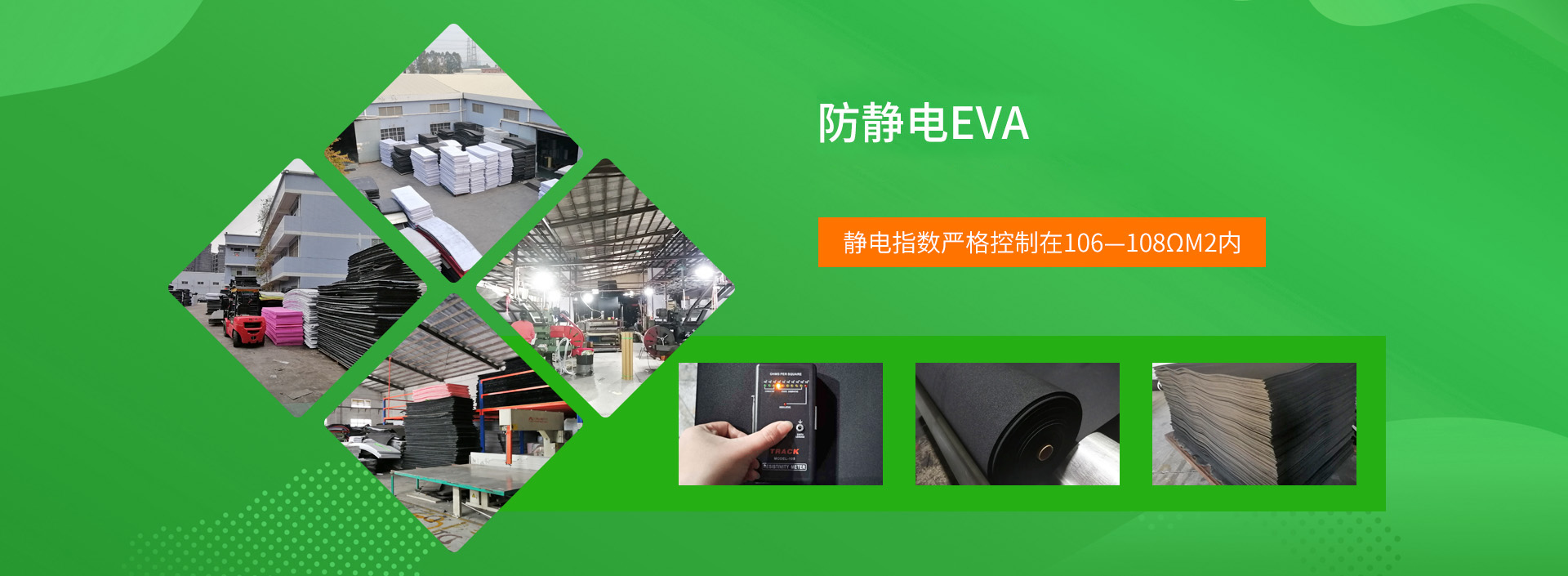

Anti-static EVA is an ideal material for anti-static packaging of optoelectronic devices, microelectronic devices, integrated circuits, printed circuit boards, and communication equipment, thanks to its excellent conductive anti-static properties, soft texture, strong buffering capacity, and ease of secondary processing.
Feature:
The antistatic performance and conductivity are excellent, with very stable surface and volume resistivity. The general antistatic resistance is 106-1011Ω, while the conductive resistance is 103Ω, which can be adjusted according to customer requirements.
2. Long-lasting anti-static and conductive properties, maintaining effective anti-static or conductive characteristics.
3. Static dissipative and conductive properties are unaffected by environmental humidity.
4. Eco-friendly, non-toxic, and odorless.
5. Shock and vibration absorption buffer
Construction Standards:
This specification applies to anti-static semi-hard PVC block plastic flooring made primarily from polyvinyl chloride resin, compounded with conductive materials and other additives, and processed through plasticizing and molding. It is mainly used for ground installations that require anti-static and conductive properties.
2. The ground requirements are as follows: The surface should be flat and dry (the cement surface should be whitish), with no significant unevenness, no sanding, and no peeling. The surface flatness should be less than 2/1000mm. It can be terrazzo, tile, or cement ground, etc.
3. Construction Method
(1) Clear the ground and locate the centerline.
First, clean all the floating dust from the ground, then use measuring tools to locate the center of the room, and draw a central cross line, ensuring it is vertically divided evenly.
(2) The copper foil network is laid by applying a small amount of conductive adhesive onto the foil, starting from the center and placing adjacent layers on the ground.
(3) Apply a layer of adhesive evenly on the ground and allow it to dry.
(4) Begin laying the flooring when the ground adhesive feels neither too dry nor too sticky to the touch. Tap the edges of the flooring with a rubber mallet to ensure a secure bond between planks, continuing until the entire room is completed.
(5) Use a groove machine to create V-shaped grooves at the floor joints, then lay welding rods in the grooves. Heat-weld the rods to the floor joints using a plastic welding torch, and flatten any protruding rods with a scraper.
After flooring installation, the surface must be thoroughly cleaned.
