
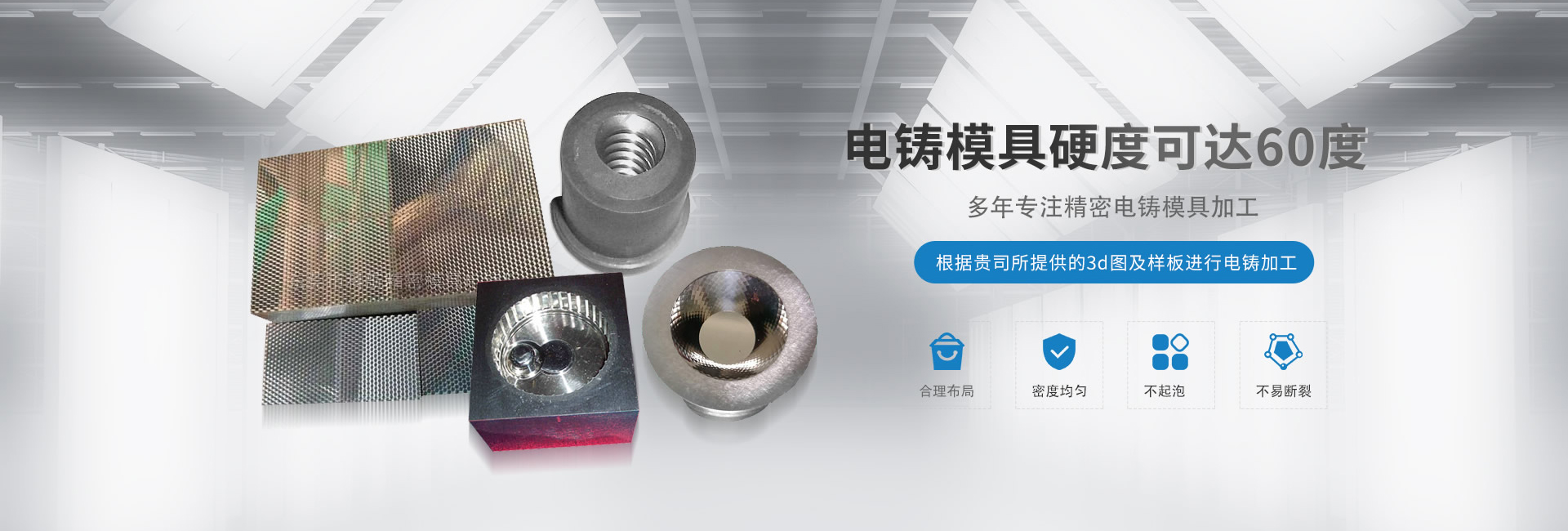


Electroforming is a specialized processing method that utilizes the electrochemical deposition principle of metal to replicate certain complex or special-shaped workpieces, which is a special application of electroplating.
The electroplating process involves the following steps:
Firstly, produce an anode model with the same shape and dimensions as the required copy part.
Next, place the anode model on the conductive substrate and immerse it in the electroplating solution.
Then, by applying an electric current, metal ions on the anode model are deposited onto the substrate under the influence of the electric field, forming a metal layer with the same shape as the anode model.
Subsequently, the metal layer is peeled off and trimmed from the substrate, resulting in the required electroplating mold.
Electroformed molds offer the following advantages:
Can replicate complex or special-shaped workpieces with high precision and smooth surfaces.
The material and processing of electroplated molds can be customized as required, thus catering to a wide variety of needs.
Electroplated molds have a long service life and can be reused multiple times.
By adjusting the composition and parameters of the electroplating solution, the deposition speed and quality of the metal layer can be controlled, thereby achieving electroplated molds with varying performance.
