
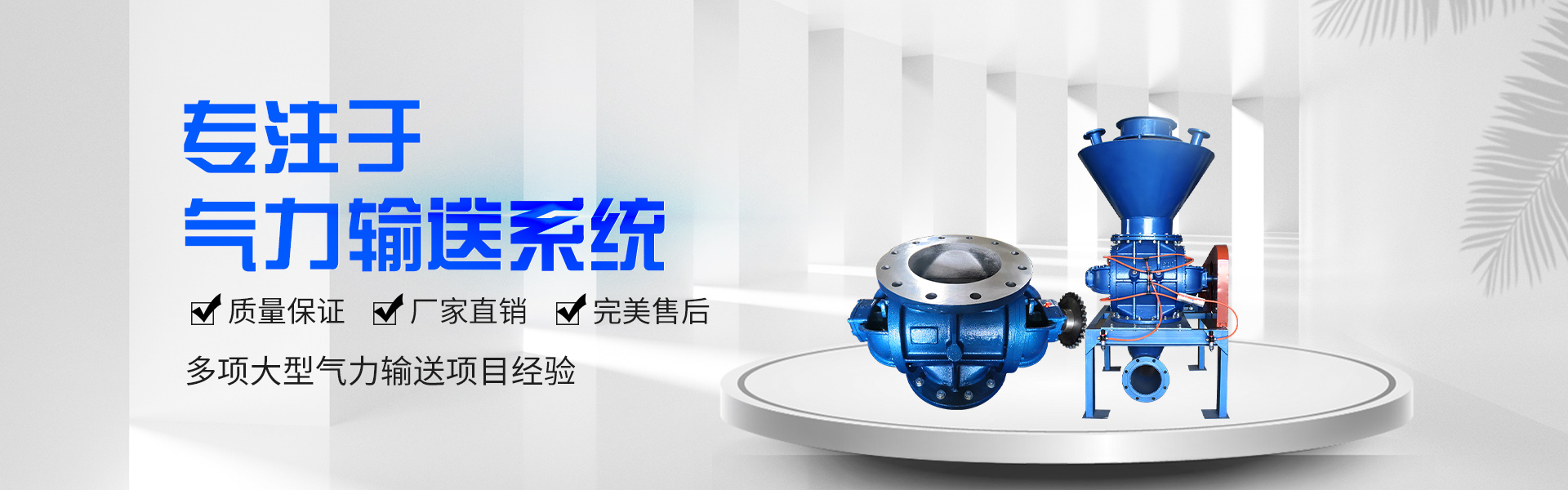

The impeller feeder is one type of pneumatic conveying feeding equipment, consisting of a housing body, impeller, transmission unit, and sealing rings. The top of the housing is the feeding port, connected to the hopper, and the bottom is the discharge port. The rotating impeller is the main working component, separating the feeding and discharge ports, allowing materials to smoothly enter the conveying pipeline under positive pressure without spilling out. When the feeding impeller operates, materials are discharged from the hopper above, falling between the two blades. As the blades rotate, the materials are continuously conveyed into the pipeline. Combined with a Roots blower, the materials are then transported away. The impeller feeder can be used in both negative pressure and positive pressure pneumatic conveying systems. In negative pressure conveying, it serves to feed materials into the conveying pipeline, ensures thorough mixing with air for easier acceleration of materials, and can provide quantitative feeding. In positive pressure conveying, it significantly enhances production rates and reduces pipeline pressure losses, making it a crucial component in the entire system and serving as a closed-loop device.

Principles for selecting feeders:
Delivers materials quantitatively, evenly, and dispersively, ensuring thorough mixing with air.
2. Low resistance and low power consumption, aiming to align the direction of the material entering the airflow with the airflow's direction as much as possible, to avoid reverse feeding and reduce the energy consumption for propelling the material through the airflow.
3. Non-leakage, non-particle-producing crushing
4. Smooth supply, reliable and stable operation, easy to master, and durable.
5. As a feeder, it must possess excellent airtightness to ensure its feeding volume and prevent air leakage.
6. Simple structure, low height, small land area, etc.
