

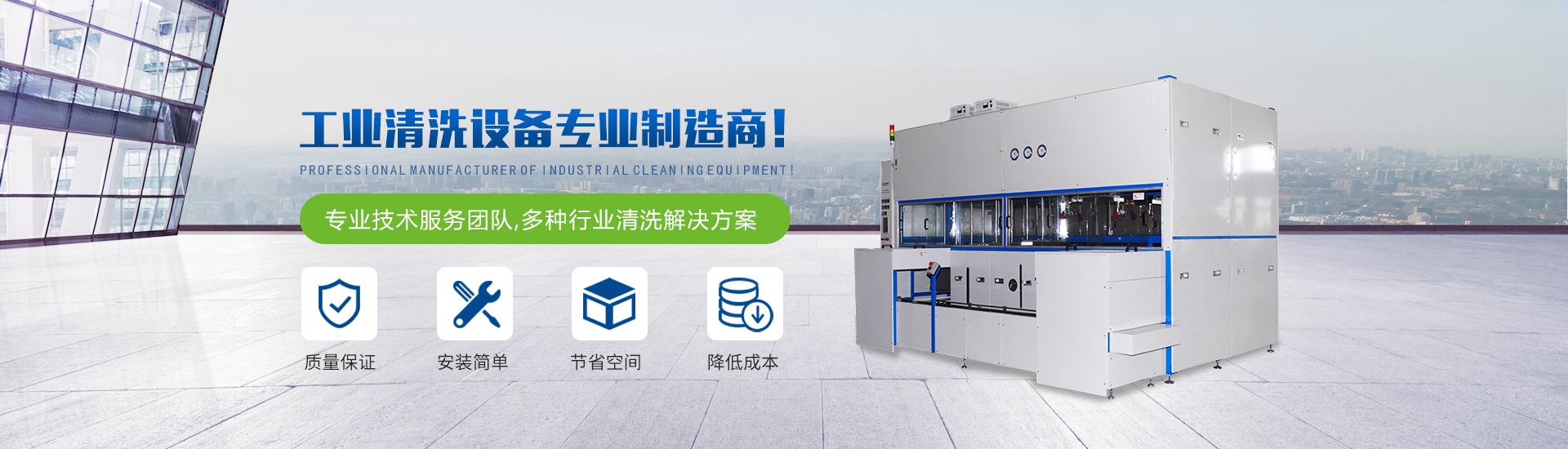

Rising living standards, the increase and expansion of machinery factories, and the emergence of various new machinery. The fully automatic ultrasonic cleaner, which utilizes the principle of high-power ultrasonic waves to achieve cleaning purposes. No more worries about oil residue in tiny crevices; the fully automatic ultrasonic cleaner can clean it all. We also offer an oil-water separation and recycling filtration system, with both automatic and manual operation modes, featuring a more user-friendly design philosophy.
The principle of the fully automatic ultrasonic cleaner mainly involves converting the acoustic energy from a power ultrasonic frequency source into mechanical vibrations using a transducer. These vibrations are then transmitted through the walls of the cleaning tank, radiating the cleaning liquid within. The liquid's microbubbles are caused to vibrate under the influence of the ultrasonic waves. When the acoustic pressure or intensity reaches a certain level, the bubbles rapidly expand and then abruptly collapse. During this process, the moment of bubble collapse generates shockwaves, creating pressures of 10^12-10^13 Pa and localized temperature adjustments around the bubble. This ultrasonic cavitation produces immense pressure capable of breaking down insoluble dirt and dispersing it in the solution, while steam-type cavitation repeatedly impacts the dirt directly.
On one hand, it disrupts the adhesion between dirt and the surface of the cleaned items, and on the other, it induces fatigue failure in the dirt layer, causing it to be peeled off. The vibration of gas-filled bubbles cleans solid surfaces. Once there's a crack in the dirt layer, the bubbles promptly "drill in," causing the dirt layer to fall off. Due to cavitation, the two liquids disperse rapidly at the interface, emulsifying. When solid particles are coated with oil and stick to the surface of the cleaned items, the oil becomes emulsified and the solid particles naturally detach. As ultrasound travels through the cleaning fluid, it produces alternating positive and negative sound pressures, forming jets that冲击 the cleaned items. Simultaneously, due to nonlinear effects, acoustic streaming and microstreaming are generated. Ultrasound cavitation at the solid-liquid interface produces high-speed microjets. All these actions can destroy dirt, remove or weaken boundary dirt layers, enhance stirring and diffusion, accelerate the dissolution of soluble dirt, and strengthen the cleaning effect of the chemical cleaning agent.
As a result, wherever a liquid can penetrate and a sound field is present, there is a cleaning effect, which is particularly suitable for cleaning parts with very complex surface shapes. This technology can significantly reduce the use of chemical solvents, thereby greatly lowering environmental pollution.
The production of fully automatic ultrasonic cleaning machines has significantly reduced labor intensity, thus greatly altering people's lives.
