

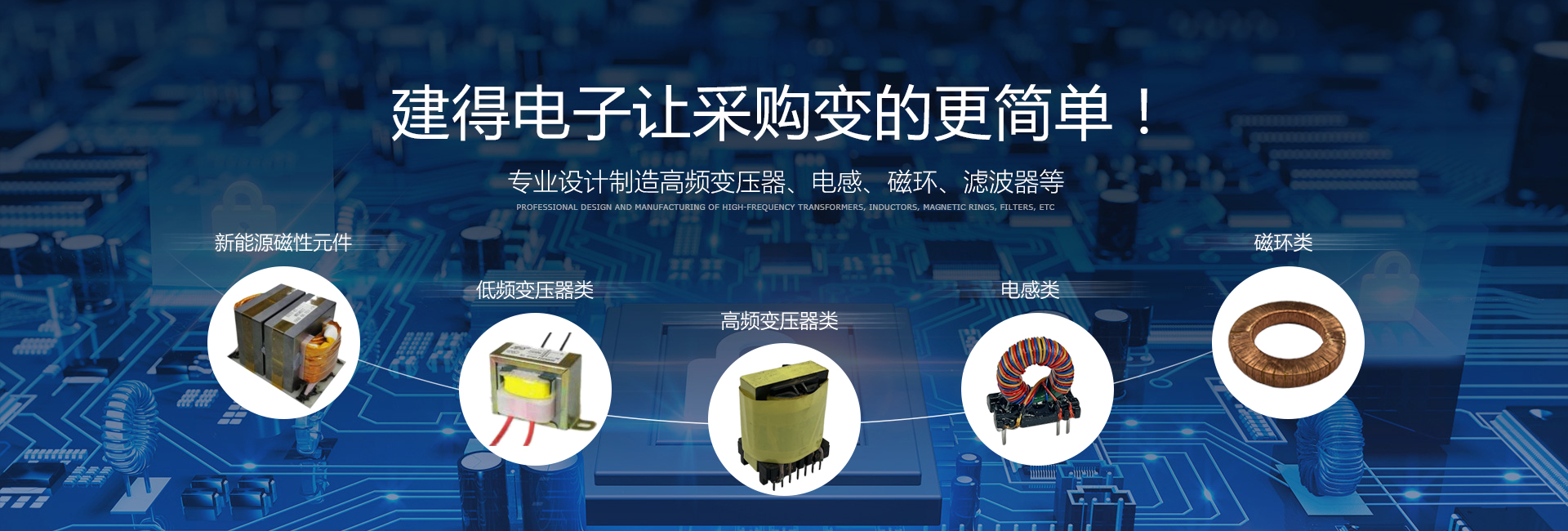


High-frequency transformers and low-frequency transformers exhibit significant differences in terms of operating frequency, structural characteristics, functions, and application scenarios. Below is a detailed comparison between the two:
One, Frequency of Work
High-frequency Transformers: Operating frequencies typically exceed 20kHz, with capabilities reaching hundreds of kHz, even MHz levels.
Low Frequency Transformers: Operate at frequencies typically ranging from 20Hz to 20kHz, primarily used for voltage transformation at utility power frequencies (50Hz or 60Hz).
Section II: Structural Features
High-frequency Transformer
The core is typically made of ferrite and other high-frequency magnetic materials, featuring high resistivity, which effectively reduces eddy current losses at high frequencies.
Compact and lightweight, the cores can be made smaller during high-frequency operations, and the number of turns in the coil is relatively fewer, significantly reducing the overall size.
Coils are typically made by winding multiple fine wires together or using Litz wire to reduce the skin effect at high frequencies and minimize the coil's AC resistance.
Low-frequency Transformer
Core materials are commonly made from silicon steel sheets, featuring high permeability and low loss, making them suitable for operation at low frequencies.
The units are relatively larger and heavier due to the requirement of a larger core cross-sectional area for energy transmission at low frequencies, resulting in dimensions typically larger than those of high-frequency transformers.
High coil turns are often required at low frequencies to achieve the desired inductance and voltage transformation ratio.
III. Features and Application Scenarios
High-frequency Transformer
The high-frequency circuits primarily serve the functions of energy transmission, voltage transformation, and electrical isolation.
Widely applied in fields with high requirements for size, efficiency, and operating frequency, such as switch power supplies, communication equipment, computer power supplies, and inverters.
Low-frequency Transformer:
The primary function is to achieve voltage adjustment, isolation, and impedance matching.
Commonly used in traditional linear power supplies, electrical transformers, audio equipment, and other applications where frequency requirements are not stringent.
Efficiency and Power Loss
High-frequency Transformers: With higher operating frequencies, they offer high switching frequencies and compact sizes, enabling high power densities and conversion efficiencies.
Low Frequency Transformers: Due to their lower frequency, these transformers tend to be larger in size, resulting in relatively lower power density and conversion efficiency.
In summary, high-frequency transformers and low-frequency transformers exhibit significant differences in terms of operating frequency, structural characteristics, functional applications, as well as efficiency and power loss. The choice of which type of transformer to use should be determined based on the specific application scenario and requirements.
