
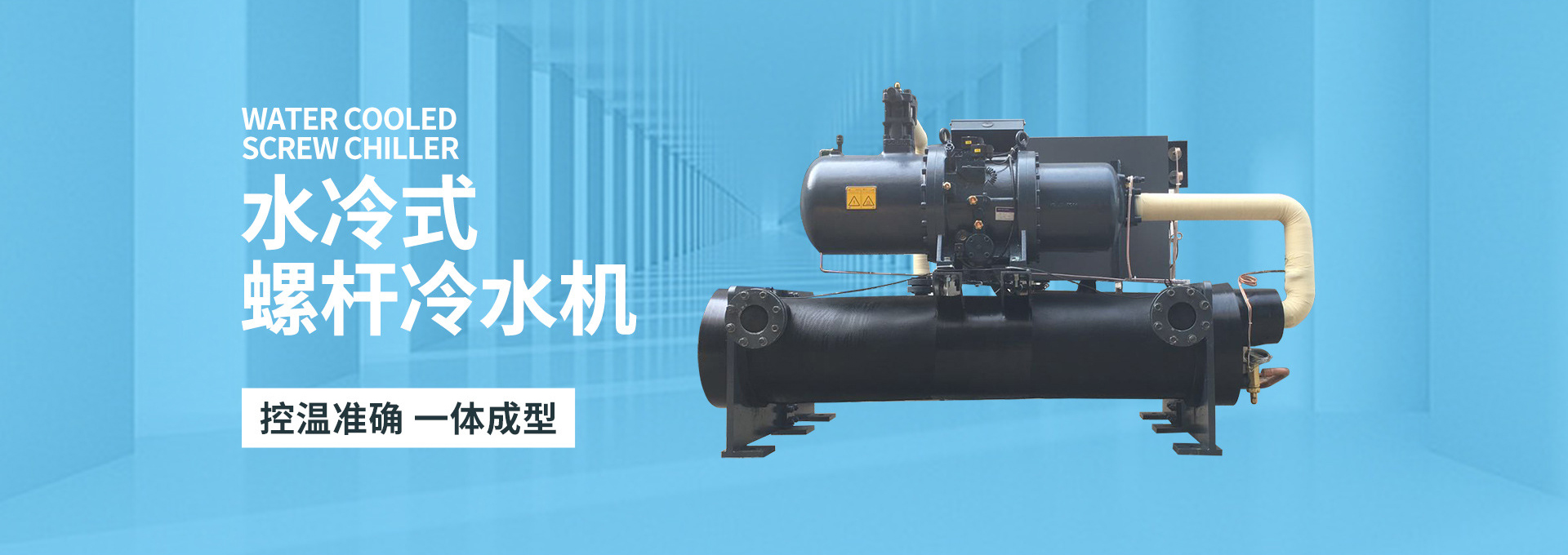


As technology advances, industrial chillers are increasingly applied across various industrial sectors, contributing to industrial production and the enhancement of product quality as they should.
Industrial chillers are also types of mechanical equipment. Over time, they can encounter issues, with corrosion being one of the common phenomena.
To prevent corrosion and extend the lifespan of chillers, our editor will discuss several causes of chiller corrosion for industry friends and then outline measures to prevent chiller corrosion, which could affect our company's production.
Corrosion is caused by improper construction, design, and installation.
Some industry friends may have seen it, such as after purchasing industrial chillers, especially standard chillers, which are not treated with anti-corrosion or anti-rust processes and are directly placed in outdoor environments. After long exposure to wind and sun, the shell gets corroded.
Improper installation or abnormal operation of water treatment equipment causing corrosion
Cooling water pipes are the channels for the circulation of cooling water in water-cooled chillers. Water quality determines whether the system pipes will scale and corrode. If the water treatment unit is not properly installed or functioning, it can lead to corrosion.
3. Most water purifiers are Y-type filters, with weak ability to filter out small impurities.
The Y-type filter is easy to install and clean. It can perform coarse filtration for mechanical impurities, iron shavings, and sand particles, but cannot refine fine impurities. Consequently, the extended operation time of the unit can easily lead to scaling and sludge buildup in the condenser.
The quick drainage valve for the chilled water system was not installed.
The Rapid Drain Valve is designed for draining waste from refrigeration or chilled water systems. It boasts simple structure, excellent sealing, compact size, and lightweight, making it particularly suitable for regular system draining. Additionally, it offers corrosion resistance, shock resistance, and a long service life.
Many businesses fail to install quick drain valves on industrial refrigerator panels, which can lead to corrosion of the system pipes. When the chilled water unit is in normal operation, the drain valve should be opened and closed three times a week to facilitate system drainage.
5. The补水管 within the cooling system does not have a water meter.
In water treatment, it is common to use chemicals and disinfectants to eliminate and manage internal fungi, as well as microorganisms and various impurities. When using chemicals, a certain amount should be added based on the amount of water being supplemented and the total system water volume.
Without water meter measurement, dosages would be inaccurate, leading to system pipeline corrosion.
6. Acidic and alkaline gases in the environment cause corrosion on the equipment surface.
Special gases, such as acidic and alkaline gases, are inevitable during the production process, which can cause damage to the surface of equipment. In such an environment, when selecting a chiller, it is necessary to inform professionals in advance and prioritize explosion-proof and corrosion-resistant piping or evaporator piping within the electrical control cabinet. This is to avoid later corrosion losses.
With the development of industry and the continuous application of new materials and technologies, the usage scenarios of industrial chillers have become more diversified, inadvertently increasing the possibility of equipment corrosion. For our industrial chiller equipment, real-time maintenance and customized maintenance remain the key to reducing corrosion and extending the service life.
